

Prediction Markets: How They Work and What US Investors Should Know
07/23/2026
A prediction market lets participants trade contracts tied to the outcome of real-world events, from elections to interest-rate decisions. Prices move as new information arrives, turning collective forecasts into a live, tradable probability. If you're wondering how do prediction markets work and where they fit next to stocks and options, this guide covers the mechanics, the leading platforms, and the safeguards US traders should understand, in a clear, no-hype format.
Table of Contents
Part 1: How Do Prediction Markets Work?
Definition: A prediction market is an exchange-traded marketplace where participants buy and sell contracts whose value is tied to the outcome of a specific future event. Each contract typically settles at $1 if the event happens and $0 if it doesn't, so the current price reads directly as the market-implied probability.
Prediction markets convert opinions into prices. When you buy a "Yes" contract at $0.62, the market is effectively saying there's a 62% chance the event occurs. As traders react to news, polls, and data, that price updates in real time — which is exactly what makes a prediction market such a fast, transparent forecasting tool.
The Core Mechanics: Contracts, Shares, and Settlement
Most US prediction markets use binary event contracts (also called yes/no shares or event contracts). Here's the structure:
Contract: A claim on a clearly defined outcome (e.g., "Will the Fed cut rates in September?").
Price range: $0.00 to $1.00 per share, mirroring 0% to 100% probability.
Settlement: At expiration, winning shares pay $1.00; losing shares pay $0.00.
Order book: Buyers and sellers are matched by an exchange, with liquidity often supported by market makers.
Your profit is the difference between your entry price and the settlement value, minus fees. Buy "Yes" at $0.40, and if the event resolves true, each share pays $1.00 — a $0.60 gain per share.
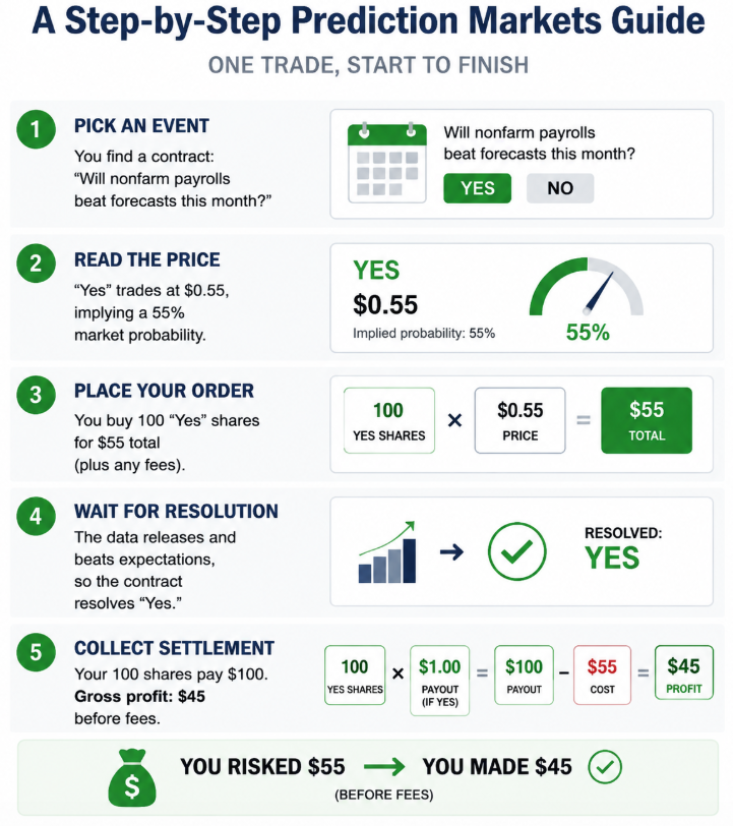
A Step-by-Step Prediction Markets Investment Guide
Here's how do prediction markets work in a single trade, start to finish:
Pick an event. You find a contract: "Will nonfarm payrolls beat forecasts this month?"
Read the price. "Yes" trades at $0.55, implying a 55% market probability.
Place your order. You buy 100 "Yes" shares for $55 total (plus any fees).
Wait for resolution. The data releases and beats expectations, so the contract resolves "Yes."
Collect settlement. Your 100 shares pay $100. Gross profit: $45 before fees.
If the data had missed, the shares would settle at $0 and you'd lose the $55 stake. That capped, defined-risk structure is central to how these contracts behave.
Why Prices Reflect Real Probabilities
Prediction markets are often praised for the "wisdom of crowds." Because traders put real capital behind their views, the market aggregates dispersed information — polls, expert models, insider sentiment, and breaking news — into one number. Academic research and event-forecasting studies have repeatedly shown that well-designed prediction market prices can rival or beat individual expert forecasts. That forecasting accuracy is why hedgers, analysts, and everyday traders watch these markets closely.
Part 2: How Are Prediction Markets Different From Gambling?
Quick answer: Prediction markets differ from gambling because they are exchange-traded, regulated financial instruments used for forecasting and hedging, where prices reflect real probabilities and you trade against other participants. Gambling is a fixed-odds wager set by a house, structured for entertainment, with odds built to favor the operator.
Prediction Markets vs. Gambling: Side-by-Side
Feature | Prediction Market | Traditional Gambling |
Structure | Exchange-traded event contracts | House-set fixed odds |
Pricing | Set by supply and demand (live probability) | Set by the operator with built-in margin |
Counterparty | Other traders on the exchange | The house/casino/sportsbook |
Primary purpose | Forecasting, hedging, information | Entertainment |
Regulation (US) | CFTC-regulated exchanges for many contracts | State gaming commissions |
Exit before outcome | Yes — sell your position anytime | Usually no — bet is locked |
Risk profile | Defined risk, capped at stake | Defined risk, capped at stake |
Regulation and Oversight
In the United States, legitimate prediction market platforms operate as CFTC-regulated designated contract markets (DCMs), the same regulatory category used for other derivatives exchanges. This oversight covers contract listing, settlement rules, and market conduct. When you use a prediction market through a US brokerage, your securities activity and cash may also fall under separate protections like SIPC membership and FINRA regulation — a layer traditional sports betting simply doesn't offer.
Part 3: Popular Prediction Market Platforms for US Traders
Choosing a prediction market platform comes down to regulation, fees, contract selection, and how well event trading integrates with the rest of your portfolio. Below is our ranked breakdown for US traders.
1. Webull — Prediction Market Platform for US Investors
Webull stands out because it pairs event trading with a full-featured, regulated brokerage — so your prediction market activity lives alongside stocks, ETFs, and options in one account, on one platform. For traders who want forecasting exposure and a serious investing toolkit, that integration is the differentiator.
Platform Overview
Webull is a US brokerage built for active, self-directed traders. Securities are offered through Webull Financial LLC, a member of SIPC and FINRA, which means eligible securities accounts carry standard SIPC protection and the firm operates under FINRA oversight. The platform is known for commission-free equities trading, advanced charting, and a mobile-first experience that scales up to desktop.
Why Choose Webull for Prediction Markets
One unified account: Trade seamlessly between stocks, options, futures, and prediction markets — no separate apps or wallets to fund.
Around-the-clock event trading: Markets stay open across sports, finance, and global events, so you can trade as breaking information hits rather than waiting for a fixed close.
Exit early, settle instantly: Don't wait for the final whistle. Lock in gains or limit losses by closing your position before the market resolves, with settlement the moment you exit.
Programmatic trading via OpenAPI: Deploy algorithmic strategies, automate sentiment analysis, and execute event contracts programmatically using the Webull OpenAPI.
Regulated, transparent infrastructure: Backed by a FINRA member broker-dealer with SIPC membership on the securities side.
Built for volatility: Every play on the field and every breaking headline shifts the market in real time — position yourself ahead of the curve.
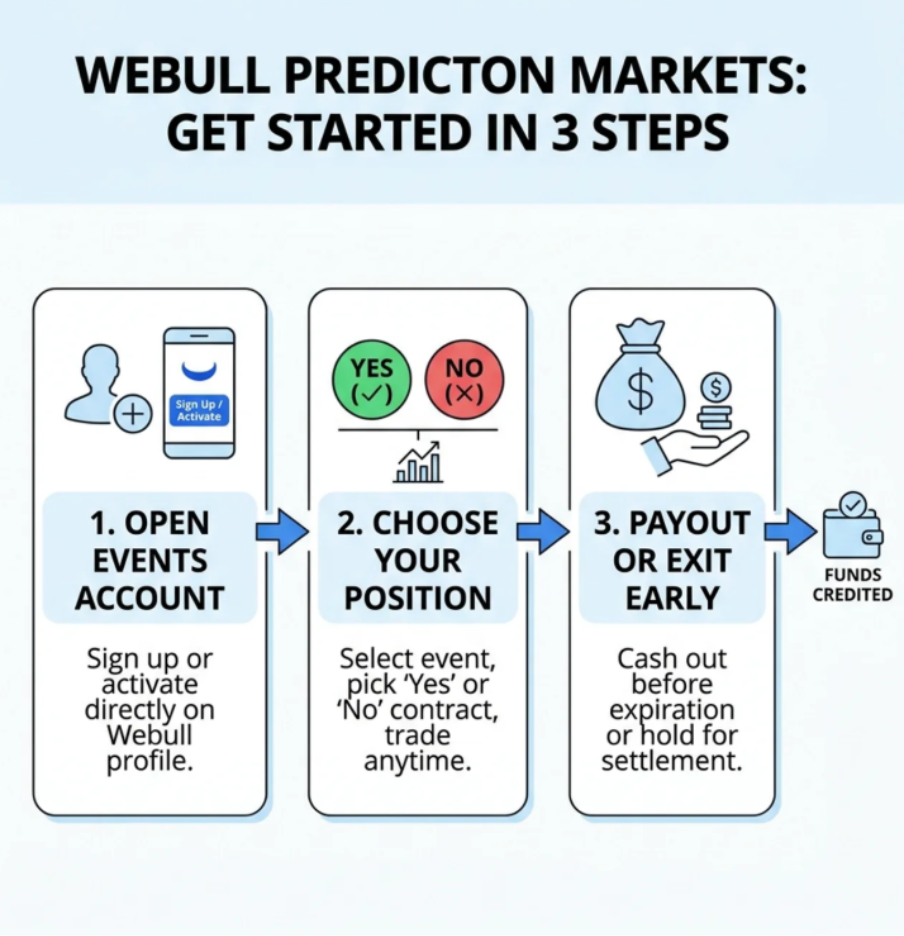
How to Get Started in Three Steps
Open your Events Account. Sign up on Webull in a few minutes to unlock prediction markets. Already a Webull user? Activate your Events account directly from your profile.
Choose your position. Select an event or matchup you're following, pick a "Yes" or "No" contract based on your view, and trade your stance anytime before the market closes.
Payout or exit early. Cash out before expiration to secure gains, or hold until the market settles. If your position finishes in your favor, funds are credited directly to your account.
2. Kalshi — Dedicated CFTC-Regulated Event Exchange
Kalshi is a US, CFTC-regulated exchange focused purely on event contracts across economics, weather, and current events. It's a strong specialist choice, though it lacks the integrated stock and options environment a full brokerage provides.
3. Polymarket — High-Volume, Broad Event Coverage
Polymarket is known for wide event coverage and deep liquidity on popular markets. US traders should carefully confirm current availability and regulatory status before participating.
4. PredictIt — Long-Running Political Markets
PredictIt has historically focused on political and election contracts under a specific regulatory arrangement, with position caps that limit larger traders.
Platform Comparison Table
Platform | Best For | Integrated Stocks/Options | US Regulatory Framing |
Webull | All-in-one trading + events | Yes | SIPC member, FINRA-regulated broker-dealer |
Kalshi | Pure event trading | No | CFTC-regulated exchange |
Polymarket | Broad event variety | No | Confirm current US status |
PredictIt | Political markets | No | Specialized arrangement |
FAQs
1. What is a prediction market in simple terms?
A prediction market is a marketplace where you trade contracts on the outcome of future events. Each contract's price, between $0 and $1, reflects the market's estimated probability of that event happening.
2. Are prediction markets legal in the US?
Many prediction market contracts trade legally on CFTC-regulated exchanges in the US. Legality depends on the platform, the contract type, and current regulation, so always confirm a platform's status before trading.
3. How do prediction markets work for beginners?
You pick an event, buy "Yes" or "No" shares at their current price, and hold until the event resolves. Winning shares pay $1.00 each; losing shares pay $0.00. You can often sell before resolution.
4. Can you make money on prediction markets?
Yes, it's possible to profit if your forecasts are accurate and you manage fees and risk, but losses are equally possible. Contracts can settle at $0, so only risk capital you can afford to lose.
The Bottom Line
Prediction markets turn real-world events into transparent, tradable probabilities, and they're distinct from gambling in structure, purpose, and regulation. If you want event trading integrated with a full, regulated brokerage, Webull brings it together with stocks, options, advanced tools, and SIPC-member protection. Explore the platform, start small, and trade with a clear view of the risks.
Disclamer:
Event contract trading is speculative and may not be suitable for all investors. Webull Futures LLC is a CFTC-registered FCM and NFA member. Event contract accounts are not protected by SIPC. Customers should carefully consider the risks before investing. For more information, visit webull.com/disclosures.
Disclosure:
Webull Financial LLC, Member SIPC, FINRA. Investing involves risk. More info at webull.com/policy
Read More
How to Practice Trading with a Free Paper Trading Stimulator
07/21/2026
Learn how to practice trading with a free paper trading simulator. Explore paper trading accounts, Webull paperTrade features, and tips to test strategies before investing real money.
How to Invest in Stocks: A Beginner's Step-by-Step Guide
07/21/2026
Learn how to invest in stocks step by step. This beginner guide explains how to start investing, choose a brokerage account, buy stocks, diversify your portfolio, and manage risk.
The Impact of Global Events on the Stock Market
10/23/2024
The stock market reflects the economy, investor sentiment, and even world affairs.