'%3e %3cpath d='M41.7832962%2c0 C41.9459106%2c0 42.0882746%2c0.0866854658 42.1666825%2c0.216359069 C43.8289923%2c2.66540836 44.7676281%2c5.46271319 44.7676281%2c8.43208061 C44.7676281%2c18.1345746 34.7460532%2c26 22.383814%2c26 C10.0215749%2c26 0%2c18.1345746 0%2c8.43208061 C0%2c5.46716016 0.935826425%2c2.67378733 2.58829888%2c0.223985685 C2.67109477%2c0.0916264068 2.81687473%2c0 2.9840593%2c0 C3.23130408%2c0 3.43173558%2c0.200393004 3.43173558%2c0.447590303 C3.43173558%2c0.475056669 3.42926112%2c0.501945205 3.42452292%2c0.528045226 L3.41810883%2c0.550292077 C3.37800671%2c0.861741908 3.3575721%2c1.17661276 3.3575721%2c1.49443092 C3.3575721%2c7.98336 11.2132389%2c12.5742305 22.383814%2c12.5742305 C33.5543891%2c12.5742305 41.410056%2c7.98336 41.410056%2c1.49443092 C41.410056%2c1.17865223 41.3898828%2c0.865783153 41.3502888%2c0.556288325 C41.3402868%2c0.521941442 41.3356199%2c0.48531078 41.3356199%2c0.447590303 C41.3356199%2c0.200393004 41.5360514%2c0 41.7832962%2c0 Z' id='logo%e5%a4%87%e4%bb%bd-6' fill='white'%3e%3c/path%3e %3cpath d='M74.6899231%2c3.74404927 C75.2411227%2c3.74404927 75.7734299%2c3.66184338 76.2756219%2c3.50883715 L73.8159676%2c20.8666902 C73.5770593%2c22.5662954 72.8072434%2c23.0518969 71.4268838%2c23.0518969 L69.9934336%2c23.0518969 C68.7988917%2c23.0518969 68.1618027%2c22.458384 67.7901674%2c20.893668 L65.6930827%2c11.9909739 C65.639992%2c11.7481731 65.639992%2c11.6942174 65.5338105%2c11.6942174 C65.427629%2c11.6942174 65.4010836%2c11.7481731 65.3479929%2c11.9909739 L63.2509082%2c20.893668 C62.8792729%2c22.458384 62.2421839%2c23.0518969 61.047642%2c23.0518969 L59.6141918%2c23.0518969 C58.2338322%2c23.0518969 57.4640163%2c22.5662954 57.225108%2c20.8666902 L54.7463723%2c3.37406084 C55.3593498%2c3.61307396 56.0249975%2c3.74404927 56.7207458%2c3.74404927 C57.3314263%2c3.74404927 57.918917%2c3.64314414 58.4679557%2c3.4568446 L60.3574623%2c19.3829078 C60.3840076%2c19.6257086 60.3840076%2c19.7875757 60.4901891%2c19.7875757 C60.5963706%2c19.7875757 60.5963706%2c19.6257086 60.6494614%2c19.3829078 L62.9323637%2c9.91367858 C63.0916359%2c9.26620991 63.4632712%2c8.69967483 64.6047223%2c8.69967483 L66.4363532%2c8.69967483 C67.5778044%2c8.69967483 67.9494397%2c9.26620991 68.1087119%2c9.91367858 L70.3916142%2c19.3829078 C70.4447049%2c19.6257086 70.4447049%2c19.7875757 70.5508864%2c19.7875757 C70.6570679%2c19.7875757 70.6570679%2c19.6257086 70.6836133%2c19.3829078 L72.5891207%2c3.32292288 C73.2365902%2c3.59432921 73.9460524%2c3.74404927 74.6899231%2c3.74404927 Z' id='Combined-Shape' fill='white'%3e%3c/path%3e %3cpath d='M84.5933901%2c7.43171536 C88.6813779%2c7.43171536 90.9111894%2c10.2643908 90.9111894%2c14.2840921 L90.9111894%2c15.7948523 C90.9111894%2c16.2264981 90.7519172%2c16.4692988 90.3802819%2c16.4692988 L81.7264895%2c16.4692988 L81.7264895%2c16.5502324 C81.7264895%2c18.1149484 82.3635785%2c19.9764208 84.9119346%2c19.9764208 C86.849747%2c19.9764208 88.6813779%2c19.8145536 89.7962837%2c19.7066422 L89.8759198%2c19.7066422 C90.1413735%2c19.7066422 90.3537366%2c19.8415315 90.3537366%2c20.1113101 L90.3537366%2c21.8918489 C90.3537366%2c22.3234947 90.2741004%2c22.5123397 89.7962837%2c22.5932733 C88.0708343%2c22.9170076 87.0355646%2c23.0518969 84.6464808%2c23.0518969 C81.9919433%2c23.0518969 78.2225%2c21.5950924 78.2225%2c16.2804538 L78.2225%2c14.2840921 C78.2225%2c10.0755457 80.5319476%2c7.43171536 84.5933901%2c7.43171536 Z M84.5933901%2c10.5071915 C82.9475768%2c10.5071915 81.7530349%2c11.6942174 81.7530349%2c13.8254684 L81.7530349%2c13.9333799 L87.3806545%2c13.9333799 L87.3806545%2c13.8254684 C87.3806545%2c11.7211953 86.2392034%2c10.5071915 84.5933901%2c10.5071915 Z' id='Combined-Shape' fill='white'%3e%3c/path%3e %3cpath d='M97.4154906%2c2.98826245 L97.4148064%2c7.62056039 C98.3969853%2c7.48567108 99.3260735%2c7.43171536 99.9631625%2c7.43171536 C104.236968%2c7.43171536 106.307507%2c9.99461216 106.307507%2c14.2031585 L106.307507%2c16.2804538 C106.307507%2c20.4890001 104.236968%2c23.0518969 99.9631625%2c23.0518969 C98.2642584%2c23.0518969 96.2733553%2c22.7821183 94.627542%2c22.3504725 C94.0169984%2c22.1886054 93.9108169%2c22.0267382 93.9108169%2c21.6220703 L93.9098179%2c3.08694115 C94.4185466%2c3.24434375 94.9584615%2c3.32900525 95.5178331%2c3.32900525 C96.184659%2c3.32900525 96.8238351%2c3.20869291 97.4154906%2c2.98826245 Z M99.9631625%2c10.3453244 C99.3260735%2c10.3453244 98.1580769%2c10.4262579 97.4148064%2c10.5341694 L97.4148064%2c19.9494429 C97.9191686%2c20.0573544 99.007529%2c20.1382879 99.9631625%2c20.1382879 C102.246065%2c20.1382879 102.803518%2c18.4926384 102.803518%2c16.2804538 L102.803518%2c14.2031585 C102.803518%2c11.9909739 102.246065%2c10.3453244 99.9631625%2c10.3453244 Z' id='Combined-Shape' fill='white'%3e%3c/path%3e %3cpath d='M111.036668%2c8.72457747 C111.579488%2c8.72457747 112.103987%2c8.64485191 112.599444%2c8.49629404 L112.598761%2c16.5232546 C112.598761%2c19.3289521 113.607485%2c19.9764208 115.147117%2c19.9764208 L115.306389%2c19.9764208 C116.846021%2c19.9764208 117.854746%2c19.3289521 117.854746%2c16.5232546 L117.854207%2c8.4334735 C118.406525%2c8.62226395 118.997939%2c8.72457747 119.612866%2c8.72457747 C120.223332%2c8.72457747 120.810625%2c8.62374317 121.359498%2c8.43756894 L121.358735%2c16.5232546 C121.358735%2c22.4044283 116.872567%2c23.0518969 115.306389%2c23.0518969 L115.060464%2c23.0512514 C113.42215%2c23.0271041 109.094772%2c22.2994073 109.094772%2c16.5232546 L109.094446%2c8.36700801 C109.698522%2c8.59813531 110.353066%2c8.72457747 111.036668%2c8.72457747 Z' id='Combined-Shape' fill='white'%3e%3c/path%3e %3cpath d='M128.314162%2c3.03790128 L128.313623%2c22.269539 C128.313623%2c22.5662954 128.10126%2c22.836074 127.809261%2c22.836074 L125.340541%2c22.836074 C125.048542%2c22.836074 124.809634%2c22.5662954 124.809634%2c22.269539 L124.809455%2c3.04219481 C125.358161%2c3.22824247 125.945253%2c3.32900525 126.555503%2c3.32900525 C127.17043%2c3.32900525 127.761844%2c3.22669173 128.314162%2c3.03790128 Z' id='Combined-Shape' fill='white'%3e%3c/path%3e %3cpath d='M133.90653%2c3.32900525 C134.473329%2c3.32900525 135.02015%2c3.24208064 135.534793%2c3.08063296 L135.533966%2c22.269539 C135.533966%2c22.5662954 135.321603%2c22.836074 135.029603%2c22.836074 L132.560884%2c22.836074 C132.268884%2c22.836074 132.029976%2c22.5662954 132.029976%2c22.269539 L132.029909%2c2.99605058 C132.615669%2c3.21152525 133.2476%2c3.32900525 133.90653%2c3.32900525 Z' id='Combined-Shape' fill='white'%3e%3c/path%3e %3c/g%3e %3c/g%3e %3c/g%3e%3c/svg%3e)



Paper trading allows investors to practice buying and selling securities without risking real money. A risk-free paper trading account gives beginners and experienced traders access to a simulated trading environment where they can test strategies, learn about market mechanics, and improve decision-making. Modern free paper trading simulators provide realistic market conditions similar to live trading platforms.
Part 1: What Is Paper Trading and How Does It Work?
Definition:
Paper trading is a simulated trading method that allows investors to buy and sell stocks, ETFs, options, or other securities using virtual money instead of real capital.
Traditional paper trading involved recording hypothetical trades on paper. Today, online brokers provide digital platforms that replicate real trading environments.
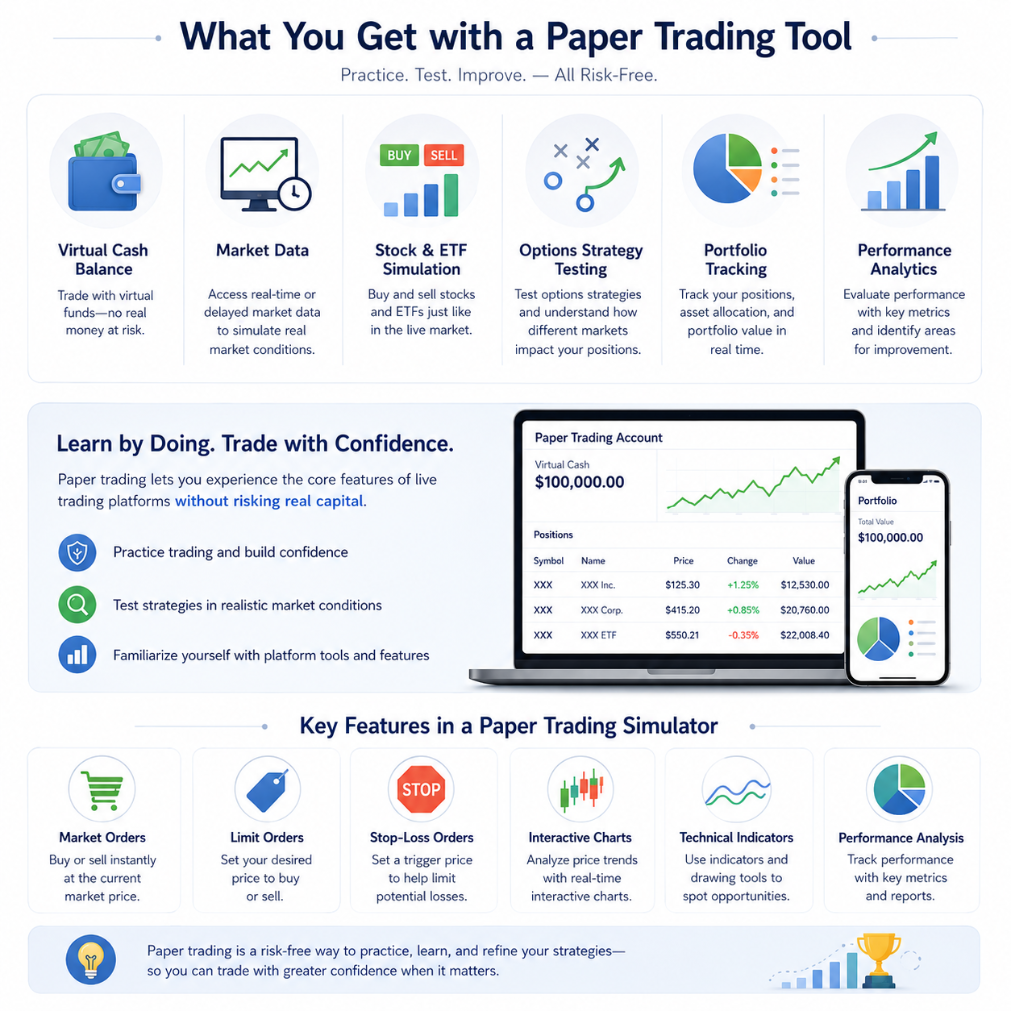
A paper trading tool typically includes:
Virtual cash balance
Real-time or delayed market data
Stock and ETF trading simulation
Options strategy testing
Portfolio tracking
Performance analytics
Free simulated trading gives investors an opportunity to experience many of the core features found on live brokerage platforms without committing real capital. Most paper trading methods support common order types, charting tools, and technical analysis features, allowing users to build familiarity with platform functionality while testing trading strategies in realistic market conditions.
Typical features available in a paper trading simulator include:
Market orders
Limit orders
Stop-loss orders
Interactive price charts
Technical indicators and drawing tools
Portfolio tracking and performance analysis
Although these tools closely resemble those used in live trading, paper trading has important limitations. Because no real money is at risk, simulated trading cannot fully replicate the emotional aspects of investing, such as fear, greed, hesitation, or the psychological impact of market volatility. In addition, order execution, liquidity, slippage, and transaction costs may differ from real-market conditions. For these reasons, paper trading is best viewed as a learning and strategy-testing tool rather than a guarantee of future trading performance.
Paper trading vs real trading
Features | Paper Trading | Real Trading |
Capital risk | No real money risk | Real financial risk |
Emotions | Limited emotional impact | Strong psychological impact |
Execution | Simulated fills | Real market execution |
Learning | Excellent for beginners | Requires experience |
Fees | Free | Costs included |
Part 2: Paper Trading Platform for beginners and experts
When comparing various paper trading platforms, investors should evaluate several key factors to find the option that best meets their needs. Important considerations include the availability and quality of trading tools, the accuracy and reliability of market data, and the platform’s overall ease of use. Investors should also consider whether the platform provides educational resources to support learning and skill development. In addition, brokerage reliability, regulatory compliance, and security features are essential factors that help ensure a safe and trustworthy simulated trading experience.
Paper Trading Platform Review – Webull paperTrade
Webull paperTrade is Webull’s simulated trading feature that allows investors to practice trading strategies using virtual funds while experiencing many of the tools and workflows available in live trading. It is designed for users who want to become familiar with order execution, market analysis, portfolio management, and advanced trading strategies before committing real capital.
Beyond basic simulated buying and selling, Webull paperTrade provides access to real-time market data, advanced trading tools, and multi-asset practice environments. The platform supports US stocks, ETFs, options, and crypto-related simulated strategies, making it suitable for users who want to test different approaches across multiple asset classes.
Webull paperTrade Key Features
Feature | Description |
Real-time market data | Practice trading with real-time pricing and Level 2 market data to better understand market movements and order execution. |
Advanced Order Types | Supports Market, Limit, Stop, Stop-Limit, OCO, and Trailing Stop orders to simulate different trading approaches. |
Active Trading Interfaces | Provides multiple trading layouts, including Trade, Turbo Trading, and Ladder Trading, similar to live active-trading workflows. |
Technical Analysis Tools | Offers 60+ technical indicators and 17+ charting tools for strategy research and market analysis. |
Multi-Asset Simulation | Practice trading across stocks, ETFs, options, and crypto-related strategies. |
Risk Management Practice | Simulates margin requirements, margin calls, liquidations, and other account risk scenarios. |
How to use Webull paperTrade on your phone:
Step 1. Download Webull app on your mobile device and click on paperTrade feature to start the easy paper trading experience.
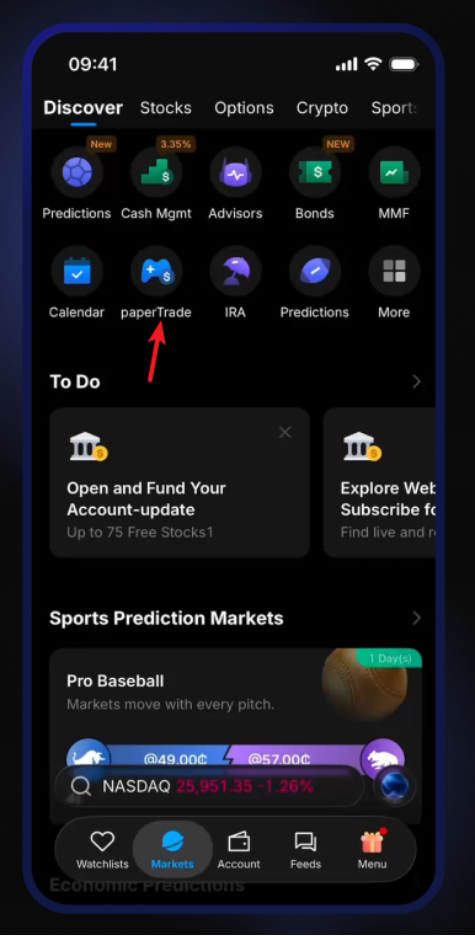
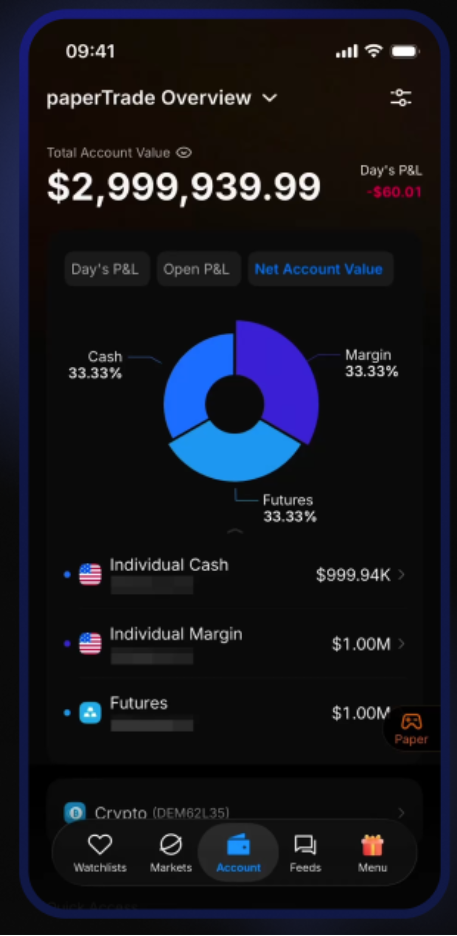
Step 2. Now you can start your paper trading with Webull.
Part 3: How to Use Paper Trading Effectively Before Investing Real Money
Paper trading is most effective when you approach it as if you were investing real money. Following a structured process can help you build consistent habits and better prepare for live trading.
Step 1: Define Your Trading Goals
Start by identifying what you want to achieve. Your objectives will determine how you use your paper trading account and which assets or strategies you focus on.
Common goals include:
Learning the basics of investing
Practicing long-term investing
Testing swing trading strategies
Developing day trading skills
Exploring options trading strategies
Step 2: Use a Realistic Account Size
Although many paper trading platforms provide large amounts of virtual cash, using an unrealistic balance may encourage excessive risk-taking. Instead, choose a starting balance that closely matches the amount you expect to invest with real money. This helps create more realistic position sizing and risk management habits.
Step 3: Measure Your Performance
Treat every simulated trade as part of a trading journal. Instead of focusing only on profits, evaluate the quality and consistency of your strategy using key performance metrics.
Metrics | Why it matters |
Win rate | Shows the percentage of profitable trades |
Risk-to-reward ratio | Measures whether potential rewards justify the risks taken |
Maximum drawdown | Indicates the largest portfolio decline during the testing period |
Portfolio return | Tracks overall investment performance over time |
Step 4: Transition to Live Trading Gradually
Consistent results in a paper trading simulator do not automatically translate into success with real money. Before making the switch, review your trading plan and make sure you understand how live markets differ from simulated environments.
Before opening live positions, consider whether you have:
A clear understanding of trading fees and commissions
A risk tolerance that matches your strategy
Position sizing rules for every trade
A diversified portfolio where appropriate
A written trading plan you can consistently follow
Regulation, Security, and Risk Considerations
When choosing a paper trading platform, it is helpful to evaluate not only the simulator itself but also the brokerage that provides it. A broker's regulatory status, security practices, and overall reputation can be important considerations, particularly if you plan to transition from paper trading to a live account.
For US brokerage firms, investors may look for regulation by recognized authorities such as:
Securities and Exchange Commission (SEC)
Financial Industry Regulatory Authority (FINRA)
Many US brokerage firms also offer accounts that are eligible for protection by the Securities Investor Protection Corporation (SIPC). However, it is important to understand that SIPC protection applies only to eligible customer securities and cash held in brokerage accounts—not to virtual balances used in paper trading. Since paper trading accounts contain simulated funds rather than real assets, virtual portfolios are not covered by SIPC protection.
In addition to regulatory oversight, investors should review a platform's account security features, such as two-factor authentication, encryption, and account monitoring, especially if they intend to use the same broker for live investing.
Part 4: Paper Trading FAQs
1. What is paper trading on Webull?
Webull paper trading (also called paperTrade) is a risk-free trading simulator that mirrors the Webull live trading platform. It provides users with virtual funds to practice trading stocks, options, crypto, and other supported assets without using real money.
With a Webull paper trading account, users can experience many of the same features available on the live platform, including:
Realistic trading workflows
Multiple order types
Advanced charting tools
Investment analysis features
Portfolio tracking tools
Webull paperTrade helps investors learn the platform, test strategies, and gain trading experience before committing real capital.
2. Is Webull paper trading free?
Yes. Webull paperTrade is available as free paper trading with virtual funds that users can reset and reload.
Unlike some paper trading platforms that limit usage or require paid subscriptions, Webull provides an unlimited simulated trading environment where users can continue practicing strategies without risking real money.
3. Can beginners use a Webull paper trading account?
Yes. A Webull paper trading account is designed for beginners who want to learn investing and trading without financial risk.
New traders can use paperTrade to:
Practice placing buy and sell orders
Understand how market orders and limit orders work
Explore trading and investment tools
Learn market concepts step by step
Build confidence before opening live positions
For investors who are not ready to trade with real funds, paper trading provides a practical way to become familiar with the market environment.
4. Can experienced traders use Webull paperTrade?
Yes. Experienced traders can also use Webull’s paper trading simulator to test ideas before applying them to a live account.
Common use cases include:
Testing new trading strategies
Evaluating technical setups
Practicing options strategies
Validating investment decisions
Reviewing risk management approaches
Simulated trading allows experienced investors to experiment while avoiding unnecessary capital risk.
5. What assets can I trade with Webull paperTrade?
Webull paperTrade supports a broad range of assets, allowing users to practice different trading strategies in one platform.
Depending on availability, users can simulate trading across:
Stocks
ETFs
Cryptocurrency
Multi-leg options strategies
Event contracts
Compared with many other paper trading websites and simulators, Webull provides a wider range of asset classes for users who want a more complete trading experience.
6. Does Webull paperTrade use the same tools as live trading?
Yes. Webull paperTrade is designed to closely mirror the live trading experience.
Users can practice with many of the same platform features, including:
Advanced charts
Technical indicators
Watchlists
Order entry tools
Different order types
Portfolio monitoring features
This allows traders to become familiar with the platform interface before transitioning to live trading.
7. How do I start paper trading on Webull?
To start using Webull paperTrade, make sure your Webull app is updated to the latest version.
On mobile:
Open the Webull app
Go to the Accounts tab
Open Accounts Overview
Select Switch to paperTrade
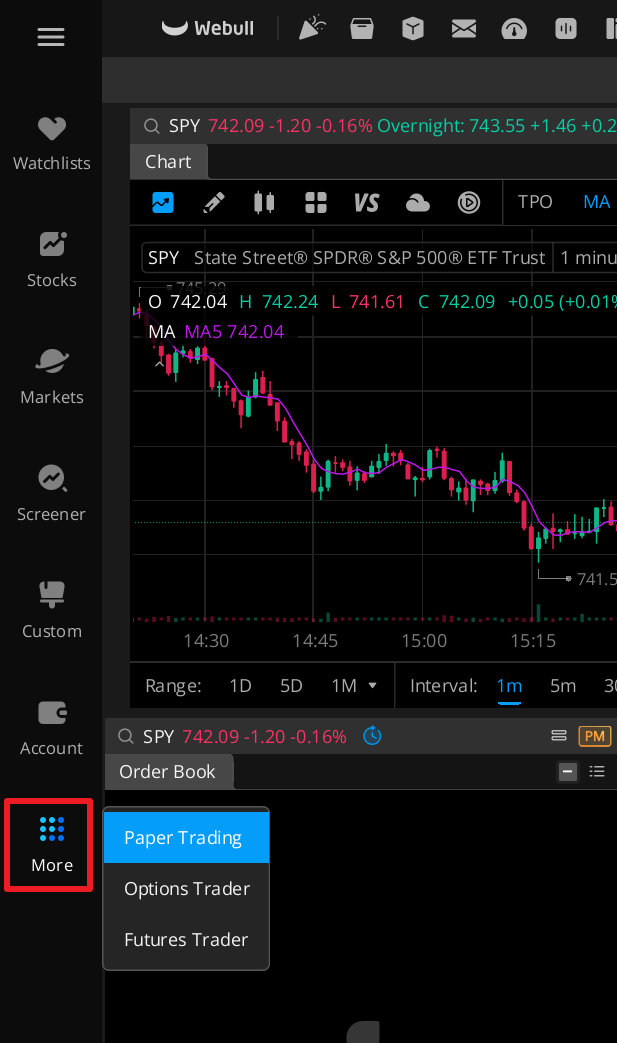
On desktop:
Open your Webull account page
Locate the paperTrade switch toggle in the left More button
Turn on paperTrade mode
Part 5: The Bottom Line
Paper trading helps investors build market knowledge, test strategies, and understand trading platforms without risking real money. Choosing the right simulator depends on your goals, experience level, and preferred trading style. A strong paper trading account can be an effective first step before live investing.
Disclamer:
Securities trading is offered to self-directed customers by Webull Financial LLC, member SIPC, FINRA. All investments involve risk, including the possible loss of principal. You should consider your investment objectives carefully before investing. This is not a recommendation, investment advice, or a solicitation for the purchase or sale of a security. Additional info: webull.com/disclosures
Disclosure:
Webull Financial LLC, Member SIPC, FINRA. Investing involves risk. More info at webull.com/policy
