'%3e %3cpath d='M41.7832962%2c0 C41.9459106%2c0 42.0882746%2c0.0866854658 42.1666825%2c0.216359069 C43.8289923%2c2.66540836 44.7676281%2c5.46271319 44.7676281%2c8.43208061 C44.7676281%2c18.1345746 34.7460532%2c26 22.383814%2c26 C10.0215749%2c26 0%2c18.1345746 0%2c8.43208061 C0%2c5.46716016 0.935826425%2c2.67378733 2.58829888%2c0.223985685 C2.67109477%2c0.0916264068 2.81687473%2c0 2.9840593%2c0 C3.23130408%2c0 3.43173558%2c0.200393004 3.43173558%2c0.447590303 C3.43173558%2c0.475056669 3.42926112%2c0.501945205 3.42452292%2c0.528045226 L3.41810883%2c0.550292077 C3.37800671%2c0.861741908 3.3575721%2c1.17661276 3.3575721%2c1.49443092 C3.3575721%2c7.98336 11.2132389%2c12.5742305 22.383814%2c12.5742305 C33.5543891%2c12.5742305 41.410056%2c7.98336 41.410056%2c1.49443092 C41.410056%2c1.17865223 41.3898828%2c0.865783153 41.3502888%2c0.556288325 C41.3402868%2c0.521941442 41.3356199%2c0.48531078 41.3356199%2c0.447590303 C41.3356199%2c0.200393004 41.5360514%2c0 41.7832962%2c0 Z' id='logo%e5%a4%87%e4%bb%bd-6' fill='white'%3e%3c/path%3e %3cpath d='M74.6899231%2c3.74404927 C75.2411227%2c3.74404927 75.7734299%2c3.66184338 76.2756219%2c3.50883715 L73.8159676%2c20.8666902 C73.5770593%2c22.5662954 72.8072434%2c23.0518969 71.4268838%2c23.0518969 L69.9934336%2c23.0518969 C68.7988917%2c23.0518969 68.1618027%2c22.458384 67.7901674%2c20.893668 L65.6930827%2c11.9909739 C65.639992%2c11.7481731 65.639992%2c11.6942174 65.5338105%2c11.6942174 C65.427629%2c11.6942174 65.4010836%2c11.7481731 65.3479929%2c11.9909739 L63.2509082%2c20.893668 C62.8792729%2c22.458384 62.2421839%2c23.0518969 61.047642%2c23.0518969 L59.6141918%2c23.0518969 C58.2338322%2c23.0518969 57.4640163%2c22.5662954 57.225108%2c20.8666902 L54.7463723%2c3.37406084 C55.3593498%2c3.61307396 56.0249975%2c3.74404927 56.7207458%2c3.74404927 C57.3314263%2c3.74404927 57.918917%2c3.64314414 58.4679557%2c3.4568446 L60.3574623%2c19.3829078 C60.3840076%2c19.6257086 60.3840076%2c19.7875757 60.4901891%2c19.7875757 C60.5963706%2c19.7875757 60.5963706%2c19.6257086 60.6494614%2c19.3829078 L62.9323637%2c9.91367858 C63.0916359%2c9.26620991 63.4632712%2c8.69967483 64.6047223%2c8.69967483 L66.4363532%2c8.69967483 C67.5778044%2c8.69967483 67.9494397%2c9.26620991 68.1087119%2c9.91367858 L70.3916142%2c19.3829078 C70.4447049%2c19.6257086 70.4447049%2c19.7875757 70.5508864%2c19.7875757 C70.6570679%2c19.7875757 70.6570679%2c19.6257086 70.6836133%2c19.3829078 L72.5891207%2c3.32292288 C73.2365902%2c3.59432921 73.9460524%2c3.74404927 74.6899231%2c3.74404927 Z' id='Combined-Shape' fill='white'%3e%3c/path%3e %3cpath d='M84.5933901%2c7.43171536 C88.6813779%2c7.43171536 90.9111894%2c10.2643908 90.9111894%2c14.2840921 L90.9111894%2c15.7948523 C90.9111894%2c16.2264981 90.7519172%2c16.4692988 90.3802819%2c16.4692988 L81.7264895%2c16.4692988 L81.7264895%2c16.5502324 C81.7264895%2c18.1149484 82.3635785%2c19.9764208 84.9119346%2c19.9764208 C86.849747%2c19.9764208 88.6813779%2c19.8145536 89.7962837%2c19.7066422 L89.8759198%2c19.7066422 C90.1413735%2c19.7066422 90.3537366%2c19.8415315 90.3537366%2c20.1113101 L90.3537366%2c21.8918489 C90.3537366%2c22.3234947 90.2741004%2c22.5123397 89.7962837%2c22.5932733 C88.0708343%2c22.9170076 87.0355646%2c23.0518969 84.6464808%2c23.0518969 C81.9919433%2c23.0518969 78.2225%2c21.5950924 78.2225%2c16.2804538 L78.2225%2c14.2840921 C78.2225%2c10.0755457 80.5319476%2c7.43171536 84.5933901%2c7.43171536 Z M84.5933901%2c10.5071915 C82.9475768%2c10.5071915 81.7530349%2c11.6942174 81.7530349%2c13.8254684 L81.7530349%2c13.9333799 L87.3806545%2c13.9333799 L87.3806545%2c13.8254684 C87.3806545%2c11.7211953 86.2392034%2c10.5071915 84.5933901%2c10.5071915 Z' id='Combined-Shape' fill='white'%3e%3c/path%3e %3cpath d='M97.4154906%2c2.98826245 L97.4148064%2c7.62056039 C98.3969853%2c7.48567108 99.3260735%2c7.43171536 99.9631625%2c7.43171536 C104.236968%2c7.43171536 106.307507%2c9.99461216 106.307507%2c14.2031585 L106.307507%2c16.2804538 C106.307507%2c20.4890001 104.236968%2c23.0518969 99.9631625%2c23.0518969 C98.2642584%2c23.0518969 96.2733553%2c22.7821183 94.627542%2c22.3504725 C94.0169984%2c22.1886054 93.9108169%2c22.0267382 93.9108169%2c21.6220703 L93.9098179%2c3.08694115 C94.4185466%2c3.24434375 94.9584615%2c3.32900525 95.5178331%2c3.32900525 C96.184659%2c3.32900525 96.8238351%2c3.20869291 97.4154906%2c2.98826245 Z M99.9631625%2c10.3453244 C99.3260735%2c10.3453244 98.1580769%2c10.4262579 97.4148064%2c10.5341694 L97.4148064%2c19.9494429 C97.9191686%2c20.0573544 99.007529%2c20.1382879 99.9631625%2c20.1382879 C102.246065%2c20.1382879 102.803518%2c18.4926384 102.803518%2c16.2804538 L102.803518%2c14.2031585 C102.803518%2c11.9909739 102.246065%2c10.3453244 99.9631625%2c10.3453244 Z' id='Combined-Shape' fill='white'%3e%3c/path%3e %3cpath d='M111.036668%2c8.72457747 C111.579488%2c8.72457747 112.103987%2c8.64485191 112.599444%2c8.49629404 L112.598761%2c16.5232546 C112.598761%2c19.3289521 113.607485%2c19.9764208 115.147117%2c19.9764208 L115.306389%2c19.9764208 C116.846021%2c19.9764208 117.854746%2c19.3289521 117.854746%2c16.5232546 L117.854207%2c8.4334735 C118.406525%2c8.62226395 118.997939%2c8.72457747 119.612866%2c8.72457747 C120.223332%2c8.72457747 120.810625%2c8.62374317 121.359498%2c8.43756894 L121.358735%2c16.5232546 C121.358735%2c22.4044283 116.872567%2c23.0518969 115.306389%2c23.0518969 L115.060464%2c23.0512514 C113.42215%2c23.0271041 109.094772%2c22.2994073 109.094772%2c16.5232546 L109.094446%2c8.36700801 C109.698522%2c8.59813531 110.353066%2c8.72457747 111.036668%2c8.72457747 Z' id='Combined-Shape' fill='white'%3e%3c/path%3e %3cpath d='M128.314162%2c3.03790128 L128.313623%2c22.269539 C128.313623%2c22.5662954 128.10126%2c22.836074 127.809261%2c22.836074 L125.340541%2c22.836074 C125.048542%2c22.836074 124.809634%2c22.5662954 124.809634%2c22.269539 L124.809455%2c3.04219481 C125.358161%2c3.22824247 125.945253%2c3.32900525 126.555503%2c3.32900525 C127.17043%2c3.32900525 127.761844%2c3.22669173 128.314162%2c3.03790128 Z' id='Combined-Shape' fill='white'%3e%3c/path%3e %3cpath d='M133.90653%2c3.32900525 C134.473329%2c3.32900525 135.02015%2c3.24208064 135.534793%2c3.08063296 L135.533966%2c22.269539 C135.533966%2c22.5662954 135.321603%2c22.836074 135.029603%2c22.836074 L132.560884%2c22.836074 C132.268884%2c22.836074 132.029976%2c22.5662954 132.029976%2c22.269539 L132.029909%2c2.99605058 C132.615669%2c3.21152525 133.2476%2c3.32900525 133.90653%2c3.32900525 Z' id='Combined-Shape' fill='white'%3e%3c/path%3e %3c/g%3e %3c/g%3e %3c/g%3e%3c/svg%3e)



Investing in stocks is one of the most effective ways to build long-term wealth, but getting started can feel overwhelming. If you're wondering how to invest in stocks, this guide explains every step—from opening your first brokerage account to building a diversified portfolio and managing investment risk.
Part 1. What Does It Mean to Invest in Stocks?
Stock investing means purchasing shares of publicly traded companies with the goal of benefiting from long-term price appreciation, dividends, or both.
When you buy stock, you become a shareholder and own a small portion of the company. Your investment can increase or decrease in value depending on company performance, market conditions, and investor sentiment.
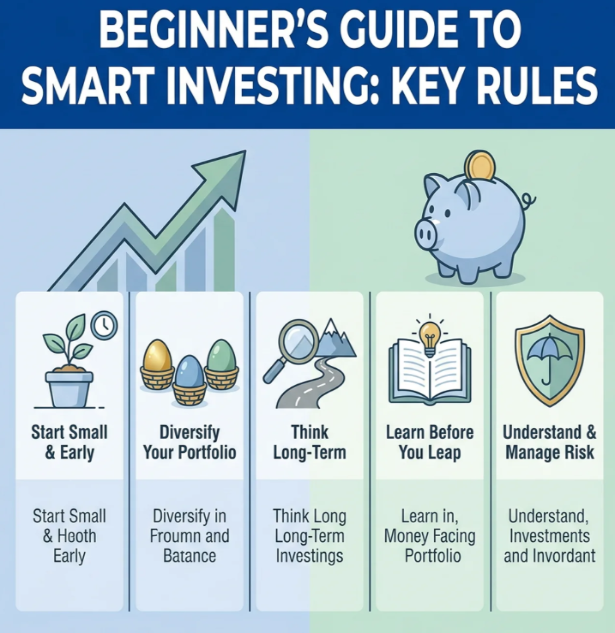
Why Do People Invest in Stocks?
People invest for several reasons:
Build long-term wealth
Save for retirement
Generate dividend income
Beat inflation
Participate in economic growth
Historically, the U.S. stock market has delivered positive long-term returns despite periods of volatility. However, past performance never guarantees future results.
Investment | Growth Potential | Risk | Liquidity | Income |
Stocks | High | High | High | Dividends(some) |
Bonds | Moderate | Lower | High | Interest |
ETFs | Moderate-Hight | Moderate | High | Varies |
Mutual Funds | Moderate | Moderate | Daily | Varies |
CDs | Low | Very Low | Limited | Fixed Interest |
Part 2. How to Start Investing in Stocks Step by Step
If you're wondering how to start investing in stocks, the process is easier than many beginners expect. You don't need to be a professional trader to buy stocks, but you do need a clear plan, the right account, and an understanding of your investment goals.
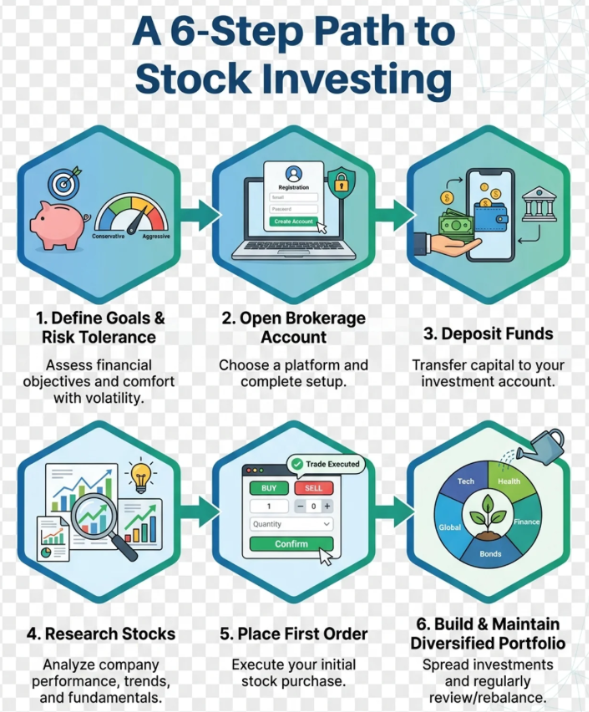
At a high level, starting to invest in stocks involves six key steps:
Define your financial goals and risk tolerance
Open a brokerage account
Deposit money into your account
Research stocks before investing
Place your first stock order
Build and maintain a diversified portfolio
Following these steps can help beginners create a more disciplined approach to investing.
2.1 Set Your Financial Goals
Before investing in stocks, define your financial goals, investment timeline, and risk tolerance. Consider whether you are investing for retirement, long-term growth, or short-term goals. Make sure you have enough emergency savings before putting money into the market. Your investment strategy should match your financial situation, because different goals require different approaches to managing risk and choosing investments.
2.2 Choose a Brokerage Account
To learn how to buy stocks, you need a brokerage account that provides access to publicly traded investments. Common account types include individual taxable accounts, joint accounts, Traditional IRAs, and Roth IRAs. When choosing a broker, consider fees, available investments, research tools, mobile app experience, educational resources, and customer support to find an account that fits your investing needs.
2.3 Fund Your Account
After opening a brokerage account, deposit funds before purchasing stocks. Most brokerages support funding methods such as ACH bank transfers, wire transfers, debit transfers, or account transfers from another broker. Many online brokers offer no minimum deposit requirements, making it easier for beginners to start investing. However, only invest money that you do not need for daily expenses or emergency costs.
2.4 Research Stocks Before Buying
Before purchasing a stock, research the company’s financial performance and future potential. Review factors such as revenue growth, earnings, profit margins, valuation ratios, industry outlook, and competitive advantages. Avoid buying stocks based only on social media trends or market headlines. A strong investment decision should be based on company fundamentals, research, and how the investment fits your overall financial goals.
2.5 Place Your First Stock Trade
If you are searching for how to purchase stock, the process is simple. First, find the stock ticker symbol, choose the number of shares or investment amount, select an order type, review the details, and submit your trade. Common order types include market orders, limit orders, stop orders, and stop-limit orders, each offering different levels of price control and risk management.
2.6 Build a Diversified Portfolio
Diversification is an important principle when learning how to invest in stocks. Instead of investing in a single company, consider spreading investments across sectors such as technology, healthcare, financials, consumer goods, and international markets. Many beginners also use ETFs alongside individual stocks because ETFs provide exposure to multiple companies in one investment, helping create a more balanced portfolio.
2.7 Regulation, Investor Protection, and Risks
Choosing a brokerage account involves more than comparing commissions, trading tools, and investment features. Investors should also consider whether a brokerage is properly regulated, what protections are available for customer accounts, and what risks remain when investing in financial markets.
A regulated brokerage must follow strict rules designed to protect investors, maintain fair markets, and safeguard customer assets. Before opening an account, investors should verify the brokerage’s regulatory status and understand the protections that apply to their investments.
Part 3. How to Choose the Right Brokerage Platform
Not all brokerage platforms offer the same experience. Consider costs, research tools, educational resources, and trading technology.
Webull: Trading platform for All Investors
Webull is an online brokerage platform designed for investors who want a balance between simplicity and advanced trading capabilities. It provides an easy entry point for beginners while offering professional-grade tools that can support investors as their experience grows.

Unlike some platforms that focus only on basic investing, Webull combines commission-free trading with advanced charting, market data, technical analysis tools, and multiple trading platforms. This makes it suitable for investors who want to start with straightforward stock and ETF investing while gradually exploring more advanced strategies.
Investor Type | Why Webull May Be a Good Choice |
Beginner investors | Simple account setup, educational resources, paper trading, and commission-free investing make it easier to get started |
Active traders | Advanced charts, real-time data, technical indicators, and extended-hours trading support more frequent trading activity |
Mobile-first investors | The mobile app provides trading tools, portfolio monitoring, alerts, and market research features |
Desktop traders | Desktop and web platforms provide expanded charting and analysis capabilities |
Cost-conscious investors | $0 commission trading for eligible stocks and ETFs helps reduce transaction costs |
Key Features of Webull
Webull offers a range of tools designed for both new investors and more experienced traders.
Commission-Free Stock and ETF Trading
Investors can trade eligible U.S. stocks and ETFs with $0 commissions. This allows investors to build portfolios without paying traditional trading fees on eligible transactions.
Fractional Shares
Webull supports fractional share investing for eligible securities, allowing investors to purchase portions of stocks rather than needing to buy a full share. This feature can make higher-priced stocks more accessible for investors with smaller amounts of capital.
Advanced Market Research and Charting Tools
For investors who want deeper analysis, Webull provides:
Real-time market data
Advanced stock charts
Technical indicators
Stock screeners
Custom watchlists
Price alerts and notifications
These tools can help investors track market movements, analyze trends, and monitor potential investment opportunities.
Extended-Hours Trading
Webull offers extended-hours trading access, allowing investors to trade outside standard market hours. This can be useful for investors who want to respond to market news or earnings announcements before or after regular trading sessions.
Paper Trading for Practice
New investors can use paper trading to practice investment strategies without risking real money. This feature allows users to become familiar with trading tools, order types, and market movements before placing actual trades.
Multiple Trading Platforms
Webull provides access through:
Mobile app
Desktop platform
Web trading platform
Investors can manage portfolios, monitor markets, and execute trades across different devices.
Webull Fees and Account Requirements
Feature | Webull |
Stock Trading Commission | $0 |
ETF Trading Commission | $0 |
Account Minimum | $0 |
Paper Trading | Available |
Fractional Shares | Available for eligible securities |
While many basic investing features are available without account minimums or commissions, investors should review Webull’s current fee schedule for potential charges related to specific services, transfers, margin trading, or advanced products.
Part 4. Common Beginner Investing Mistakes to Avoid
Many new investors make avoidable mistakes when entering the stock market. Understanding these common pitfalls can help investors build healthier long-term investing habits.
1. Trying to Time the Market
Some investors attempt to buy stocks at the lowest price and sell at the highest price. While this sounds appealing, consistently predicting short-term market movements is extremely difficult, even for experienced investors.
Many long-term investors focus instead on building diversified portfolios and maintaining consistent investment strategies.
2. Investing Without Diversification
Putting too much money into a single stock, industry, or market segment can increase risk.
For example, an investor who invests only in one company may experience significant losses if that company faces financial difficulties.
Diversification across different companies, sectors, and asset classes can help reduce the impact of individual investment losses.
3. Ignoring Fees and Costs
Even when a brokerage offers commission-free trading, investors should understand that other costs may apply depending on the products and services they use.
Potential costs may include:
Options-related fees
Margin interest
Account transfer fees
Regulatory fees
Fund expense ratios
Small costs can affect long-term investment results, especially over many years.
4. Chasing Trending Stocks
New investors may feel pressure to buy stocks that are receiving significant attention online or in the news.
However, popular stocks can experience rapid price changes, and buying based only on hype or short-term trends can lead to unexpected losses.
Investors should evaluate factors such as:
Company financial performance
Business model
Competitive position
Valuation
Long-term growth potential
5. Making Emotional Investment Decisions
Fear and excitement can strongly influence investment decisions.
Common emotional mistakes include:
Selling during market downturns because of panic
Buying after a stock has already risen sharply due to fear of missing out (FOMO)
Changing strategies based on short-term market movements
Developing a clear investment plan can help investors make more disciplined decisions.
6. Investing Money Needed in the Short Term
The stock market can be unpredictable over short periods. Investors should generally avoid investing money they may need soon for essential expenses, such as:
Emergency savings
Rent or mortgage payments
Near-term purchases
Short-term financial obligations
Maintaining an appropriate cash reserve can help investors avoid selling investments at unfavorable times.
7. Failing to Research Investments
Before buying a stock, investors should understand what they are purchasing.
Basic research may include reviewing:
Company revenue and earnings
Business strategy
Industry conditions
Competitive advantages
Financial health
Management performance
Taking time to research investments can help investors make more informed decisions rather than relying on speculation.
Part 5. FAQs
1. How do I invest in stocks if I'm a complete beginner?
Start by opening a brokerage account, funding it, researching companies or ETFs, and investing gradually with a long-term plan.
2. How much money do I need to start investing in stocks?
Many brokerages allow investors to start with little money through fractional shares, though the amount you should invest depends on your financial goals and budget.
3. How can you invest in stocks without taking too much risk?
Diversify across companies and sectors, invest consistently, focus on long-term goals, and avoid concentrating your portfolio in a single stock.
4. Is it better to invest in individual stocks or ETFs?
Many beginners choose ETFs for broad diversification, while experienced investors may combine ETFs with individual stocks.
5. What is the safest way to buy stocks online?
Use a regulated U.S. brokerage that is registered with the SEC, is a FINRA member, offers SIPC protection for eligible assets, and provides strong account security features such as multi-factor authentication.
6. When is the best time to start investing?
Many financial professionals recommend investing as early as possible so your investments have more time to potentially benefit from compound growth. The right timing also depends on your financial situation and risk tolerance.
Part 6. The Bottom Line
Learning how to invest in stocks starts with understanding your goals, choosing a trusted brokerage, and following a disciplined long-term strategy. A platform with strong education, research tools, and investor protections can help you begin with confidence while supporting your growth as your investing experience expands.
Disclamer:
Securities trading is offered to self-directed customers by Webull Financial LLC, member SIPC, FINRA. All investments involve risk, including the possible loss of principal. You should consider your investment objectives carefully before investing. This is not a recommendation, investment advice, or a solicitation for the purchase or sale of a security. Additional info: webull.com/disclosures
Disclosure:
Webull Financial LLC, Member SIPC, FINRA. Investing involves risk. More info at webull.com/policy
