'%3e %3cpath d='M41.7832962%2c0 C41.9459106%2c0 42.0882746%2c0.0866854658 42.1666825%2c0.216359069 C43.8289923%2c2.66540836 44.7676281%2c5.46271319 44.7676281%2c8.43208061 C44.7676281%2c18.1345746 34.7460532%2c26 22.383814%2c26 C10.0215749%2c26 0%2c18.1345746 0%2c8.43208061 C0%2c5.46716016 0.935826425%2c2.67378733 2.58829888%2c0.223985685 C2.67109477%2c0.0916264068 2.81687473%2c0 2.9840593%2c0 C3.23130408%2c0 3.43173558%2c0.200393004 3.43173558%2c0.447590303 C3.43173558%2c0.475056669 3.42926112%2c0.501945205 3.42452292%2c0.528045226 L3.41810883%2c0.550292077 C3.37800671%2c0.861741908 3.3575721%2c1.17661276 3.3575721%2c1.49443092 C3.3575721%2c7.98336 11.2132389%2c12.5742305 22.383814%2c12.5742305 C33.5543891%2c12.5742305 41.410056%2c7.98336 41.410056%2c1.49443092 C41.410056%2c1.17865223 41.3898828%2c0.865783153 41.3502888%2c0.556288325 C41.3402868%2c0.521941442 41.3356199%2c0.48531078 41.3356199%2c0.447590303 C41.3356199%2c0.200393004 41.5360514%2c0 41.7832962%2c0 Z' id='logo%e5%a4%87%e4%bb%bd-6' fill='white'%3e%3c/path%3e %3cpath d='M74.6899231%2c3.74404927 C75.2411227%2c3.74404927 75.7734299%2c3.66184338 76.2756219%2c3.50883715 L73.8159676%2c20.8666902 C73.5770593%2c22.5662954 72.8072434%2c23.0518969 71.4268838%2c23.0518969 L69.9934336%2c23.0518969 C68.7988917%2c23.0518969 68.1618027%2c22.458384 67.7901674%2c20.893668 L65.6930827%2c11.9909739 C65.639992%2c11.7481731 65.639992%2c11.6942174 65.5338105%2c11.6942174 C65.427629%2c11.6942174 65.4010836%2c11.7481731 65.3479929%2c11.9909739 L63.2509082%2c20.893668 C62.8792729%2c22.458384 62.2421839%2c23.0518969 61.047642%2c23.0518969 L59.6141918%2c23.0518969 C58.2338322%2c23.0518969 57.4640163%2c22.5662954 57.225108%2c20.8666902 L54.7463723%2c3.37406084 C55.3593498%2c3.61307396 56.0249975%2c3.74404927 56.7207458%2c3.74404927 C57.3314263%2c3.74404927 57.918917%2c3.64314414 58.4679557%2c3.4568446 L60.3574623%2c19.3829078 C60.3840076%2c19.6257086 60.3840076%2c19.7875757 60.4901891%2c19.7875757 C60.5963706%2c19.7875757 60.5963706%2c19.6257086 60.6494614%2c19.3829078 L62.9323637%2c9.91367858 C63.0916359%2c9.26620991 63.4632712%2c8.69967483 64.6047223%2c8.69967483 L66.4363532%2c8.69967483 C67.5778044%2c8.69967483 67.9494397%2c9.26620991 68.1087119%2c9.91367858 L70.3916142%2c19.3829078 C70.4447049%2c19.6257086 70.4447049%2c19.7875757 70.5508864%2c19.7875757 C70.6570679%2c19.7875757 70.6570679%2c19.6257086 70.6836133%2c19.3829078 L72.5891207%2c3.32292288 C73.2365902%2c3.59432921 73.9460524%2c3.74404927 74.6899231%2c3.74404927 Z' id='Combined-Shape' fill='white'%3e%3c/path%3e %3cpath d='M84.5933901%2c7.43171536 C88.6813779%2c7.43171536 90.9111894%2c10.2643908 90.9111894%2c14.2840921 L90.9111894%2c15.7948523 C90.9111894%2c16.2264981 90.7519172%2c16.4692988 90.3802819%2c16.4692988 L81.7264895%2c16.4692988 L81.7264895%2c16.5502324 C81.7264895%2c18.1149484 82.3635785%2c19.9764208 84.9119346%2c19.9764208 C86.849747%2c19.9764208 88.6813779%2c19.8145536 89.7962837%2c19.7066422 L89.8759198%2c19.7066422 C90.1413735%2c19.7066422 90.3537366%2c19.8415315 90.3537366%2c20.1113101 L90.3537366%2c21.8918489 C90.3537366%2c22.3234947 90.2741004%2c22.5123397 89.7962837%2c22.5932733 C88.0708343%2c22.9170076 87.0355646%2c23.0518969 84.6464808%2c23.0518969 C81.9919433%2c23.0518969 78.2225%2c21.5950924 78.2225%2c16.2804538 L78.2225%2c14.2840921 C78.2225%2c10.0755457 80.5319476%2c7.43171536 84.5933901%2c7.43171536 Z M84.5933901%2c10.5071915 C82.9475768%2c10.5071915 81.7530349%2c11.6942174 81.7530349%2c13.8254684 L81.7530349%2c13.9333799 L87.3806545%2c13.9333799 L87.3806545%2c13.8254684 C87.3806545%2c11.7211953 86.2392034%2c10.5071915 84.5933901%2c10.5071915 Z' id='Combined-Shape' fill='white'%3e%3c/path%3e %3cpath d='M97.4154906%2c2.98826245 L97.4148064%2c7.62056039 C98.3969853%2c7.48567108 99.3260735%2c7.43171536 99.9631625%2c7.43171536 C104.236968%2c7.43171536 106.307507%2c9.99461216 106.307507%2c14.2031585 L106.307507%2c16.2804538 C106.307507%2c20.4890001 104.236968%2c23.0518969 99.9631625%2c23.0518969 C98.2642584%2c23.0518969 96.2733553%2c22.7821183 94.627542%2c22.3504725 C94.0169984%2c22.1886054 93.9108169%2c22.0267382 93.9108169%2c21.6220703 L93.9098179%2c3.08694115 C94.4185466%2c3.24434375 94.9584615%2c3.32900525 95.5178331%2c3.32900525 C96.184659%2c3.32900525 96.8238351%2c3.20869291 97.4154906%2c2.98826245 Z M99.9631625%2c10.3453244 C99.3260735%2c10.3453244 98.1580769%2c10.4262579 97.4148064%2c10.5341694 L97.4148064%2c19.9494429 C97.9191686%2c20.0573544 99.007529%2c20.1382879 99.9631625%2c20.1382879 C102.246065%2c20.1382879 102.803518%2c18.4926384 102.803518%2c16.2804538 L102.803518%2c14.2031585 C102.803518%2c11.9909739 102.246065%2c10.3453244 99.9631625%2c10.3453244 Z' id='Combined-Shape' fill='white'%3e%3c/path%3e %3cpath d='M111.036668%2c8.72457747 C111.579488%2c8.72457747 112.103987%2c8.64485191 112.599444%2c8.49629404 L112.598761%2c16.5232546 C112.598761%2c19.3289521 113.607485%2c19.9764208 115.147117%2c19.9764208 L115.306389%2c19.9764208 C116.846021%2c19.9764208 117.854746%2c19.3289521 117.854746%2c16.5232546 L117.854207%2c8.4334735 C118.406525%2c8.62226395 118.997939%2c8.72457747 119.612866%2c8.72457747 C120.223332%2c8.72457747 120.810625%2c8.62374317 121.359498%2c8.43756894 L121.358735%2c16.5232546 C121.358735%2c22.4044283 116.872567%2c23.0518969 115.306389%2c23.0518969 L115.060464%2c23.0512514 C113.42215%2c23.0271041 109.094772%2c22.2994073 109.094772%2c16.5232546 L109.094446%2c8.36700801 C109.698522%2c8.59813531 110.353066%2c8.72457747 111.036668%2c8.72457747 Z' id='Combined-Shape' fill='white'%3e%3c/path%3e %3cpath d='M128.314162%2c3.03790128 L128.313623%2c22.269539 C128.313623%2c22.5662954 128.10126%2c22.836074 127.809261%2c22.836074 L125.340541%2c22.836074 C125.048542%2c22.836074 124.809634%2c22.5662954 124.809634%2c22.269539 L124.809455%2c3.04219481 C125.358161%2c3.22824247 125.945253%2c3.32900525 126.555503%2c3.32900525 C127.17043%2c3.32900525 127.761844%2c3.22669173 128.314162%2c3.03790128 Z' id='Combined-Shape' fill='white'%3e%3c/path%3e %3cpath d='M133.90653%2c3.32900525 C134.473329%2c3.32900525 135.02015%2c3.24208064 135.534793%2c3.08063296 L135.533966%2c22.269539 C135.533966%2c22.5662954 135.321603%2c22.836074 135.029603%2c22.836074 L132.560884%2c22.836074 C132.268884%2c22.836074 132.029976%2c22.5662954 132.029976%2c22.269539 L132.029909%2c2.99605058 C132.615669%2c3.21152525 133.2476%2c3.32900525 133.90653%2c3.32900525 Z' id='Combined-Shape' fill='white'%3e%3c/path%3e %3c/g%3e %3c/g%3e %3c/g%3e%3c/svg%3e)



Sector rotation is an active investing approach that draws on patterns in the US business cycle to guide portfolio positioning. Rather than holding a fixed allocation indefinitely, investors using a sector rotation strategy shift their equity exposure toward sectors that have historically shown relative strength at different economic stages. This guide explains how sector rotation works, how to use business cycle ETF strategies, and what tools US investors may find useful when exploring this approach.
Key Takeaways
Sector rotation involves shifting portfolio allocations between the 11 GICS equity sectors based on anticipated business cycle changes.
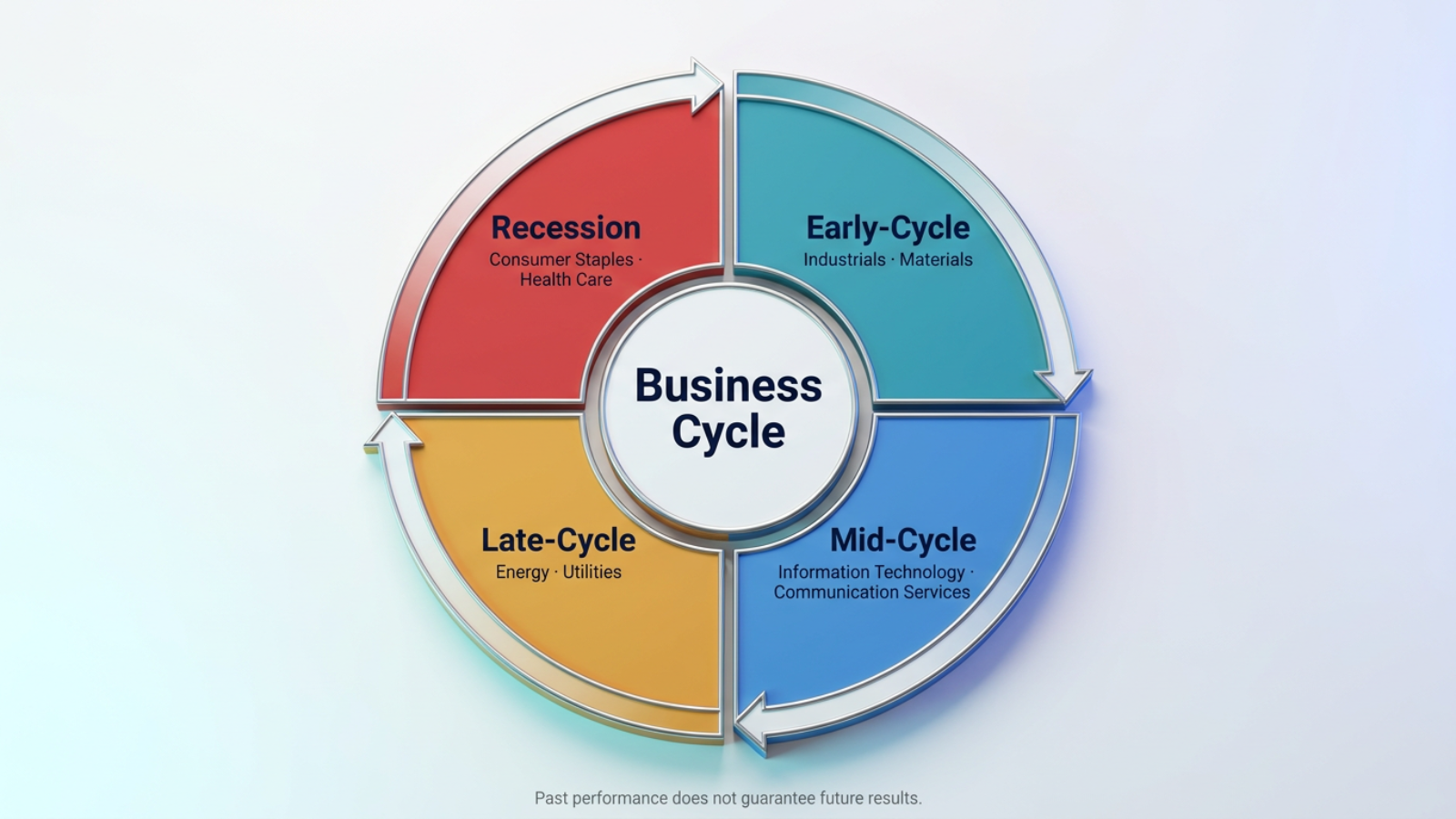
The US business cycle has four main phases: early-cycle, mid-cycle, late-cycle, and recession — each associated with different patterns of sector performance.
Financial markets typically price in economic changes three to six months before they occur, making timing a critical challenge.
ETFs offer an accessible way to execute sector rotation without concentrating in individual stocks.
Research suggests sector rotation strategies carry meaningful risk and may not reliably outperform simpler approaches after costs.
Platforms like Webull offer commission-free ETF trading, screening tools, and analytical resources relevant to sector-based strategies.
Part 1. What Is Sector Rotation and How Does It Work?
Sector rotation is the movement of investment capital from one equity sector to another as investors anticipate the next stage of the economic cycle. Instead of passively holding a broad index, sector rotation practitioners actively adjust their allocations based on where they believe the economy is heading.
The strategy is rooted in a well-documented observation: companies within the same industry tend to react similarly to macroeconomic changes. When interest rates rise or commodity prices shift, entire sectors often move in tandem — making sector-level positioning a meaningful portfolio lever.
Today's standard framework for sector classification is the Global Industry Classification Standard (GICS®), which currently defines 11 equity sectors: consumer discretionary, consumer staples, energy, financials, health care, industrials, information technology, materials, real estate, communication services, and utilities.
Fidelity Investments — https://www.fidelity.com/learning-center/trading-investing/markets-sectors/intro-sector-rotation-strats
1.1 How the Market Anticipates the Economic Cycle
One critical nuance distinguishes sector rotation from simple economic forecasting: financial markets move in anticipation of the economic cycle, not in reaction to it. Securities are typically priced based on where investors expect the economy to be roughly three to six months in the future.
This means an investor acting on already-confirmed economic data may already be too late. The sector likely reflecting that data has often already repriced. Effective sector rotation requires forming a view on where the cycle is heading — before mainstream confirmation arrives.
Investopedia — https://www.investopedia.com/articles/trading/05/020305.asp
Part 2. The Four Business Cycle Phases and Sector Opportunities
The US economy has experienced 12 business cycles since 1945. The average cycle has lasted approximately six years, with expansions averaging five years and four months and contractions averaging just over 10 months.
Understanding each phase — and which sectors have historically shown relative strength during it — is the core analytical framework behind sector rotation. Note that no outcome is guaranteed, and past patterns do not predict future results.
Fidelity Investments — https://www.fidelity.com/learning-center/trading-investing/markets-sectors/intro-sector-rotation-strats
2.1 Early-Cycle Phase
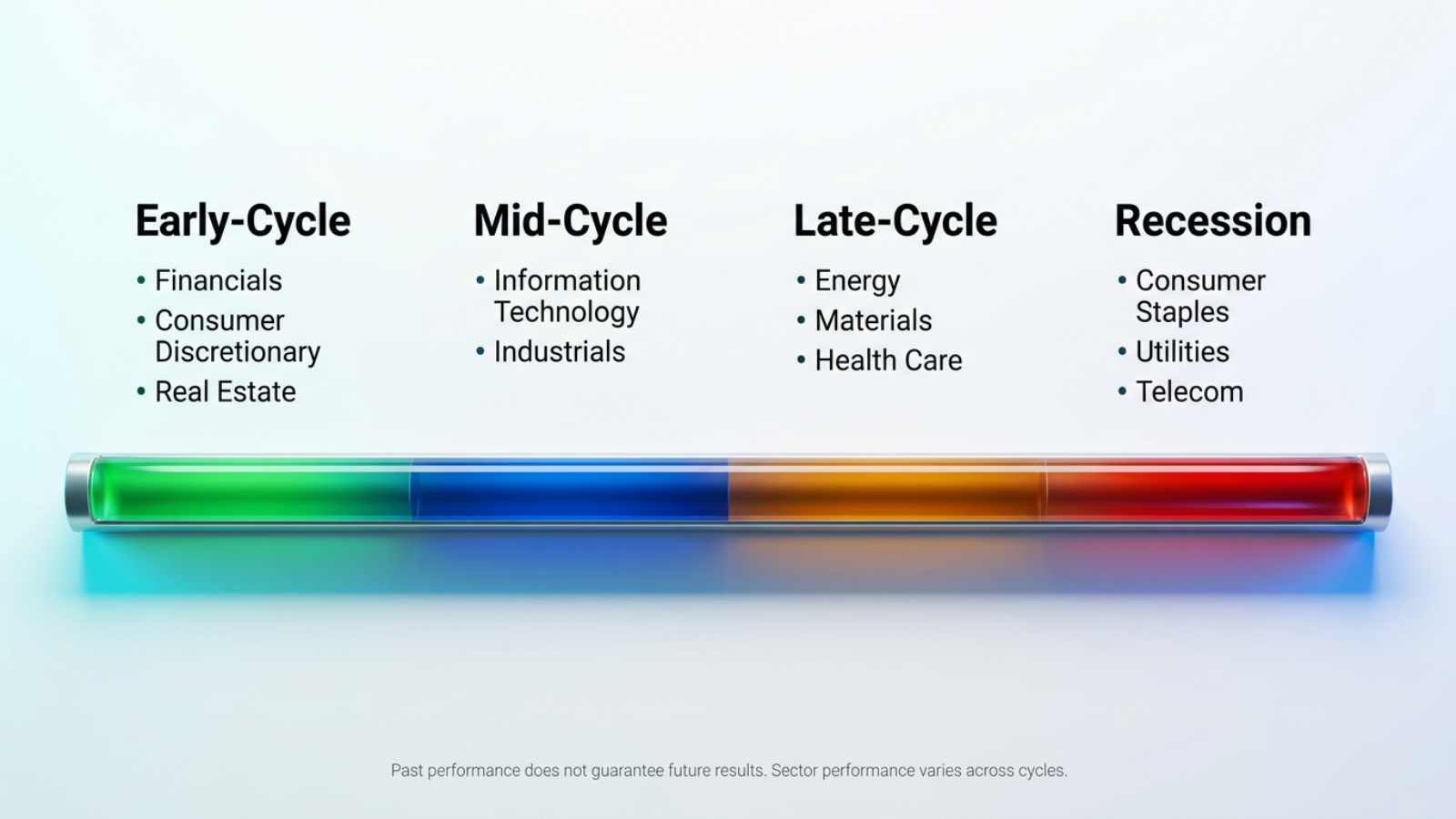
The early-cycle phase is generally marked by a sharp rebound from recession. GDP and industrial production shift from contraction to expansion. Credit conditions ease under accommodative monetary policy, supporting profit margin recovery. Business inventories remain lean while sales growth accelerates rapidly.
Sectors that have historically shown relative strength during the early-cycle phase include industrials (near the start), basic materials, and energy (toward the end). Consumer confidence typically improves, and economically sensitive companies tend to benefit from the rebound in activity.
2.2 Mid-Cycle and Late-Cycle Phases
The mid-cycle phase is typically the longest part of the business cycle. Growth continues at a positive but moderating pace. Credit expansion is healthy, corporate profitability is solid, and monetary policy gradually shifts toward a neutral stance.
The late-cycle phase signals an economy running "hot." Inflation rises above trend, monetary policy becomes restrictive, and corporate profit margins begin to compress. Sales growth slows while inventories unexpectedly build. Sectors that have historically held up relatively better during the late-cycle phase include energy (near the beginning), consumer staples, and services (toward the end).
2.3 Recession Phase
During a recession, economic output contracts quarter over quarter. Corporate profits fall sharply, credit availability tightens, and consumer expectations reach a low point. Monetary policy pivots back to accommodation.
Defensive sectors — those with more stable demand regardless of economic conditions — have historically shown relative resilience. These include consumer staples, health care, and utilities. It is important to note that the National Bureau of Economic Research (NBER), which officially dates US recessions, has sometimes confirmed a recession's end more than a year after the fact.
Business Cycle Stage | Sectors with Historical Relative Strength |
|---|---|
Recession | Consumer staples, health care, utilities |
Early Recovery / Bull Market | Consumer discretionary, industrials, technology, real estate |
Late Recovery / Peak | Energy, consumer staples, communication services |
Early Recession / Bear Market | Consumer staples, utilities |
Past performance does not guarantee future results. Sector performance can vary significantly across individual cycles.
NerdWallet — https://www.nerdwallet.com/investing/learn/sector-rotation
Investopedia — https://www.investopedia.com/articles/trading/05/020305.asp
Part 3. Three Sector Rotation Strategies and How to Use Them
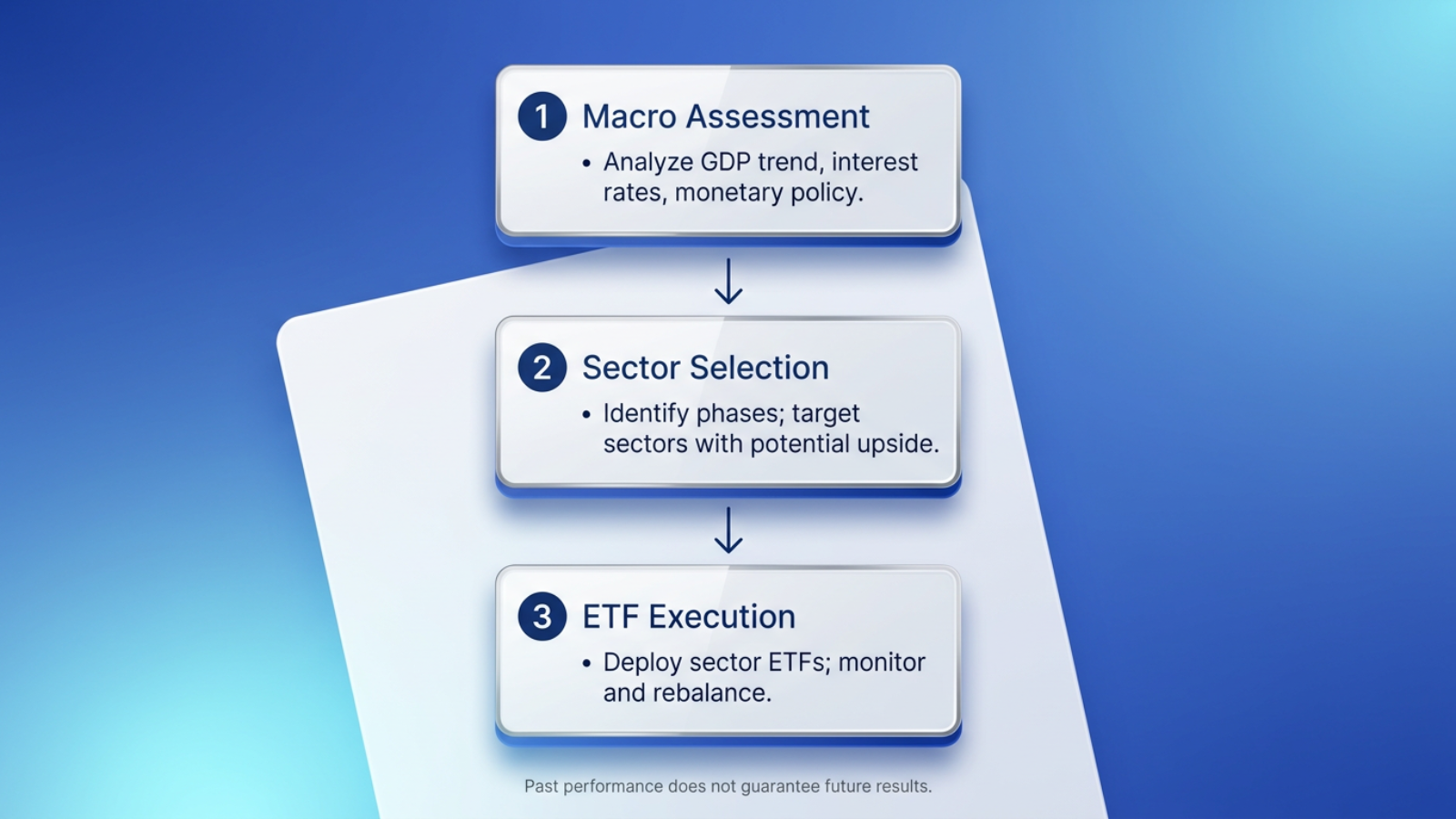
Most sector rotation practitioners begin with a top-down analytical framework: assess the macro environment first — including monetary policy direction, interest rate levels, commodity prices, and key leading indicators — then narrow to sectors likely to benefit from current and near-future conditions.
3.1 Economic-Cycle Strategy
The economic-cycle strategy is the most widely referenced approach. Strategist Sam Stovall of Standard & Poor's described a framework in which the 11 sectors of the S&P 500 are aligned with each stage of the NBER-defined business cycle, each following a predictable performance arc.
Under this framework, investors attempt to rotate into a sector before it reaches peak performance and rotate out before its cycle-driven advantage fades. ETFs make this more practical: instead of constructing a diversified position in dozens of individual stocks, a single sector ETF can provide broad exposure to an entire industry group.
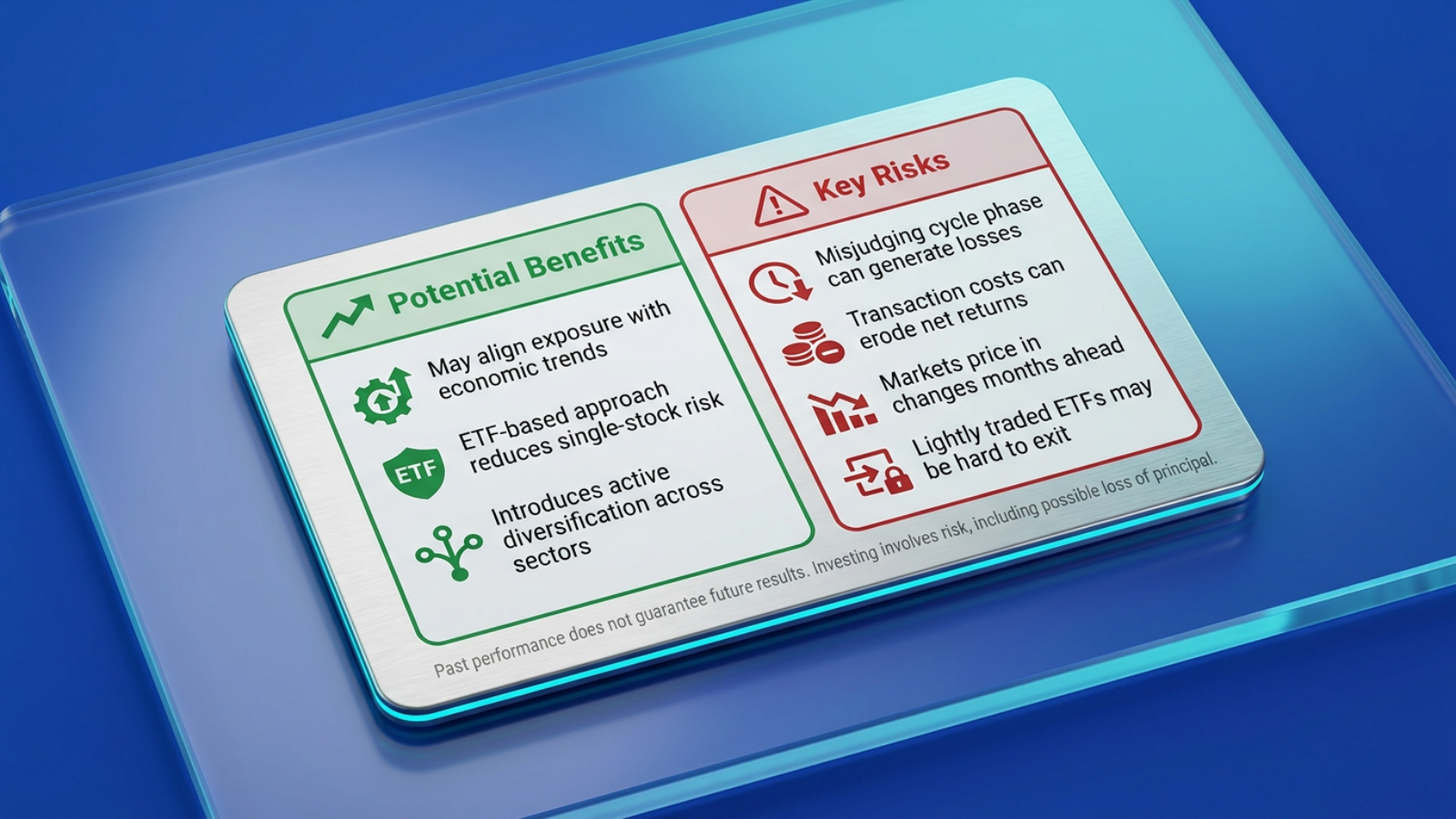
The major limitation is that the economy rarely follows the textbook cycle precisely. Even professional economists frequently disagree on which phase is current. Misjudging the stage of the business cycle can lead to losses rather than gains.
Investopedia — https://www.investopedia.com/articles/exchangetradedfunds/08/sector-rotation.asp
3.2 Calendar and Geographic Strategies
Beyond the economic cycle, two additional approaches exist:
Calendar-based rotation uses seasonal patterns. Retail-focused sectors, for example, may see elevated activity during the back-to-school and holiday seasons. Energy-related sectors may benefit from summer driving demand. ETFs with concentrated exposure to these themes may reflect seasonal tendencies — though seasonality is never guaranteed.
Geographic rotation involves selecting ETFs focused on specific countries or regions that may be experiencing faster economic growth or benefiting from commodity demand cycles. This approach adds international diversification but also introduces currency and geopolitical risk layers that require careful consideration.
Investors combining all three strategies should monitor for unintended sector concentration. Using multiple overlapping ETFs can create larger-than-intended exposure to a single sector or theme.
Part 4. Does Sector Rotation Work? What the Research Shows
The intuitive appeal of sector rotation has not been fully borne out in the academic literature. Two frequently cited studies raise important cautions for investors considering this strategy.
A 2007 paper by economists at Massey University in New Zealand examined US stock returns from 1948 to 2006. The researchers concluded: "Rotating sectors over business-cycles is unlikely to be an optimal investment strategy and question the widespread acceptance of sector rotation as a strategy that provides investors with relative outperformance."
NerdWallet — https://www.nerdwallet.com/investing/learn/sector-rotation
A 2023 study found only "modest outperformance" from sector rotation approaches — and noted that this advantage "quickly diminishes after allowing for transaction costs and incorrectly timing the business cycle."
Investopedia — https://www.investopedia.com/articles/exchangetradedfunds/08/sector-rotation.asp
Key risks investors should understand:
Timing risk: Rotating too early or too late relative to cycle inflections can erode returns significantly.
Cycle misjudgment: No universally agreed-upon method exists for identifying the current cycle phase in real time.
Concentration risk: Combining multiple ETFs can unintentionally overweight a single sector.
Transaction costs: Spreads, regulatory fees, and any applicable commissions reduce net returns from each rotation. To be profitable, a strategy must beat the market by enough to offset all costs.
ETF liquidity risk: Lightly traded sector ETFs may be difficult to exit quickly during volatile market conditions.
Sector rotation ETFs — funds that automate rotation decisions — have also generally underperformed the S&P 500 index in recent periods. The SPDR SSGA US Sector Rotation ETF (XLSR) and the Main Sector Rotation ETF (SECT) are examples that have trailed the broader index.
Past performance does not guarantee future results.
Part 5. How to Research and Execute Sector Rotation on Webull
For US investors who want to explore sector rotation strategies, access to a capable, well-equipped trading platform matters. Webull stands out for its combination of commission-free ETF trading, analytical tools, and broad market access — providing a practical environment for investors implementing sector-based approaches.
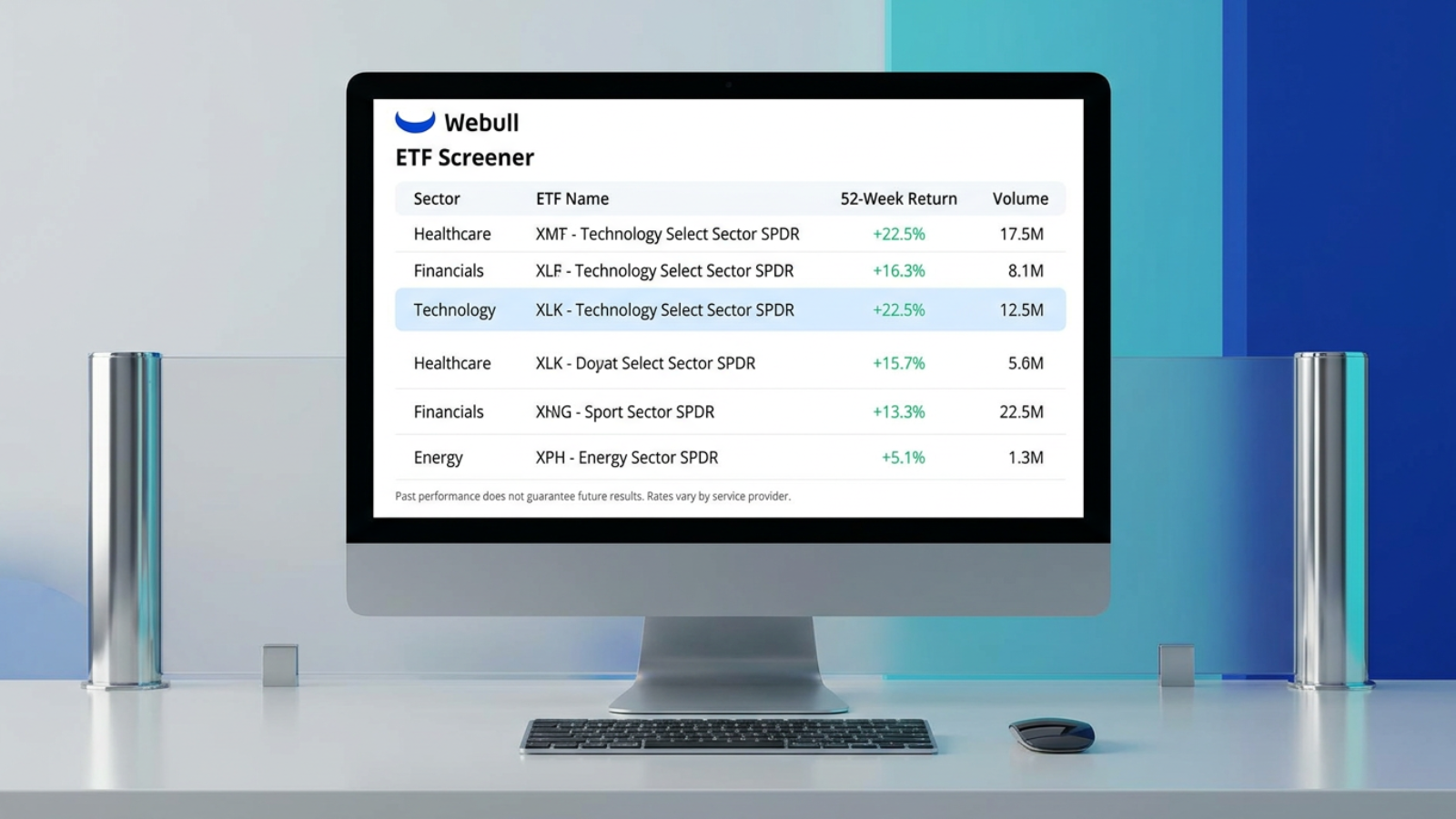
Webull provides access to thousands of US-listed ETFs spanning all 11 GICS sectors. Investors can use Webull's ETF and stock screener to filter by sector, trading volume, expense ratio, and technical indicators. This supports the kind of comparative sector analysis central to a rotation approach.
Webull's charting tools include technical overlays, relative strength comparisons, and customizable watchlists. Monitoring sector momentum — a critical input in rotation timing decisions — is facilitated by the ability to track multiple sector ETFs simultaneously on a single screen.
Explore ETF trading on Webull: ETFs
Commission-free trading on US-listed stocks and ETFs means rotation transactions do not incur per-trade commissions. However, investors should be aware that other costs may apply, including bid-ask spreads, regulatory transaction fees, and margin interest if leverage is used. Rates vary by service provider; please refer to the latest pricing.
The platform integrates real-time market news, analyst ratings, and earnings data, helping investors stay informed about macroeconomic developments and sector-specific catalysts that may signal a cycle transition.
For a full overview of Webull's platform tools and features: https://www.webull.com/
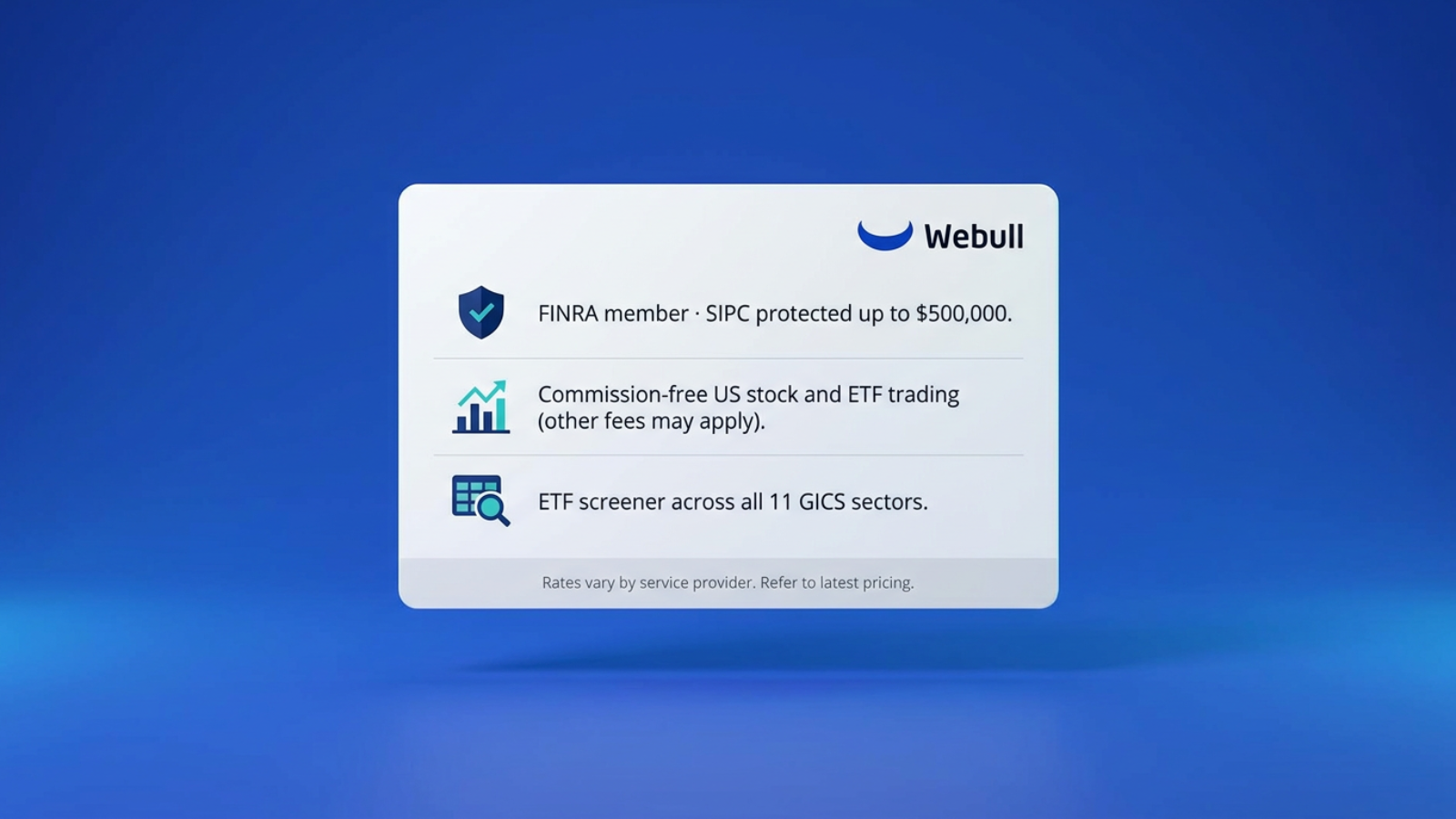
Platform safety and regulatory standing are essential considerations for any US brokerage. Webull Financial LLC is a registered broker-dealer and a member of both FINRA and SIPC. SIPC coverage protects eligible customer accounts up to $500,000 in securities (including up to $250,000 in cash) in the event of brokerage firm failure. SIPC protection does not cover investment losses resulting from market fluctuations. Webull is also subject to oversight by the SEC.
Webull platform overview:
Feature | Details |
|---|---|
Regulatory status | FINRA member, SEC registered |
Account protection | SIPC up to $500,000 (incl. $250,000 cash) |
Stock and ETF commissions | $0 commission (other fees may apply) |
Sector ETF access | Thousands of US-listed ETFs across all 11 GICS sectors |
Research tools | Screener, charting, watchlists, news feed, analyst ratings |
Platform availability | Web, iOS, Android |
Rates vary by service provider; please refer to the latest pricing.
The Bottom Line
Sector rotation is a structured, active approach to equity investing that seeks to align portfolio exposure with the shifting phases of the US business cycle. While the strategy has an intuitive logic, academic research consistently shows it carries significant execution risk and does not reliably outperform simpler strategies after accounting for costs. Investors curious about sector-based ETF trading may find Webull's commission-free platform, analytical tools, and FINRA/SIPC-regulated environment a useful starting point.
Disclosure
Webull Financial LLC (member SIPC, FINRA) offers self-directed securities trading. All investments involve risk. More info: https://www.webull.com/policy
The information provided does not constitute investment advice and it should not be relied on as such. It should not be considered a solicitation to buy or an offer to sell a security. It does not take into account any investor's particular investment objectives, strategies, tax status or investment horizon. Investing involves risk, including the risk of loss of principal.
