'%3e %3cpath d='M41.7832962%2c0 C41.9459106%2c0 42.0882746%2c0.0866854658 42.1666825%2c0.216359069 C43.8289923%2c2.66540836 44.7676281%2c5.46271319 44.7676281%2c8.43208061 C44.7676281%2c18.1345746 34.7460532%2c26 22.383814%2c26 C10.0215749%2c26 0%2c18.1345746 0%2c8.43208061 C0%2c5.46716016 0.935826425%2c2.67378733 2.58829888%2c0.223985685 C2.67109477%2c0.0916264068 2.81687473%2c0 2.9840593%2c0 C3.23130408%2c0 3.43173558%2c0.200393004 3.43173558%2c0.447590303 C3.43173558%2c0.475056669 3.42926112%2c0.501945205 3.42452292%2c0.528045226 L3.41810883%2c0.550292077 C3.37800671%2c0.861741908 3.3575721%2c1.17661276 3.3575721%2c1.49443092 C3.3575721%2c7.98336 11.2132389%2c12.5742305 22.383814%2c12.5742305 C33.5543891%2c12.5742305 41.410056%2c7.98336 41.410056%2c1.49443092 C41.410056%2c1.17865223 41.3898828%2c0.865783153 41.3502888%2c0.556288325 C41.3402868%2c0.521941442 41.3356199%2c0.48531078 41.3356199%2c0.447590303 C41.3356199%2c0.200393004 41.5360514%2c0 41.7832962%2c0 Z' id='logo%e5%a4%87%e4%bb%bd-6' fill='white'%3e%3c/path%3e %3cpath d='M74.6899231%2c3.74404927 C75.2411227%2c3.74404927 75.7734299%2c3.66184338 76.2756219%2c3.50883715 L73.8159676%2c20.8666902 C73.5770593%2c22.5662954 72.8072434%2c23.0518969 71.4268838%2c23.0518969 L69.9934336%2c23.0518969 C68.7988917%2c23.0518969 68.1618027%2c22.458384 67.7901674%2c20.893668 L65.6930827%2c11.9909739 C65.639992%2c11.7481731 65.639992%2c11.6942174 65.5338105%2c11.6942174 C65.427629%2c11.6942174 65.4010836%2c11.7481731 65.3479929%2c11.9909739 L63.2509082%2c20.893668 C62.8792729%2c22.458384 62.2421839%2c23.0518969 61.047642%2c23.0518969 L59.6141918%2c23.0518969 C58.2338322%2c23.0518969 57.4640163%2c22.5662954 57.225108%2c20.8666902 L54.7463723%2c3.37406084 C55.3593498%2c3.61307396 56.0249975%2c3.74404927 56.7207458%2c3.74404927 C57.3314263%2c3.74404927 57.918917%2c3.64314414 58.4679557%2c3.4568446 L60.3574623%2c19.3829078 C60.3840076%2c19.6257086 60.3840076%2c19.7875757 60.4901891%2c19.7875757 C60.5963706%2c19.7875757 60.5963706%2c19.6257086 60.6494614%2c19.3829078 L62.9323637%2c9.91367858 C63.0916359%2c9.26620991 63.4632712%2c8.69967483 64.6047223%2c8.69967483 L66.4363532%2c8.69967483 C67.5778044%2c8.69967483 67.9494397%2c9.26620991 68.1087119%2c9.91367858 L70.3916142%2c19.3829078 C70.4447049%2c19.6257086 70.4447049%2c19.7875757 70.5508864%2c19.7875757 C70.6570679%2c19.7875757 70.6570679%2c19.6257086 70.6836133%2c19.3829078 L72.5891207%2c3.32292288 C73.2365902%2c3.59432921 73.9460524%2c3.74404927 74.6899231%2c3.74404927 Z' id='Combined-Shape' fill='white'%3e%3c/path%3e %3cpath d='M84.5933901%2c7.43171536 C88.6813779%2c7.43171536 90.9111894%2c10.2643908 90.9111894%2c14.2840921 L90.9111894%2c15.7948523 C90.9111894%2c16.2264981 90.7519172%2c16.4692988 90.3802819%2c16.4692988 L81.7264895%2c16.4692988 L81.7264895%2c16.5502324 C81.7264895%2c18.1149484 82.3635785%2c19.9764208 84.9119346%2c19.9764208 C86.849747%2c19.9764208 88.6813779%2c19.8145536 89.7962837%2c19.7066422 L89.8759198%2c19.7066422 C90.1413735%2c19.7066422 90.3537366%2c19.8415315 90.3537366%2c20.1113101 L90.3537366%2c21.8918489 C90.3537366%2c22.3234947 90.2741004%2c22.5123397 89.7962837%2c22.5932733 C88.0708343%2c22.9170076 87.0355646%2c23.0518969 84.6464808%2c23.0518969 C81.9919433%2c23.0518969 78.2225%2c21.5950924 78.2225%2c16.2804538 L78.2225%2c14.2840921 C78.2225%2c10.0755457 80.5319476%2c7.43171536 84.5933901%2c7.43171536 Z M84.5933901%2c10.5071915 C82.9475768%2c10.5071915 81.7530349%2c11.6942174 81.7530349%2c13.8254684 L81.7530349%2c13.9333799 L87.3806545%2c13.9333799 L87.3806545%2c13.8254684 C87.3806545%2c11.7211953 86.2392034%2c10.5071915 84.5933901%2c10.5071915 Z' id='Combined-Shape' fill='white'%3e%3c/path%3e %3cpath d='M97.4154906%2c2.98826245 L97.4148064%2c7.62056039 C98.3969853%2c7.48567108 99.3260735%2c7.43171536 99.9631625%2c7.43171536 C104.236968%2c7.43171536 106.307507%2c9.99461216 106.307507%2c14.2031585 L106.307507%2c16.2804538 C106.307507%2c20.4890001 104.236968%2c23.0518969 99.9631625%2c23.0518969 C98.2642584%2c23.0518969 96.2733553%2c22.7821183 94.627542%2c22.3504725 C94.0169984%2c22.1886054 93.9108169%2c22.0267382 93.9108169%2c21.6220703 L93.9098179%2c3.08694115 C94.4185466%2c3.24434375 94.9584615%2c3.32900525 95.5178331%2c3.32900525 C96.184659%2c3.32900525 96.8238351%2c3.20869291 97.4154906%2c2.98826245 Z M99.9631625%2c10.3453244 C99.3260735%2c10.3453244 98.1580769%2c10.4262579 97.4148064%2c10.5341694 L97.4148064%2c19.9494429 C97.9191686%2c20.0573544 99.007529%2c20.1382879 99.9631625%2c20.1382879 C102.246065%2c20.1382879 102.803518%2c18.4926384 102.803518%2c16.2804538 L102.803518%2c14.2031585 C102.803518%2c11.9909739 102.246065%2c10.3453244 99.9631625%2c10.3453244 Z' id='Combined-Shape' fill='white'%3e%3c/path%3e %3cpath d='M111.036668%2c8.72457747 C111.579488%2c8.72457747 112.103987%2c8.64485191 112.599444%2c8.49629404 L112.598761%2c16.5232546 C112.598761%2c19.3289521 113.607485%2c19.9764208 115.147117%2c19.9764208 L115.306389%2c19.9764208 C116.846021%2c19.9764208 117.854746%2c19.3289521 117.854746%2c16.5232546 L117.854207%2c8.4334735 C118.406525%2c8.62226395 118.997939%2c8.72457747 119.612866%2c8.72457747 C120.223332%2c8.72457747 120.810625%2c8.62374317 121.359498%2c8.43756894 L121.358735%2c16.5232546 C121.358735%2c22.4044283 116.872567%2c23.0518969 115.306389%2c23.0518969 L115.060464%2c23.0512514 C113.42215%2c23.0271041 109.094772%2c22.2994073 109.094772%2c16.5232546 L109.094446%2c8.36700801 C109.698522%2c8.59813531 110.353066%2c8.72457747 111.036668%2c8.72457747 Z' id='Combined-Shape' fill='white'%3e%3c/path%3e %3cpath d='M128.314162%2c3.03790128 L128.313623%2c22.269539 C128.313623%2c22.5662954 128.10126%2c22.836074 127.809261%2c22.836074 L125.340541%2c22.836074 C125.048542%2c22.836074 124.809634%2c22.5662954 124.809634%2c22.269539 L124.809455%2c3.04219481 C125.358161%2c3.22824247 125.945253%2c3.32900525 126.555503%2c3.32900525 C127.17043%2c3.32900525 127.761844%2c3.22669173 128.314162%2c3.03790128 Z' id='Combined-Shape' fill='white'%3e%3c/path%3e %3cpath d='M133.90653%2c3.32900525 C134.473329%2c3.32900525 135.02015%2c3.24208064 135.534793%2c3.08063296 L135.533966%2c22.269539 C135.533966%2c22.5662954 135.321603%2c22.836074 135.029603%2c22.836074 L132.560884%2c22.836074 C132.268884%2c22.836074 132.029976%2c22.5662954 132.029976%2c22.269539 L132.029909%2c2.99605058 C132.615669%2c3.21152525 133.2476%2c3.32900525 133.90653%2c3.32900525 Z' id='Combined-Shape' fill='white'%3e%3c/path%3e %3c/g%3e %3c/g%3e %3c/g%3e%3c/svg%3e)



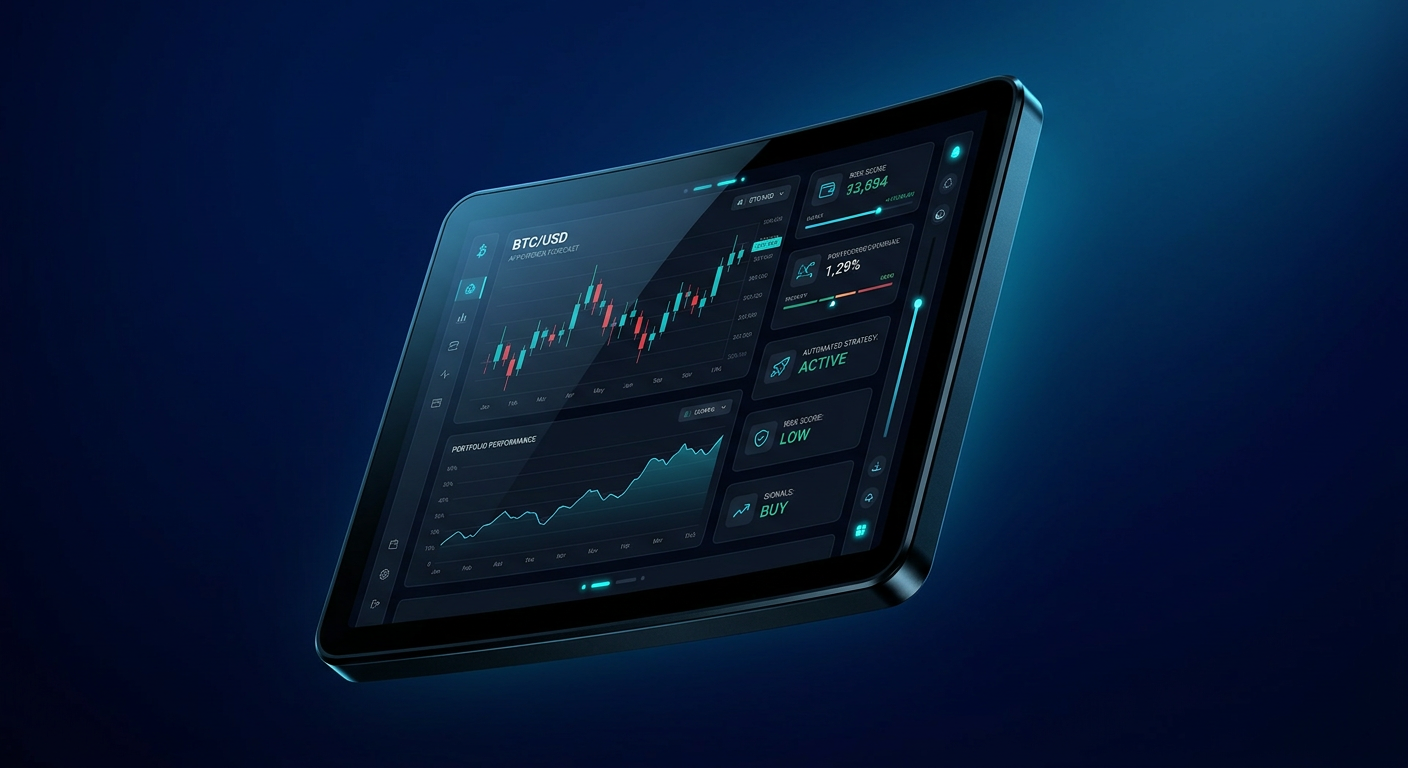
The rise of AI crypto trading bots has introduced a new layer of automation for traders who want structured, repeatable execution without staring at screens around the clock. These systems use machine learning, real-time data analysis, and preconfigured rules to identify patterns and place trades — but they are not a shortcut to guaranteed profits. As platforms like Webull expand their offerings to include agentic trading capabilities that let users connect AI assistants directly to brokerage accounts, understanding how these tools work, where they add value, and what risks they carry has never been more relevant.
Key Takeaways
AI crypto trading bots automate entries, exits, and position sizing using algorithms — some of which incorporate machine learning to adapt to shifting market conditions.
Bots operate 24/7 and remove emotional decision-making, but they do not create a trading edge on their own and require active human oversight.
Webull's Agentic Trading platform lets users connect AI agents like ChatGPT or Claude to their brokerage account for research, portfolio management, and trade execution with built-in safety controls.
Third-party platforms such as Cryptohopper, Pionex, and 3Commas each offer distinct approaches ranging from strategy marketplaces to plain-English bot configuration.
Security is critical: always use trade-only API keys, enable two-factor authentication, and regularly audit connected applications.
Investing and trading involve risk, including the possible loss of principal. Past performance does not guarantee future results.
Part 1. What Are AI Crypto Trading Bots and How Do They Work
1.1 Defining AI-Powered Trading Automation
Crypto AI trading bots are software programs that use mathematical models, machine learning algorithms, and automation to execute trading strategies on behalf of users. Unlike traditional pre-programmed algorithms that follow a fixed script, AI-driven bots can analyze large volumes of market data, identify patterns, and adjust their approach as conditions change.
As Kraken explains in its educational guide, AI-driven trading bots represent an upgrade over conventional automated systems because they can "learn from new data, adjust strategies on the fly, and predict market movements with greater accuracy." This adaptability is especially relevant in cryptocurrency markets, which operate 24/7 and can experience rapid shifts in volatility and sentiment.
1.2 The Trading Bot Workflow: From Data to Decision
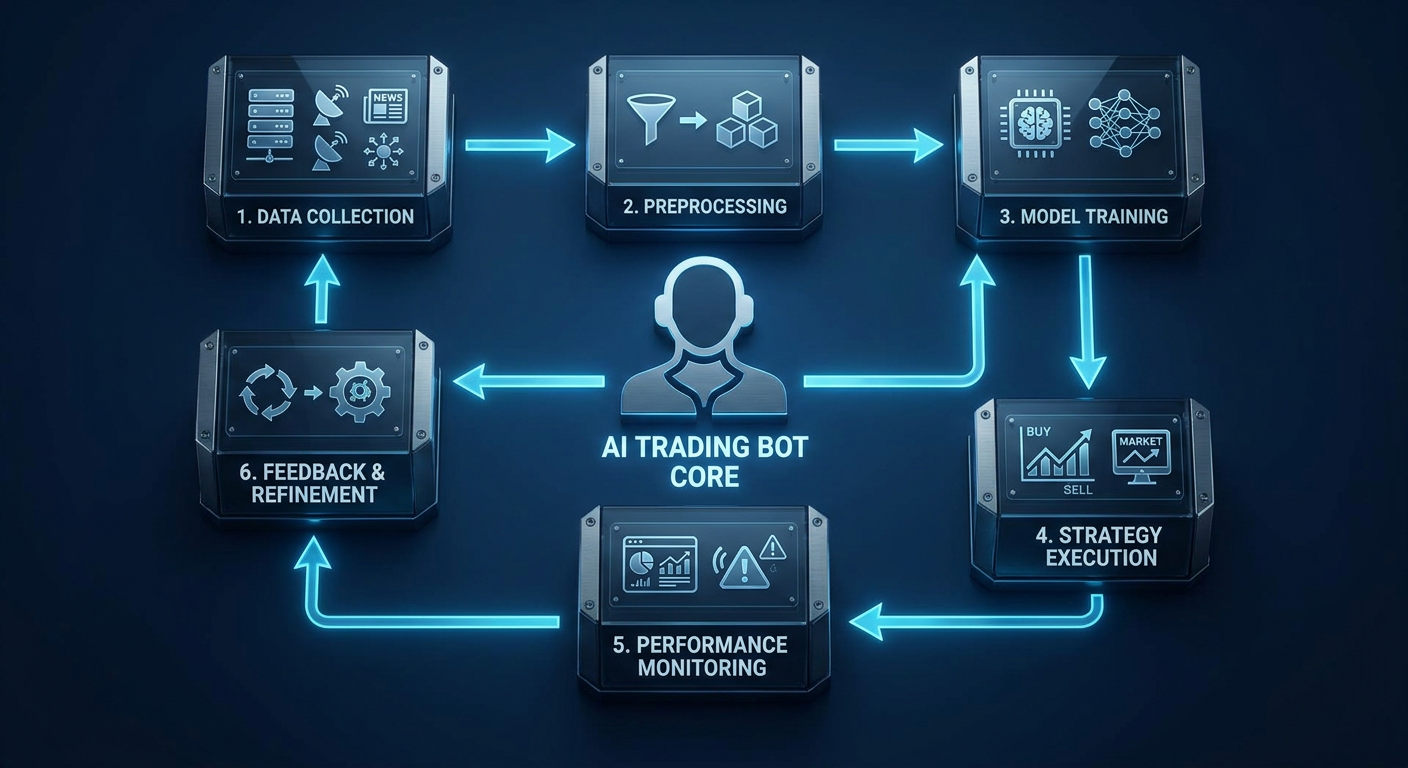
AI trading bots follow a repeatable loop that turns market data into decisions and then into orders. Coin Bureau's analysis describes this process as an assembly line where each stage performs one job before handing the result forward:
Data → Analysis/Model → Signal → Execution → Monitoring → Feedback
Data: Raw inputs such as price feeds, order books, volume, funding rates, and on-chain metrics. If the data is delayed or noisy, every downstream step suffers.
Analysis/Model: The system processes data through indicators, statistical models, or machine learning to identify patterns and probabilities.
Signal: A clear instruction — buy, sell, hold, or adjust position size — often with confidence thresholds.
Execution: The bot sends orders to the exchange, selecting order types, timing, and routing to manage slippage and fees.
Monitoring: Tracks open positions, fills, latency, and errors to ensure behavior matches expectations.
Feedback: Performance data flows back into the system to refine parameters, update models, or shut the strategy down if conditions change.
1.3 What AI Can and Cannot Do in Trading
It is important to understand the limits of AI in trading. As Coin Bureau notes, AI bots "optimize around historical patterns. When regimes change, performance can degrade quickly unless you pause, retest, or reconfigure." These systems learn from observed data; when markets behave in unfamiliar ways, outputs can become unreliable.
What AI trading bots can do:
Run 24/7 across multiple markets simultaneously
Remove emotional bias from execution decisions
Handle complex workflows like dollar-cost averaging (DCA), grid trading, and multi-order strategies
Process large datasets faster than any human trader
What AI trading bots cannot do:
Predict sudden market crashes or black swan events
Guarantee profits in any market condition
Create a trading edge on their own — a poor strategy executed faster is still a poor strategy
Replace the need for human oversight and risk management
Authorities including NIST's AI Risk Management Framework and the EU's AI Act emphasize that human oversight, testing, and monitoring remain essential when deploying AI in financial contexts. This content is educational and informational in nature and does not constitute personalized investment advice.
Part 2. How to Access AI Trading Through Your Brokerage Account — Spotlight on Webull Agentic Trading
2.1 What Is Webull Agentic Trading and How It Differs
Webull's Agentic Trading platform takes a distinct approach to AI-assisted trading. Rather than offering pre-packaged trading bots, it allows users to connect their own AI agents — such as ChatGPT, Claude, or any MCP-compatible (Model Context Protocol) assistant — directly to their Webull brokerage account. This means your AI agent can research markets, read your portfolio, and draft trade instructions in plain language, all within a controlled environment.
This model differs from traditional bot platforms in a few key ways. Most third-party bots require you to connect exchange accounts via API keys to an external service. Webull's approach keeps everything within the brokerage ecosystem. Your AI agent interacts with your account through a secure OAuth connection — your Webull credentials are never shared with or stored by the AI provider.
2.2 Key Capabilities of Webull Agentic Trading
The platform supports several core functions designed to integrate AI into your existing trading workflow:
Track the markets: Live prices, charts, and depth on demand. Ask your AI agent for a snapshot, the last five days of price action, or what is moving today.
Research and decide: Pull company profiles, analyst ratings, and price targets so your agent can reason with real market context before suggesting any action.
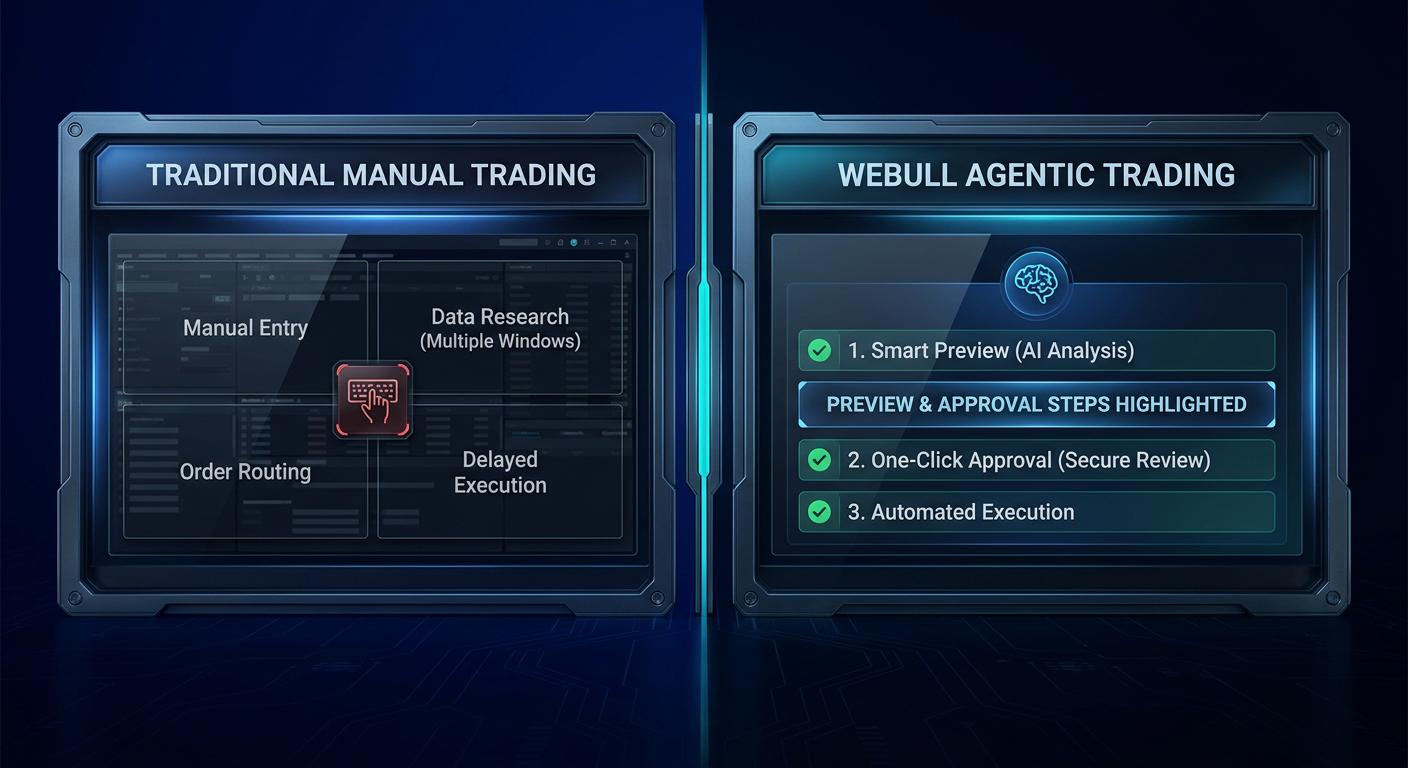
Place trades: Buy, sell, modify, or cancel orders — with a mandatory preview step before anything goes live. The platform supports equities, options, futures, event contracts, and crypto.
Manage your portfolio: Check balances, buying power, and positions in seconds without switching tabs or maintaining separate spreadsheets.
2.3 Safety Controls Built Into the Platform
Webull emphasizes that users remain in control at all times. Several guardrails are built into the agentic trading experience:
Preview every order: Your agent shows order details before anything is submitted for execution. No trade goes live without your review.
Optional read-only mode: Allow your agent to watch and research without placing any trades — useful for testing and confidence-building.
Set hard limits: Cap order size and value, or restrict trading to a list of symbols you choose, reducing the risk of unintended exposure.
Disconnect anytime: The connection uses secure OAuth authorization. Users can unlink their agent instantly with one click.
2.4 Getting Started with Webull Agentic Trading
Setting up the platform involves three steps:
Add Webull to your agent: Paste the Webull MCP server URL into your AI agent, or find Webull in your AI connector's directory.
One-time authorization: Tap to connect and log in with your Webull credentials. The connection is secured by OAuth, so credentials remain with Webull.
Call Webull to work with your agent: Start a live session — your agent is ready to assist with market research, portfolio checks, and trade previews.
For users who prefer local deployment, Webull also provides a Local MCP option that runs on the user's own machine via uvx, with keys staying on-device, making it suitable for environments like Claude Code, Cursor, and Codex. Ready-made Agent Skills and a CLI for headless automation are also available.
Learn more about automated trading tools on the Webull platform. Explore crypto trading features available through Webull.
Risk disclosure: All trading involves substantial risk of loss. AI-driven agents may misinterpret instructions, act on delayed data, or perform poorly under certain market conditions. Webull assumes no liability for losses resulting from automated or AI-directed decisions. Users are solely responsible for verifying all order details prior to execution and actively monitoring their positions. This information is educational in nature and not a recommendation to buy or sell any cryptocurrency.
Part 3. Comparing Leading Third-Party AI Crypto Trading Bot Platforms
3.1 Overview of the Bot Platform Landscape
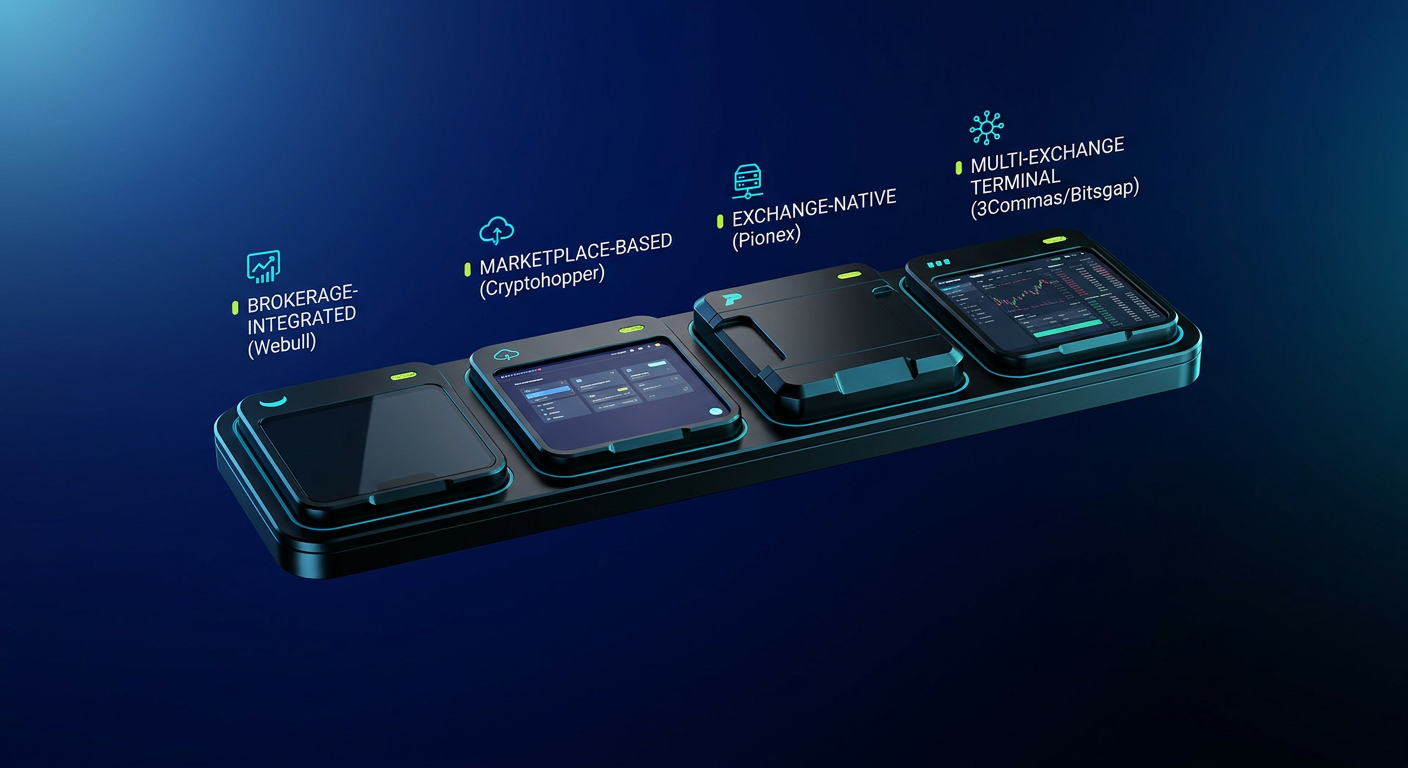
For traders who prefer third-party automation tools, several established platforms offer AI-enhanced crypto trading bots with varying approaches, pricing models, and feature sets. The following comparison is based on publicly available information as of mid-2026. Webull does not endorse any third-party services mentioned.
Platform | Key AI Feature | Best For |
|---|---|---|
Webull Agentic Trading | Connect your own AI agent (ChatGPT, Claude) via MCP | Traders who want AI integrated with their brokerage account |
Cryptohopper | Algorithm Intelligence for strategy rotation | Marketplace users who switch strategies frequently |
Pionex | PionexGPT for plain-English bot configuration | Beginners wanting built-in bots with low overhead |
3Commas | AI trading bot and assistant for SmartTrade suggestions | Multi-exchange traders with structured entry/exit flows |
Bitsgap | AI Assistant suggests bot configurations | Multi-exchange terminal users |
Coinrule | AI Trading for adaptive optimization | No-code rule builders |
HaasOnline | HaasScript for full scripting control | Advanced traders and developers |
Note: Pricing sourced from respective platform websites as of July 14, 2026. Fees and features may change. Always verify current pricing directly with each provider.
3.2 Cryptohopper: Strategy Marketplace and Algorithm Intelligence
Cryptohopper operates as a cloud-based platform that combines a visual Strategy Designer, a curated marketplace of strategies and signals, and social trading features. Its standout AI capability is Algorithm Intelligence, which scores strategies using inputs such as trend strength, volatility, and volume, then rotates the active strategy based on market conditions.
According to Cryptohopper's website, the platform serves over 1.15 million registered users. Funds remain in the user's exchange account, with Cryptohopper connecting via trade-only API keys. Supported exchanges include Binance, Bybit, OKX, Coinbase Advanced, Kraken, and KuCoin.
Potential drawbacks: Marketplace strategies and copy trading can diverge from a user's risk profile, and users need to actively review strategy performance rather than adopting a set-and-forget approach.
3.3 Pionex: Built-In Bots with Natural Language Configuration
Pionex is an exchange with trading bots built directly into the platform, eliminating the need for separate hosting or API connections to external services. Its PionexGPT feature lets users type plain-English prompts — such as "build a grid for BTC within a 2% band and add a stop loss" — to generate bot configurations with suggested parameters.
Core bot types include grid trading, DCA, infinity grid, and signal-following tools. Pionex does not charge a separate subscription for its bots; users pay only trading fees (spot at 0.05% per trade, as listed on the Pionex fee schedule).
Potential drawbacks: Bots execute only on the Pionex exchange, so users who trade across multiple venues may find this limiting. Advanced traders seeking cross-exchange routing or custom execution logic may prefer more flexible platforms.
3.4 3Commas: Multi-Exchange Control with SmartTrade
3Commas provides a unified SmartTrade workspace that centralizes DCA bots, grid bots, and TradingView alert routing across multiple exchanges. Its AI trading bot and assistant analyze trend and volatility data to propose entries, risk settings, and targets for user review before launch.
The platform experienced a security incident in December 2022 when some users' API data was disclosed, prompting 3Commas to overhaul its security architecture. API keys are no longer stored in readable format on external servers, replaced by an isolated Sign Center and asymmetric cryptography. This incident underscores why trade-only API keys, two-factor authentication, and IP allow lists remain essential security practices regardless of the platform chosen.
3.5 Quick Selection Guide
Choose Webull Agentic Trading if you want AI integrated directly with your brokerage account, with built-in preview and permission controls.
Choose Cryptohopper if you value a strategy marketplace, copy trading, and automated strategy rotation based on market conditions.
Choose Pionex if you want built-in bots with no separate subscription and the ability to configure strategies using plain English.
Choose 3Commas if you need multi-exchange management with structured SmartTrade workflows and signal routing.
Choose Bitsgap if you trade on many exchanges and want a unified terminal with AI-assisted bot configuration.
Choose HaasOnline if you need developer-grade customization with full scripting control.
Part 4. Security, Risk Management, and Responsible Use of AI Trading Bots
4.1 Understanding the Security Landscape
AI trading bots require exchange or brokerage API access, which introduces an expanded attack surface. An API key with broad permissions can allow unauthorized trades or, in worst-case scenarios, fund transfers if withdrawal permissions are enabled.
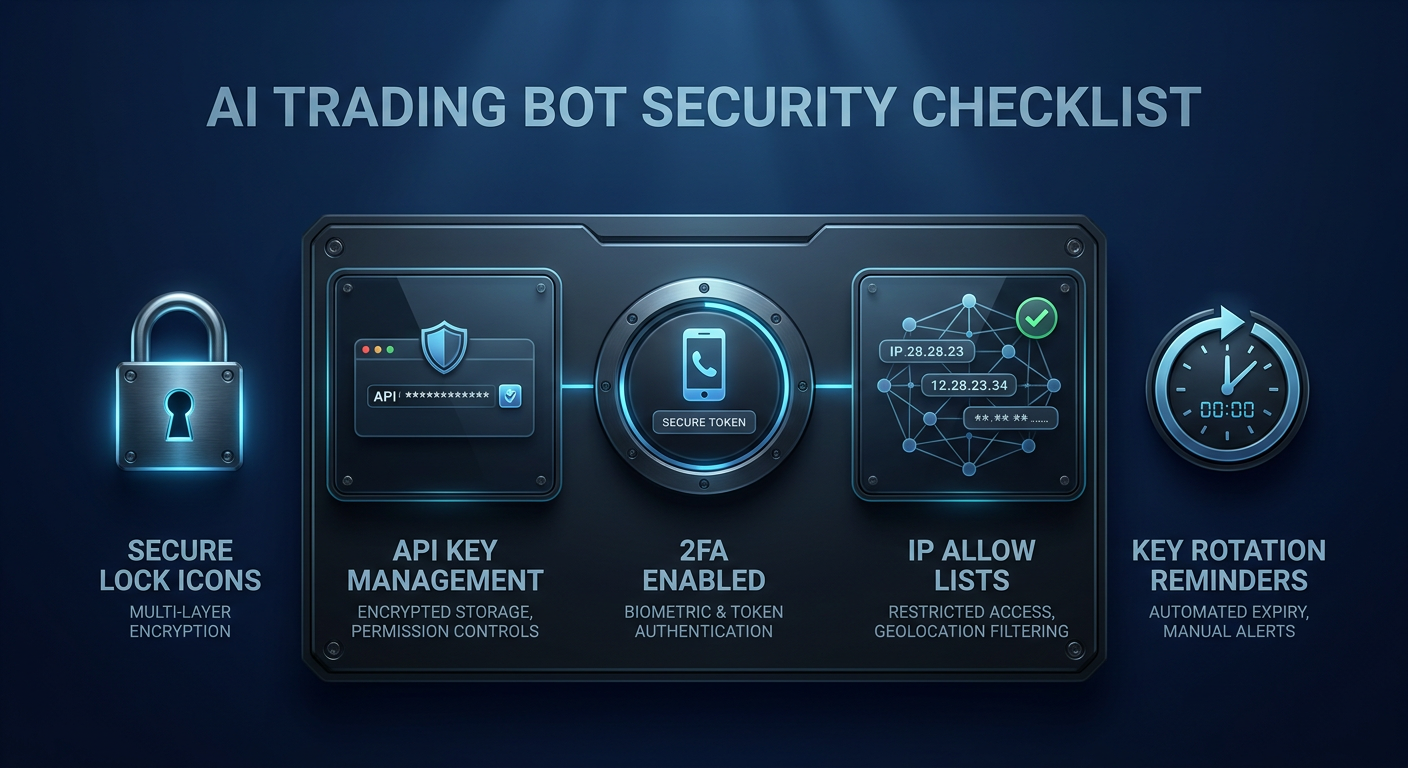
The core principle is simple: limit what a key can do, limit where it can be used, and rotate or revoke keys at the first sign of risk. Key security practices include:
Trade-only API keys: Never enable withdrawal permissions on keys used for trading automation. This is the single most important security control.
Two-factor authentication (2FA): Enable 2FA on both the bot platform account and the exchange account.
IP allow lists: Where supported by the exchange, restrict API key usage to approved IP addresses.
Separate read-only keys: Use distinct keys with read-only permissions for monitoring dashboards that do not need trading access.
Regular audits and key rotation: Review connected applications monthly and revoke any unused or suspicious permissions.
4.2 Platform Safety: How Different Solutions Handle Security
Webull's Agentic Trading platform uses OAuth-based authorization, meaning the user's Webull credentials are never shared with or stored by the third-party AI provider. Users can disconnect their AI agent instantly at any time. The read-only mode and hard limits on order size and symbol lists provide additional layers of protection against unintended trading activity.
For third-party platforms, Cryptohopper states it works closely with exchanges and regulators and uses industry-standard security protocols. Stoic AI emphasizes that it connects via read-and-trade API keys only, with no withdrawal access, and stores API keys in an encrypted system with regular audits.
4.3 Common Pitfalls and How to Avoid Them
Coin Bureau identifies several pitfalls that traders should be aware of when using AI trading bots:
Overfitting: Too many parameters, very short test windows, or a perfectly smooth equity curve during backtesting are red flags. Validate strategies on out-of-sample data.
Revenge parameter tweaks: Adjusting bot settings after a loss without a clear rationale can compound problems. Document every change.
Ignoring fees: Trading fees, funding rates on derivatives, and slippage can erode results that looked profitable in backtests.
Leverage creep: Derivatives introduce additional risk through leverage and liquidation. Start small and apply strict risk management before scaling.
4.4 Responsible Use Guidelines
Automation does not replace oversight. Treat a trading bot like a pilot on instruments — define the route, watch the gauges, and step in when something looks wrong.
Practical risk management steps include:
Define position sizing rules and a maximum daily loss before going live
Set up alerts for fills, errors, and drawdowns
Keep a trading journal to log every change
Withdraw profits on a schedule rather than letting all capital compound within the automated system
Have a contingency plan for outages that covers exchange API limits and failover steps
The Commodity Futures Trading Commission (CFTC) has cautioned the public about fraudulent schemes that exploit interest in AI trading, including Ponzi schemes disguised as AI-driven trading bots. Always verify claims independently and avoid platforms promising guaranteed or unusually high returns.
Risk disclosure: Investing and trading in cryptocurrencies and other securities involves substantial risk, including the possible loss of principal. AI trading bots and automated systems can fail, produce unexpected results, and amplify losses. Past performance, whether of a strategy or a platform, does not guarantee future results. This content is for educational purposes only and does not constitute investment advice, a recommendation, or a solicitation to buy or sell any cryptocurrency.
Part 5. How to Choose the Right AI Trading Tool for Your Goals
5.1 Defining Your Goals and Risk Tolerance
The right tool depends on what you are trying to achieve and how much risk you are willing to accept. Before selecting any platform, clarify these factors:
Time horizon: Short-term traders who want frequent trade execution need tighter controls and faster review cycles than long-term investors using automation for slow accumulation.
Market type: Spot trading avoids leverage and is simpler for beginners. Futures enable directional views but add complexity and liquidation risk.
Involvement level: Decide if you want a hands-on setup that you actively monitor or a more hands-off routine. Regardless of preference, no AI trading bot should be treated as truly set-and-forget.
5.2 Matching Strategies to Market Conditions
Different automated strategies perform differently depending on market conditions:
Ranging markets: Grid trading places layered buy and sell orders within a defined price band, suited to sideways price action.
Accumulation phases: Dollar-cost averaging (DCA) spreads entries over time and reduces the pressure to find a perfect entry price.
Price gaps across venues: Arbitrage strategies look for small price differences across exchanges but are sensitive to fees and latency.
5.3 Evaluating Platform Fit
When assessing any AI trading platform, review these dimensions:
Exchange and account support: Confirm that your preferred venues are supported. For brokerage-based solutions like Webull Agentic Trading, verify that your account type supports the features you need.
Fees and transparency: Check not just subscription costs but also trading fees, spreads, and any hidden costs. Free bots can still incur trading fees on the underlying exchange.
Automation depth and usability: Look for a workflow you can operate without confusion. A clear interface reduces costly configuration errors.
Security controls: Prefer platforms that support trade-only keys, two-factor authentication, and IP allow lists. For brokerage integrations, OAuth-based connections that do not share credentials are preferable.
Backtesting and demo features: Validate strategies with historical data and rehearse with paper trading or read-only modes before committing real capital.
5.4 Performance Metrics That Matter
When evaluating a bot's backtest or live performance, Coin Bureau recommends tracking a small set of metrics together rather than relying on any single number:
Sharpe Ratio: Measures risk-adjusted return — a higher value suggests more return per unit of volatility.
Maximum Drawdown: The largest peak-to-trough decline, showing worst-case historical pain and recovery time.
Win Rate: The percentage of profitable trades — but pair this with drawdown and profit factor, as a high win rate can hide a few very large losses.
Profit Factor: Gross profits divided by gross losses. Values above 1.0 indicate net profitability over the tested period.
A strategy that shows very high returns but also severe drawdowns may have relied on a few outsized, lucky trades. Validate results across multiple market regimes — trending, ranging, and high-volatility periods — before trusting the numbers.
Learn more about Webull's trading tools and how they compare. For additional educational resources on risk management, visit the Webull Learn Center.
Frequently Asked Questions About AI Crypto Trading
Can AI trading bots make consistent profits in crypto markets?
No trading approach, including AI-driven bots, can guarantee consistent profits. AI bots execute strategies based on historical patterns and real-time data, but they cannot predict market crashes or regime changes. According to Coin Bureau, "bots automate execution and discipline. They do not create an edge by themselves." All trading involves the risk of loss, and past performance does not guarantee future results.
How is Webull's Agentic Trading different from traditional crypto trading bots?
Webull Agentic Trading lets users connect their own AI assistant — such as ChatGPT or Claude — directly to their Webull brokerage account via a secure MCP-based connection. Unlike third-party bots that require API keys to external exchanges, Webull uses OAuth authorization, meaning credentials stay with Webull. Every trade requires a preview and user approval, and users can set hard limits on order size and tradable symbols, or use read-only mode for research without trading.
Do I need to know how to code to use an AI trading bot?
Not necessarily. Platforms like PionexGPT allow users to type plain-English instructions to configure bots, and Cryptohopper offers a visual Strategy Designer with drag-and-drop indicator rules. Webull Agentic Trading uses natural language interactions through connected AI assistants like ChatGPT or Claude. However, platforms like HaasOnline and custom-built bots require programming knowledge.
What are the biggest risks of using an AI crypto trading bot?
Key risks include API key exposure if security best practices are not followed, strategy failure during unfamiliar market conditions, overfitting during backtesting that inflates expectations, and scams that promise unrealistic returns. The CFTC has warned about fraudulent schemes exploiting interest in AI trading. Always use trade-only API keys, enable 2FA, and test strategies in paper trading or read-only modes before committing real capital.
How much does it cost to use an AI crypto trading bot?
Costs vary widely. Third-party platforms range from free tiers (Cryptohopper Pioneer, Coinrule Starter) to premium plans exceeding $100 per month. Exchange-native bots like Pionex charge no subscription but collect trading fees. Subscription-based services like Stoic AI charge monthly fees based on portfolio size, starting around $24 per month. Webull Agentic Trading is available to Webull account holders, though standard trading commissions and fees may apply. Always review the full fee schedule of any platform before committing capital.
Can I use an AI trading bot with my existing brokerage account?
It depends on the brokerage. Webull supports AI integration through its Agentic Trading platform, which connects to ChatGPT, Claude, and other MCP-compatible agents. Most traditional crypto trading bots connect to cryptocurrency exchanges like Binance, Coinbase, and Kraken via API keys rather than to brokerage accounts. Review your platform's capabilities and security settings before connecting any third-party service.
Is my money safe when using an AI trading bot?
Funds typically remain in your exchange or brokerage account rather than with the bot provider. Reputable platforms use trade-only API keys (no withdrawal access), encrypted key storage, and OAuth-based connections. Webull's Agentic Trading never shares credentials with the AI provider and lets you disconnect instantly. Stoic AI explicitly states it cannot withdraw funds. Regardless of the platform, never grant withdrawal permissions to any automation service, and regularly audit connected applications.
What should I look for when choosing an AI crypto trading platform?
Evaluate exchange support, fee transparency, security controls (trade-only keys, 2FA, IP allow lists), the availability of paper trading or demo modes, and whether the platform's strategy types match your trading goals. Look for platforms with a verifiable track record, identifiable company information, and clear documentation. Be wary of services that promise guaranteed returns or use exaggerated claims — the SEC and CFTC caution against such marketing.
The Bottom Line
AI crypto trading bots can help automate execution and maintain discipline, but they are tools — not guarantees. Whether you explore brokerage-integrated options like Webull Agentic Trading or third-party platforms, start with small capital, test in safe environments, and never outsource your risk management. The most important control in any automated trading system remains your own judgment.
Disclosure: This content is for educational and informational purposes only and does not constitute investment advice, a recommendation, or a solicitation to buy or sell any security. All investing and trading involves risk, including the possible loss of principal. Past performance, whether of a strategy, platform, or market, does not guarantee future results. AI-driven trading systems may misinterpret instructions, act on delayed data, or perform unexpectedly under certain market conditions. You are solely responsible for verifying all order details, actively monitoring your positions, and ensuring any connected tools operate as intended. Webull does not endorse any third-party products or services mentioned in this article. Readers should conduct their own research and consider consulting a qualified financial professional before making investment decisions. Webull Financial LLC is a member of FINRA and SIPC. Cryptocurrency trading is offered through Webull Pay LLC. Cryptocurrency holdings are not SIPC-protected.
Disclaimer
The Webull OpenAPI and MCP Server are provided "as is" without warranty of any kind and do not constitute investment advice. All trading involves a substantial risk of loss. By utilizing these tools, you acknowledge that AI-driven agents may misinterpret instructions, act on delayed data, or perform poorly under certain market conditions. Webull assumes no liability for losses resulting from automated or AI-directed decisions. You are solely responsible for verifying all order details prior to execution, actively monitoring your positions, and ensuring that any connected agents, algorithms, or tools operate exactly as intended.
The information provided does not constitute investment advice and it should not be relied on as such. It should not be considered a solicitation to buy or an offer to sell a security. It does not take into account any investor's particular investment objectives, strategies, tax status or investment horizon. Investing involves risk, including the risk of loss of principal.
