
3 UK Consumer Stocks That Could Benefit From The Autumn Budget
The UK Autumn Budget has reset the mood, with lower gilt yields and fresh support for household incomes putting domestic consumer shares back under the spotlight. When bills feel a little less punishing, spending patterns can shift in ways that catch investors off guard. This article walks through three UK retail and hospitality stocks exposed to these policy moves and explains why their stories deserve a closer look right now.
The three stocks highlighted next are just a sample, and the full screen surfaced 14 more UK consumer-focused companies with equally compelling narratives that are not covered in this article. To identify and analyze those extra ideas directly, head straight to the UK Consumer-Focused Retail and Hospitality Stocks screener.
Frasers Group (LSE:FRAS)
Overview: Frasers Group is a UK-headquartered retailer of sportswear, leisure gear and premium fashion. It runs large physical chains and online stores that depend heavily on domestic consumer spending.
Operations: Frasers Group generates about £2.6b from UK Sports Retail and £1.0b from Premium Lifestyle. International retail contributes about £1.6b, and the UK remains the largest geographic market at roughly £3.7b of revenue.
Market Cap: £3.9b
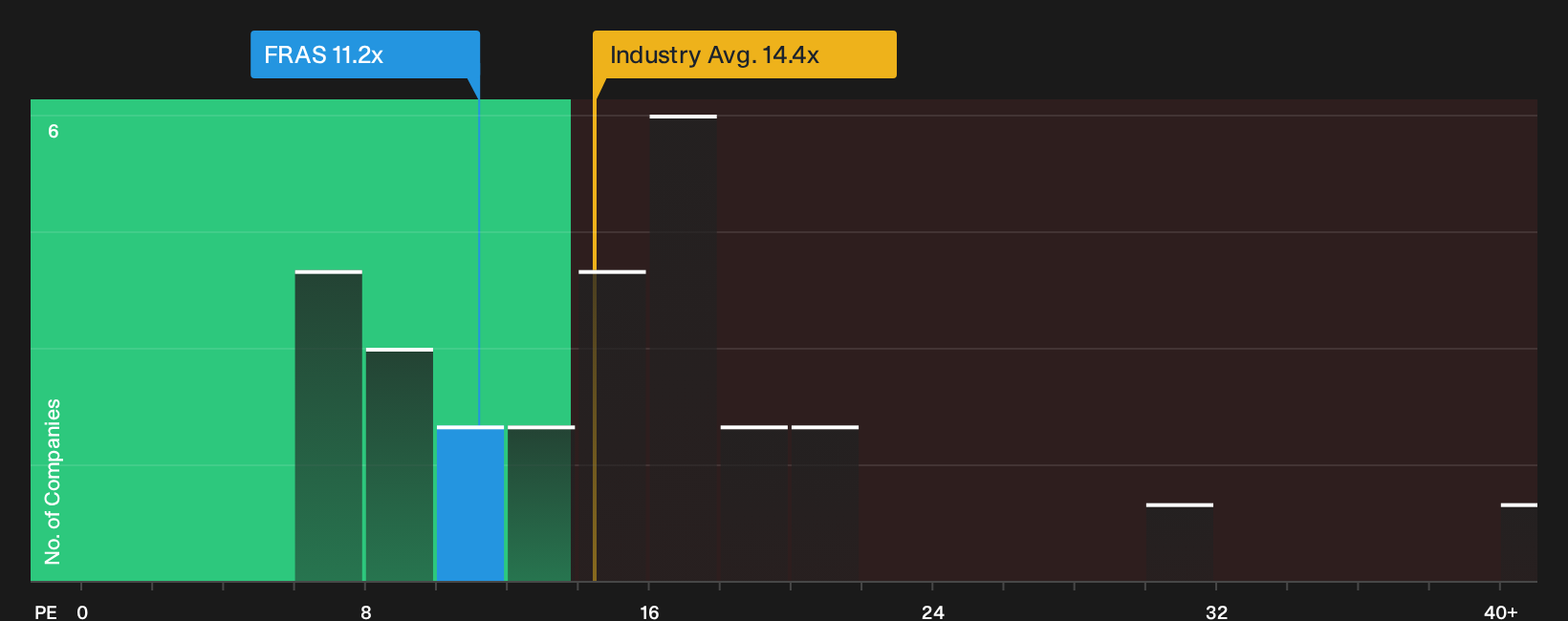
Frasers Group provides direct exposure to UK shoppers through sports shops, department stores and gyms, supported by a broad mix of mid-market and luxury brands. The stock currently trades on a relatively low P/E compared with the wider UK market, but it also carries meaningful debt and one-off items that could significantly affect how investors view its pricing power if a single key assumption changes.
If you want to see how that pricing power and debt profile really stack up, run through the 4 key rewards and 2 important warning signs for the full picture hiding in the detail.
SSP Group (LSE:SSPG)
Overview: SSP Group runs food and beverage outlets for travelers across airports, railway stations and other transport hubs, including a sizeable UK footprint.
Operations: SSP Group generates about £3.7b from travel related food and beverage outlets, with £992.9 million from the UK and the rest from North America, Continental Europe and Apac & Eeme.
Market Cap: £1.4b
SSP Group plugs directly into the screener theme because its cafés and restaurants are located where UK consumers travel, commute and spend on everyday treats.
"The planned exit of about one third of the European rail estate, combined with earlier progress on leaving the German motorway service business, is set to concentrate capital in higher return Continental Europe sites and is expected to support higher regional operating margins and group earnings from FY27 onwards."
What really matters now is how one less visible pressure on future cash conversion plays out against this tighter, travel focused estate.
That cash conversion question sits at the centre of the full narrative for SSP Group, which unpacks how SSP Group’s travel footprint could reshape risk and opportunity from here.

Marks and Spencer Group (LSE:MKS)
Overview: Marks and Spencer Group is a long established UK retailer whose food halls, clothing and home ranges are closely tied to domestic consumer spending.
Operations: Marks and Spencer Group generates about £9.7b from Food, £3.8b from Fashion, Home & Beauty, £3.2b from Ocado and £543 million from International.
Market Cap: £8.5b
For a screen built around everyday UK consumer spending, Marks and Spencer Group is a natural fit, with food halls and clothing stores that feel the impact of household budgets, policy support and business rate decisions almost in real time.
"Marks and Spencer Group is pushing ahead with store rotation and larger food halls in higher traffic locations, with more than 50 new food stores planned over the next three years. Non like for like space is expected to add 2 to 3 percentage points to annual Food sales growth."
What really moves the needle now is how one less visible cost pressure shapes the eventual payoff from all that extra floor space.
That cost pressure is exactly what the full narrative for Marks and Spencer Group unpacks in detail, revealing how Marks and Spencer Group’s space rotation could accelerate returns while reshaping risk.

Seeking Alternatives Before The Crowd?
Fresh themes move fast, and the strongest momentum often appears quietly before headlines catch up. Scan these curated shortlists while they are still flying under the radar and consider them while they remain less widely followed.
- Spot early-turn stories and follow improving sentiment by scanning the 5 high quality undiscovered gems that still trade as if nobody is paying attention.
- Focus on resilient income ideas and filter for payout strength with a curated set of 5 dividend fortresses that are designed to help portfolios keep up with inflation.
- Track structural shifts in energy and grid demand by following infrastructure players inside the 42 power grid technology and infrastructure stocks before long term capital becomes more concentrated.
Have feedback on this article? Concerned about the content? Get in touch with us directly. Alternatively, email editorial-team@simplywallst.com