
History Shows That Buying the Dip Can Yield Huge Profits. Consider Snapping Up These 3 $100+ Stocks Here.
Matt Cerminaro (Chart Kid Matt) posted on Tuesday about the BTD Generation, investors who bought stocks during the March 2020 correction, which saw massive drawdowns over short periods, such as Tesla (TSLA), Etsy (ETSY), and Penn Entertainment (PENN).
Truthfully, many investors bought during the Covid lows, especially people who’d been investing for a long time. I was one of those people. Unlike the 2008/2009 correction during the Great Recession, which was driven largely by stupidity and greed in the financial services industry, the feeling in 2020 was that this correction would bottom when Covid subsided.
The big gains from March 2020 to July 2020 happened because many people like Matt and me were eager to buy stocks on sale. As long as I’ve been writing about the equity markets (over 20 years), it was the one correction where I actually felt confident things would get better. You rarely think that.
Rightly or wrongly, the BTD Generation has since shown numerous examples of courage, leading to (one hopes) significant profits.
I’ve always thought buying on the dip, whether in index-focused ETFs or individual stocks, made a lot of sense.
According to YCharts, the best-performing stock over the past 25 years is Monster Beverage (MNST), which has generated a mind-boggling cumulative total return of 228,218%.
How many times do you think its stock fell by 10% in a calendar month over the 25 years? I looked at the monthly prices on Yahoo Finance; a quick visual check showed 17, plus many more between 5% and 10%.
That’s why I’ve been writing about stocks hitting new 52-week lows and new 52-week highs for several years. Buying on the dip isn't a bad idea for well-run businesses.
Yesterday, three stocks with share prices of $100 or higher hit new 52-week lows. I'm considering whether any of them are worth buying on the dip.
Boeing (BA)
Boeing (BA) hit a new 52-week low of $166.50 yesterday. It was the stock’s 13th 52-week low in the past 12 months. Shares are down 26% over the past year.
The forever-struggling (it seems) aircraft manufacturer dropped more than 10% on Tuesday after reporting Q3 2026 results.
Its adjusted earnings-per-share loss was $0.34, 10 cents worse than analysts expected, but far lower than the $7.47 per-share loss a year ago. On the top line, revenue was $24.19 billion, up 3.9% from a year ago but $200 million below consensus.
There is good news. It generated $464 million in free cash flow, the highest Q3 free cash flow generation since 2022. That said, it’s a long way from the good old days. In Q3 2022, the free cash flow was a whopping $2.91 billion.
Further, it delivered 161 planes in the third quarter, the highest since 2018. In the first nine months of 2026, it delivered 475 aircraft, up 8% from a year ago, and the 737 program is moving toward stable production of 47 planes per month.
Boeing’s quarter-end backlog was over 6,300 aircraft, valued at $612 billion, a company record. With the Defense, Space & Security business in a good place--it was selected by the U.S. Navy to design, build and deliver the F/A-XX next-generation fighter aircraft--the future is looking up.
Boeing’s current market cap is 1.4 times its revenue. Over the past decade, this ratio has rarely been below 1.5x--I count four occasions.
If you’re an aggressive investor, Boeing’s valuation is more attractive, at least from a P/S perspective, than it has been in the past 24 months.
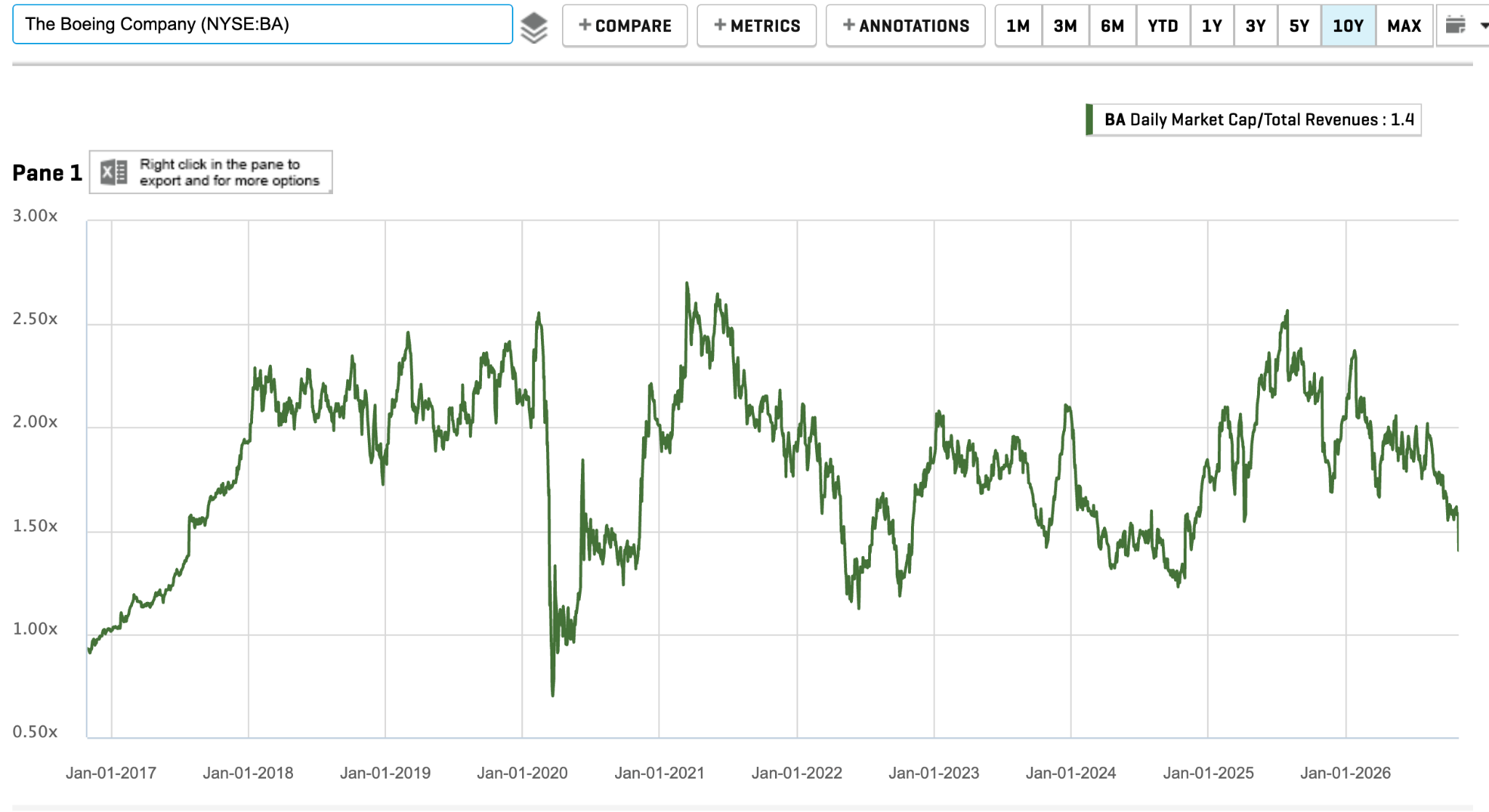
Source: S&P Global Market Intelligence
Booking Holdings (BKNG)
Booking Holdings (BKNG) hit a new 52-week low of $$148.64 yesterday. It was the stock’s 18th 52-week low in the past 12 months. Shares are down 27% over the past year.
In April, I wrote about a trade for the BKNG July 17 $160 call. Unusual options activity suggested a big fish made a bullish bet. Deep ITM (in-the-money), the 78-day DTE (days to expiration). The bullish case looked strong.
I surmised that a Bull Call Spread with a $160 call long and a $185 call short offered the best balance of cost and profit. At expiration on July 17, shares traded at $181.68, so the institution didn’t achieve maximum profit (closing above $185), but it still made more than $11 million.
Booking’s shares moved higher from there, hitting its second-highest level ($217.32) in the past year in late August. It’s been downhill ever since.
At the time, the Middle East conflict raised major concerns about travel throughout the region and elsewhere. Those concerns have partly dissipated, but they do remain. Meanwhile, several other issues have hurt the stock.
On Oct. 7, the Federal Trade Commission said it was looking into Booking’s relationship with third-party booking site Guest Reservations. Specifically, the FTC is concerned that Booking provided hotel inventory to the company, which allegedly ran misleading hotel ads that directed users to its site, not the hotel’s, resulting in unexpected extra charges.
If proven, the penalties could exceed $500 million. That would represent almost 10% of its 2025 profits. That financial hit wouldn’t sink the company, but it would definitely leave a big stain on its reputation.
In early August, when it reported its Q2 2026 results, the company lowered its annual guidance for gross bookings growth from a range of high single digits to low double digits to high single digits. I don’t think it’s a big deal in the big picture, but it's worth noting.
Lastly, there are the ongoing concerns that AI will hurt margins. The company is using AI to improve the user experience across its various platforms. In the Q2 2026 conference call, CEO Glenn Fogel discussed the ways it is integrating AI into its travel businesses. One example is Penny, Priceline’s agentic AI travel assistant. Like the guidance, I don’t think it’s a reason not to buy BKNG stock.
The company’s levered free cash flow in the 12 months ended June 30 was $7.73 billion. With a market cap of $112.81 billion, that's a free cash flow yield of 6.9%. I consider anything between 4% and 9% to be fair value. The chart shown below is the inverse of FCF yield. It’s the lowest multiple in the past three years.
BKNG is a buy.
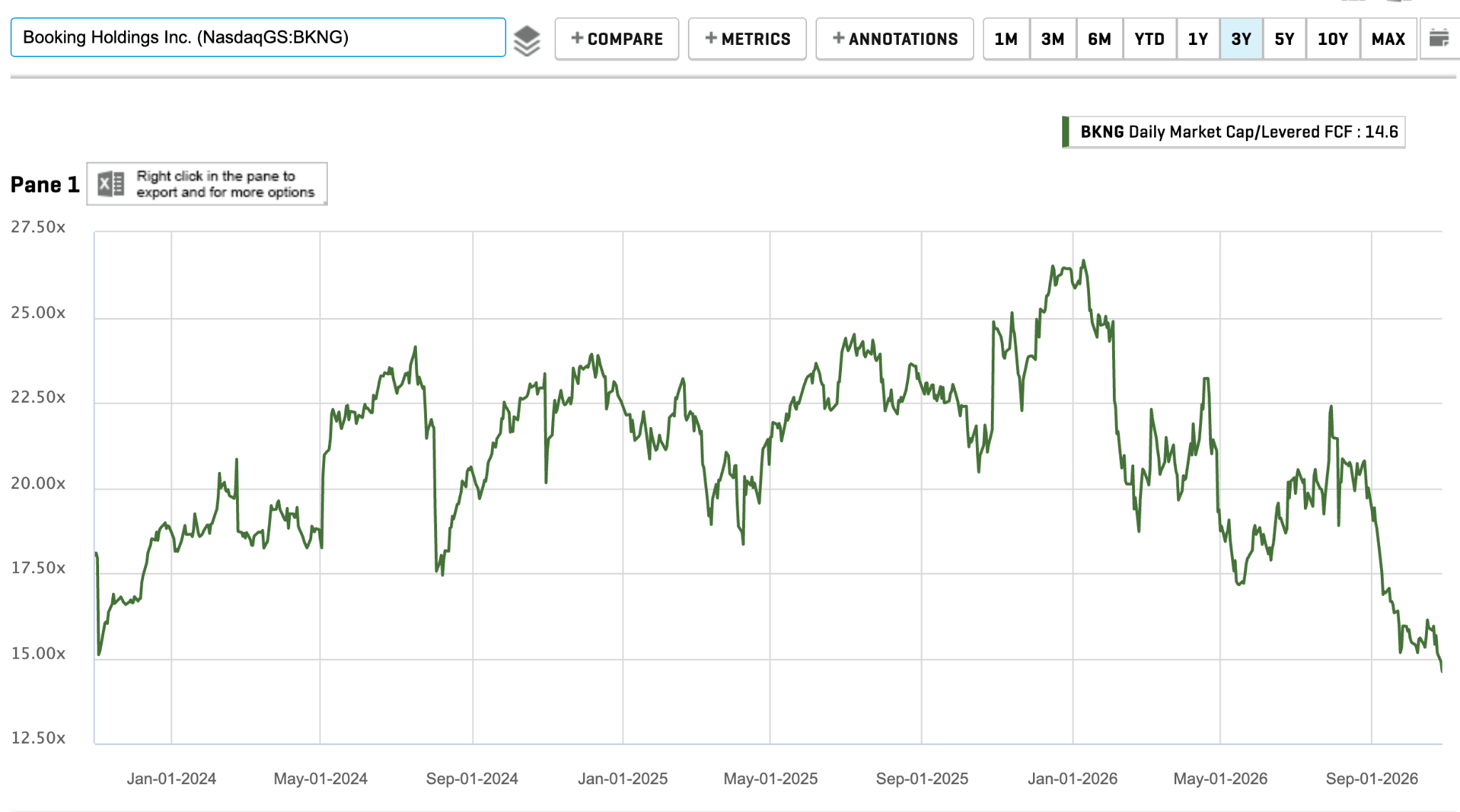
Source: S&P Global Market Intelligence
Carpenter Technology (CRS)
Carpenter Technology (CRS) hit a new 52-week low of $166.50 yesterday. It was the stock’s 8th 52-week low in the past 12 months. Shares are down 8% over the past year.
Neither the one-year decline in share price nor the number of times hitting a new 52-week low over the past 12 months is earth-shattering. Nonetheless, given it trades over $100, I’ve included it.
The company manufactures and distributes metal-based products to other manufacturers, including specialty alloys, titanium products, premium corrosion-resistant stainless steels, and advanced metal powders for injection moulding and 3D printing.
It has two operating segments: Specialty Alloys Operations (91% of revenue) and Performance Engineered Products (9%). They serve six end-use markets, with the Aerospace and Defense markets accounting for 67% of the Q1 2027 revenue. Other big ones include Industrial and Consumer (13%) and Medical (8%).
As you may know, input costs such as steel have risen significantly in 2026 due to tariffs. The company passes those on to end-user customers as a surcharge.
In Q1 2027, surcharges totalled $163.4 million, up 25% from the prior year. That demonstrates the importance of Carpenter’s products to its end users. Excluding these surcharges, revenue rose 5.3% in the first quarter, to $634.8 million.
Even more impressive, the company’s adjusted operating margin in the first quarter was 30.9%, up 550 basis points from Q1 2026. All margin gains came from Specialty Alloys Operations.
What’s holding the stock back? Several things come to mind.
1) Investors did not like that the top-line revenue number in the first quarter missed the analyst estimate by 4%. The stock dropped by 23% on the news. That’s an overreaction.
2) The medical and energy end-use markets both had double-digit sales declines in the quarter. They’re both part of the Performance Engineered Products segment. Again, an overreaction. It’s an afterthought in the big picture.
3) Some analysts have apparently cut their price targets. However, according to S&P Global Market Intelligence, the median target price is still $450, 60% higher than its current share price.
At the end of the day, CRS stock went from a three-year low of $58.87 on Feb. 5, 2024, to an all-time high of $625.98 on July 1, a nearly 1,000% move. A correction was in order.
I’m not thrilled about its lack of free cash flow generation, but as long as it keeps its adjusted operating margin in the high 20s or early 30s, it will profit nicely in the future.
The share price rollback suggests it's time to buy.
On the date of publication, Will Ashworth did not have (either directly or indirectly) positions in any of the securities mentioned in this article. All information and data in this article is solely for informational purposes. For more information please view the Barchart Disclosure Policy here.