
ProPetro (NYSE:PUMP) reports upbeat Q3 2026, stock jumps 14.7%

Oilfield services company ProPetro (NYSE:PUMP) reported Q3 2026 results exceeding the market’s revenue expectations, with revenue up 20.9% year on year to $355.4 million. Its GAAP profit of $0.09 per share was significantly above analysts’ consensus estimates.
For more on ProPetro, read our free full research report.
ProPetro (PUMP) Q3 2026 highlights:
- Revenue $355.4 million vs S&P analysts’ consensus estimates of $311.4 million (20.9% year-on-year growth, 14.1% beat)
- EPS (GAAP) $0.09 vs analysts’ consensus estimates of -$0.01 (significant beat)
- Adjusted EBITDA $59.61 million vs analysts’ consensus estimates of $54.65 million (16.8% margin, 9.1% beat)
- Operating margin 3.1%, up from -2.1% in the same quarter last year
- Free cash flow -$75.74 million compared to -$1.38 million in the same quarter last year
- Market capitalization $928.5 million
“Across both businesses, we are doing what we said we would do, and we are excited about the opportunity in front of us. The completions market is moving in our favor, PROPWR is executing and scaling, and we have the balance sheet, the equipment and the team to capture what is ahead.”
Revenue growth
A company’s long-term performance can give signals about its business quality. Even a bad business, especially in a cyclical industry, can perform well for a year or so, but a top-tier one should exhibit resilience through cycles. ProPetro’s revenue grew at a mediocre 9.3% compounded annual growth rate over the last five years, falling short of the standard for the energy upstream and integrated energy sector.
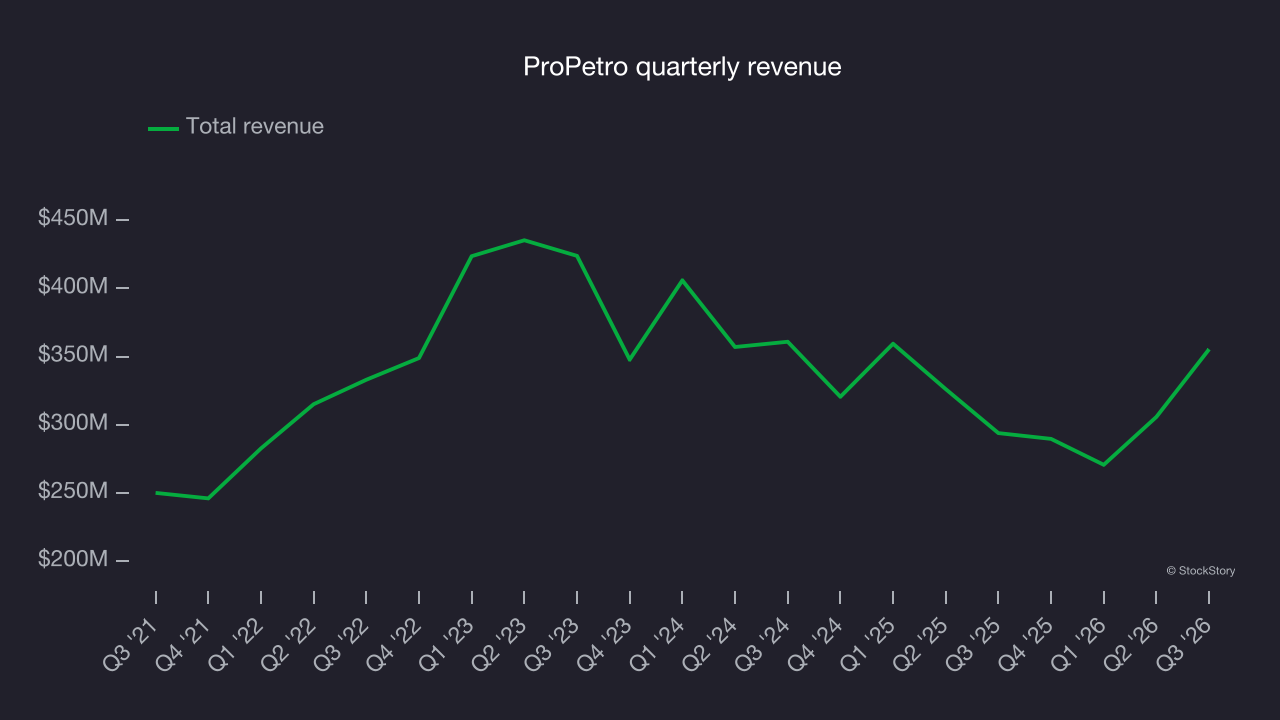
Energy cycles can be long enough that a single five-year period can still reflect one price environment, which is why an additional, decade-long view can help capture through-cycle performance. ProPetro’s annualized revenue growth of 11.7% over the last ten years is above its five-year trend.
This quarter, ProPetro reported year-on-year revenue growth of 20.9%, and its $355.4 million of revenue topped Wall Street’s consensus estimates by 14.1%.
Adjusted EBITDA margin
ProPetro was profitable over the last five years but held back by its large cost base. Its average EBITDA margin of 20.4% was weak for an upstream and integrated energy business.
ProPetro’s EBITDA margin decreased by 7.2 percentage points over the last year. This raises questions about the company’s expense base because its revenue growth should have given it leverage on its fixed costs, resulting in better economies of scale and profitability. ProPetro’s poor performance shows that costs were rising and it couldn’t pass them on to its customers.
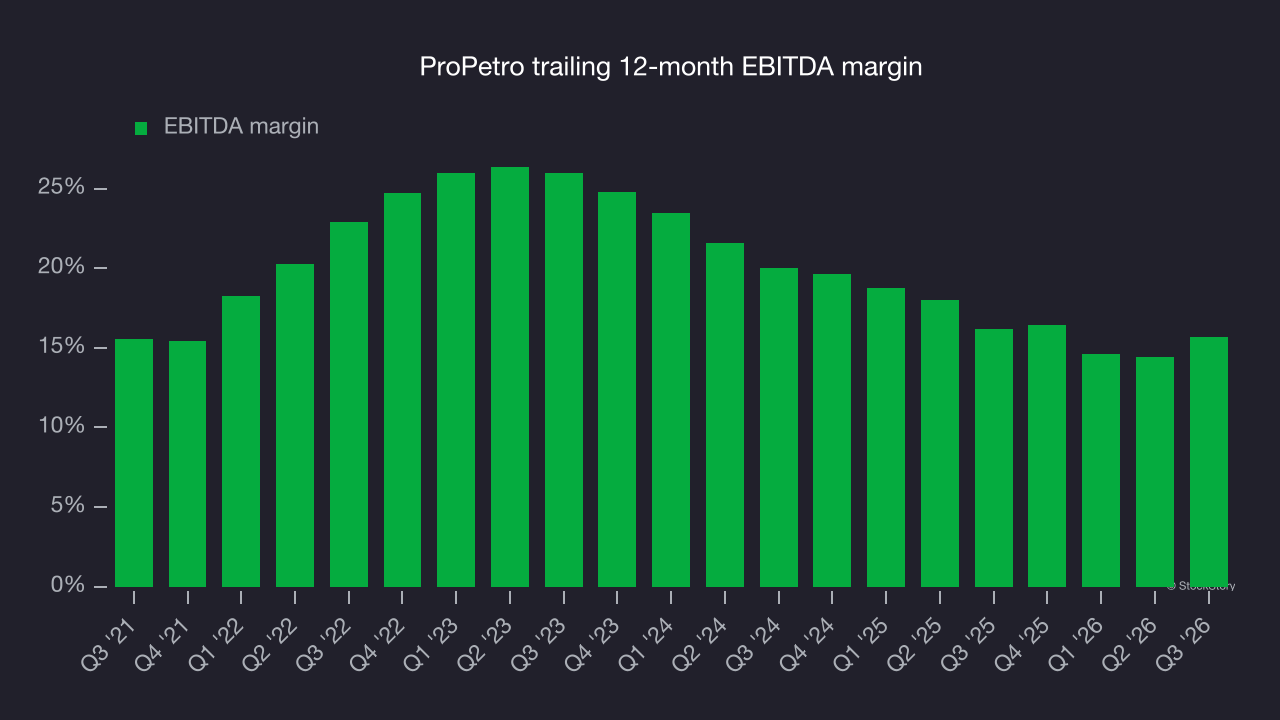
In Q3, ProPetro generated an EBITDA margin of 16.8%, up 4.8 percentage points year on year. This increase was a positive development and shows it was more efficient. This adjusted EBITDA beat Wall Street’s consensus estimates by 9.1%.
Free cash flow
As mentioned above, adjusted EBITDA ignores capital structure and drilling expenditure decisions. These are two major aspects of an energy producer’s business, so investors need to account for them to get a comprehensive picture of business quality. In other words, adjusted EBITDA margins could be solid but free cash flow poor because asset decline rates are high and drilling is expensive. Free cash flow tells you not only about the economics of past production but also how much it costs to stay in business through further drilling or extraction.
ProPetro has shown weak cash profitability relative to peers over the last five years, giving the company fewer opportunities to return capital to shareholders. Its free cash flow margin averaged 1.6%, below what we’d expect for an upstream and integrated energy business.
The level of free cash flow is important, but its durability across cycles is just as critical. Consistent margins are far more valuable than volatile swings driven by commodity prices.
ProPetro’s ratio of quarterly free cash flow volatility to WTI crude price volatility over the past five years was 43.5 (lower is better), indicating that its cash generation is far more sensitive to commodity-price swings than most peers. This elevated volatility limits its access to capital in downturns and makes it unlikely to act as a consolidator when weaker competitors come under pressure.
Why assess stability relative to commodity prices using free cash flow rather than comparing ProPetro’s revenue or EBITDA to WTI crude prices? What ultimately matters is not how much revenue or profit a company earns when prices are high but how much cash it can generate when prices are low. Free cash flow is the superior metric because it captures hedging effectiveness, growth and maintenance capex and management behavior during good times and bad.
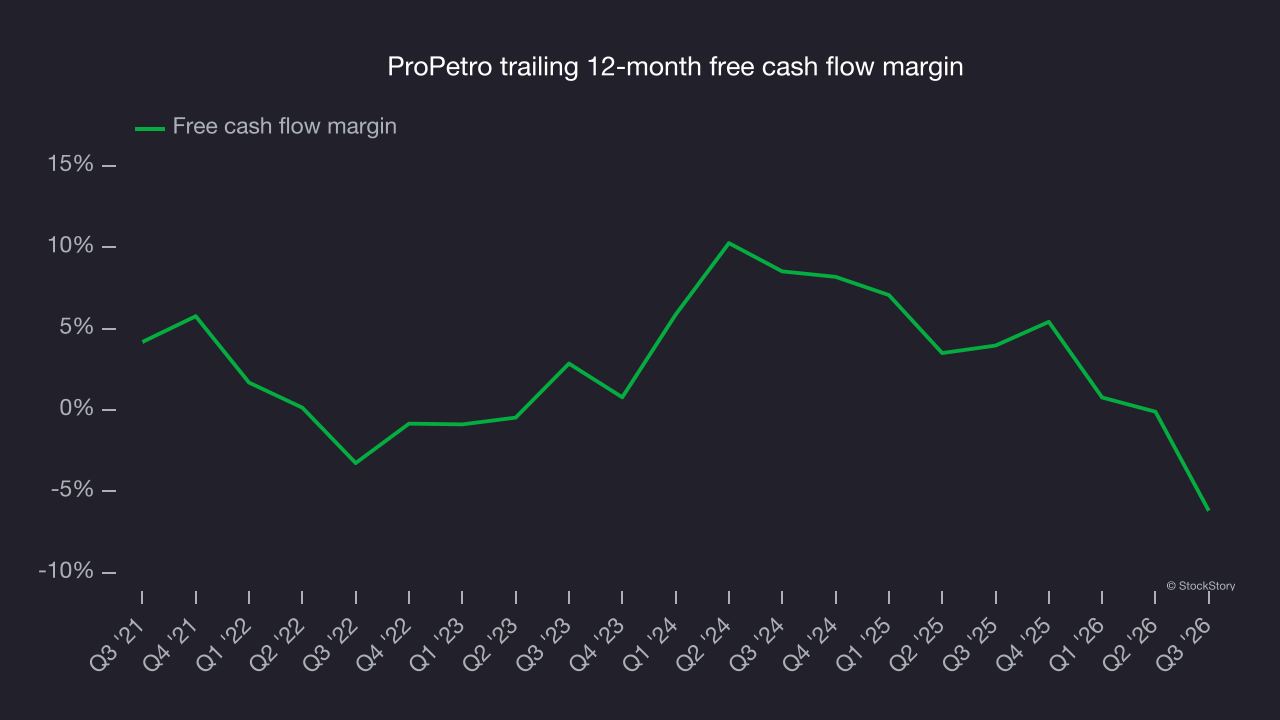
ProPetro recorded a cash outflow of $75.74 million in Q3, equivalent to a negative 21.3% margin. The company’s cash burn increased from $1.38 million in the same quarter last year. These numbers deviate from its longer-term margin, indicating it is a seasonal business that must build up inventory during certain quarters.
Key takeaways from ProPetro’s Q3 results
ProPetro delivered a solid quarter, with revenue well above Wall Street’s consensus estimates and EPS also beating expectations. Shares soared 14.7% to $8.67 immediately after the report.
ProPetro had a solid quarter, but is the stock a buy? The latest quarter matters, but longer-term fundamentals and valuation matter more when deciding whether to invest. For more on ProPetro, read the full research report here (it’s free).