
4 Reasons American Express Stock Is Having Its Worst Year Since 2015 Despite Record Earnings
Key Points
American Express would be adversely impacted by higher interest rates, if asset prices fall, and if unemployment rises among high-paying jobs.
The financial services company is betting big on artificial intelligence and agentic commerce.
American Express’s dirt cheap valuation will appeal to long-term investors.
On Oct. 23, American Express (NYSE: AXP) delivered excellent third-quarter 2026 results and raised its full-year guidance. The financial services giant is forecasting a record $18.30 to $18.60 in full-year earnings per share ($17.60 to $17.90 adjusted) and another year of 10% revenue growth. The midpoint of American Express's adjusted earnings guidance is a 15.4% increase over 2025.
Given the impeccable results, it may seem strange that American Express is down 15.3% year to date. If that level holds, it would be the worst annual decline since 2015.
Missed AI’s "Act 1"? Act 2 Could Be 15x Bigger. Most investors think they missed the AI boat because they didn't buy Nvidia in 2005. But according to our analysts, we’re only at the end of "Act 1"—the R&D phase. "Act 2" is the global rollout. Continue »
Here are four reasons American Express is selling off, and whether the financial stock is a buy anyway.

Image source: Getty Images.
1. American Express stock was red hot entering 2026
Over the last decade, American Express has delivered a 452.8% total return, compared with 322.1% for the S&P 500 (SNPINDEX: ^GSPC), while its earnings have nearly tripled. And in the last three years, American Express is up 137.6% while its earnings are up 47%.
So, despite American Express's excellent results, the simplest reason why it's underperforming in 2026 is probably just a decade-long, mostly uninterrupted surge in the stock price that outpaced earnings growth, leaving American Express prone to a pullback.
2. Margin compression
Another factor affecting American Express is rising expenses that have eroded its margins.
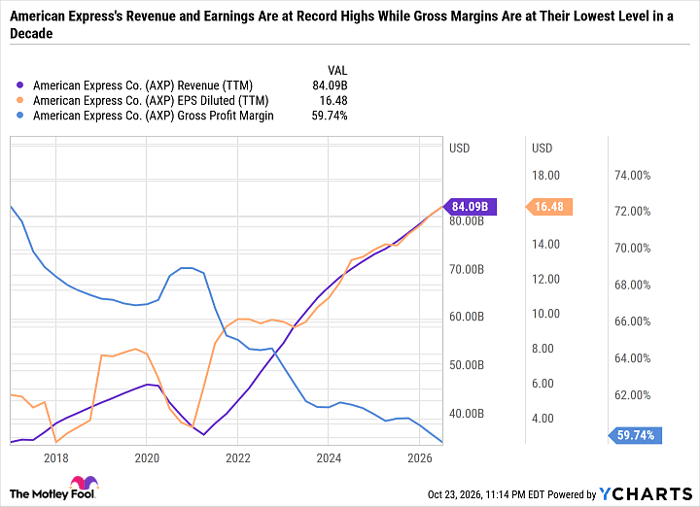
AXP Revenue (TTM) data by YCharts
As you can see in the chart, American Express's revenue and earnings have skyrocketed, but its gross margins are steadily ticking down.
In its latest quarter, card member reward expenses jumped 10% year-over-year, business development was up 11%, and card member services jumped 36%. Total expenses were up 9%, matching the 9% year-over-year increase in revenue. But the fact remains that American Express is spending heavily on customer engagement, which could weigh on margins if cardholder spending weakens.
3. A consumer spending slowdown
Some investors may be worried that American Express's affluent customer base could eventually feel the impact of a higher cost of living and inflationary pressures. It's no secret that consumer spending has been strained by higher costs for household goods, rising utility bills, gas prices, and a massive slowdown in housing and home improvement. American Express's customers continue to spend at a healthy rate, but that may be partly due to strong employment and near-record-high levels in real estate and the stock market.
If asset prices cool off or unemployment ticks up in high-paying jobs because of an economic slowdown or an artificial intelligence (AI) disruption, American Express's core customer base could be affected. Higher interest rates act as a natural brake on economic growth and consumer spending, which in turn affects the outlook for cardholder spending in 2027.
American Express's business model is built around incentivizing customers to make as many of their purchases as possible using their American Express card(s). So if overall spending comes down, it will impact the fees American Express collects from merchants based on transaction volume, interest expenses on outstanding balances, and the annual fees on its pricey cards.
4. AI and agentic commerce
Yet another reason American Express stock could be under pressure is its AI strategy. American Express CEO Stephen Squeri talked at length on the Oct. 23 earnings call about the company's plans to leverage AI efficiency improvements across its operations and the rise of AI and agentic commerce. This basically means having AI agents make purchasing decisions, such as using an American Express card, on behalf of the cardholder.
Squeri believes that American Express is uniquely positioned to win with agentic commerce and using AI to enhance the customer experience because of American Express's connection with the customer, which includes its first-party data, security, closed-loop network, and other advantages.
American Express issues its own cards and has a suite of financial services, from loans to high-yield savings accounts and more. Whereas Visa and Mastercard operate open-loop networks, meaning other banks and financial institutions issue the cards and manage the credit risk.
While Squeri is absolutely right that American Express has a unique opportunity to tap more deeply into each customer's spending habits and preferences, investors may be concerned that American Express's AI budget could further erode its margins. Or that pursuing these AI investments at the expense of reducing employee headcount is the wrong move. In Q3, American Express took a $336 million restructuring charge following a 5% reduction in its global employee headcount.
American Express is too cheap to ignore
Given the strength of American Express's business model, record revenue and earnings, strong growth rates, a loyal customer base, and excellent credit quality, investors may be scratching their heads as to why American Express has gotten so cheap. The stock trades at just 17.8 times the low end of its adjusted 2026 earnings guidance.
While American Express is prone to a consumer spending slowdown and could see further margin pressure from higher costs, the long-term fundamentals of the business are as good as ever. I also think that American Express is uniquely positioned to tap into the emerging agentic commerce industry, given its engaged customer base.
All told, the downward pressure on the stock price is driven by fears of what could happen rather than by the results themselves. This gives long-term investors an incredible opportunity to scoop up American Express shares while they are out of favor.
American Express is an advertising partner of Motley Fool Money. Daniel Foelber has positions in American Express. The Motley Fool has positions in and recommends American Express, Mastercard, and Visa. The Motley Fool has a disclosure policy.