
What Franklin Templeton Holders Got Right
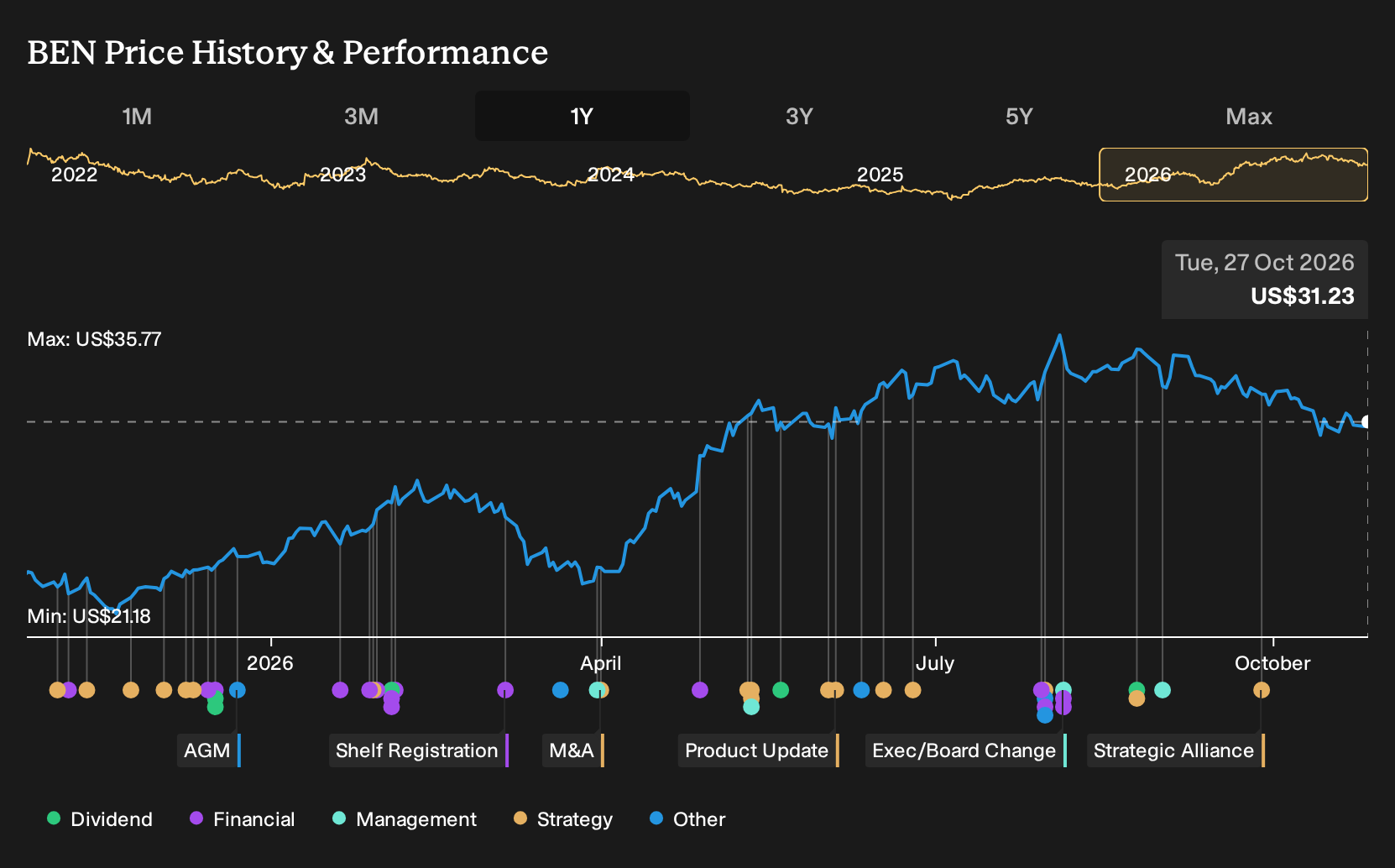
If you had bought Franklin Templeton on 27 October 2025 and simply held, the result would look very different after this volatile year. Holding Franklin Templeton over the past year would have returned 40.5%, including dividends. Early on, analysts were split between Uzbekistan and Saudi Arabia expansion stories and concerns about legacy fees and rising tech rivals. If you faced that same fork today, which mattered more in your decision process: global diversification or pressure from cheaper digital competitors?
This theme extends beyond Franklin Templeton. See which of 16 cryptocurrency and blockchain stocks may still merit a closer look.
What Franklin Templeton Investors Were Really Arguing About
The shares cost US$23.38 at the start of the period, and investors were pulled between two very different stories about Franklin Templeton.
The bullish Narrative argued that global expansion into places like Uzbekistan and Saudi Arabia, plus private assets and tokenized funds, would support growth. Its Fair Value was US$25, a price that reflected assumptions such as 1.0% annual revenue growth and profit margins reaching 15.6% within roughly three years.
The bearish view put Fair Value at US$19 based on more cautious expectations. That side focused on ongoing outflows from active funds, fee pressure from low cost rivals, and the risk that digital projects might remain expensive experiments rather than proven businesses.
What The Results Changed For The Franklin Templeton Debate
The clearest new datapoint for Franklin Templeton is the Q3 2026 report. Total revenue moved from US$2,064m in Q3 2025 to US$2,358.4m, while net income excluding extra items went from US$79m to US$160.4m and net margin rose from 3.8% to 6.8%. That shift in profitability gave more support to the optimistic case, although fee pressure and competition remain open questions.
The lesson to take elsewhere is simple. When a story hinges on future profitability, it may be useful to track the reported net margin and its direction against the original assumption, rather than focusing only on top line progress or share price moves.
What Today's Franklin Templeton Price Already Assumes
Franklin Templeton now trades at US$31.23 after a 40.5% gain over the past year, and the selected Narrative’s Fair Value sits below the current price.
The Narrative argues that the key question is not asset gathering but how much of those fees Franklin Templeton keeps. A buyer today effectively banks on higher margins, so the open issue is how platform revenue sharing might affect that outcome.
"Although Franklin Templeton reports record alternatives fundraising and a large base of fee generating private markets assets, rising revenue sharing and platform fee demands on newer vehicles like ETFs and SMAs could start to spill over into private markets distribution, which would limit the effective fee rate and keep revenue from scaling in line with assets under management."
That disagreement has a full argument behind it. → Uncover the lower Fair Value this Narrative argues for
Franklin Templeton And A Parallel Path
Franklin Templeton is pushing into alternatives and tokenized funds. You could also look one step sideways.
Large institutions still want help raising capital and structuring complex financing. Another firm concentrates on that heavy lifting across deals, trading and tailored lending.
The same allocator base also wants long term wealth management and private market exposure. That peer leans on fee based portfolios and sizeable alternative pools to address those needs.
Both stories point to a similar question for you. How might recurring financing and alternatives reshape where the real earnings power sits?
The case is on the record, with the assumptions it rests on. → See the Narrative that values this company 37% above its price
Have feedback on this article? Concerned about the content? Get in touch with us directly. Alternatively, email editorial-team@simplywallst.com