
Xiaomo: The Federal Reserve will stand still tonight. The US$4.1 trillion financing gap is getting closer. The real highlight of US debt is next week
The Zhitong Finance App learned that Jay Barry and others from J.P. Morgan's fixed income strategy team said that the Federal Reserve is likely to keep interest rates unchanged on Wednesday, but there may be more than one hawkish objection; for the US bond market, next week's Treasury's quarterly refinancing announcement is the real highlight.
The Federal Reserve is expected to stand still, and hawkish objections have surfaced
On the eve of interest rate negotiations, US bond yields remained range-bound, and the yield curve flattened by 1 basis point. J.P. Morgan is in agreement with the market consensus. It is expected that the Federal Reserve will remain on hold, but Cleveland Federal Reserve Chairman Hamak and Dallas Federal Reserve Chairman Logan are expected to cast hawkish objections, and Minneapolis Federal Reserve Chairman Kashkari is also at risk of joining.
The real point is how Chairman Walsh explained why he chose to raise interest rates in September when the core PCE was 0.2% month-on-month, but chose to wait and see when the next reading was expected to be 0.3%. J.P. Morgan believes that if Walsh avoids an explanation, the market will see it as a dovish signal.
Prospects for refinancing: the scale remains the same, the wording should be changed
The Ministry of Finance will announce quarterly financing estimates on November 2 and a full refinancing announcement on November 4. J.P. Morgan expects the interest-bearing bond auction scale to remain unchanged. The fundamental figures are: the 2026 deficit is 1.992 trillion US dollars, which is only 28 billion US dollars narrower than the bank's forecast; the 2027 deficit forecast remains at 1.960 trillion US dollars. Corresponding to net private sector borrowing of US$2.038 trillion in 2026 and US$2.202 trillion in 2027, the net supply of short-term treasury bonds will increase by US$991 billion in 2027, the highest number since 2023.
J.P. Morgan said bluntly that from the perspective of prudent debt management, the Ministry of Finance should remove the word “at least” from the “Expected to maintain the auction scale in the next few quarters” guidelines. In fact, the Treasury's Borrowing Advisory Committee (TBAC) in August proposed an update to the wording to preserve flexibility.
However, the Ministry of Finance's fear of yield levels is obvious: in August, it changed “evaluating potential increases” to “evaluating future changes,” and unexpectedly raised the scale of long-term repurchases two weeks later. Based on this, the bank determined that the current guidelines will continue until 2027, and the auction scale will not change until August 2027. Since then, it will start increasing for several quarters, focusing on a period of 2 to 10 years.
$4.1 trillion gap
According to the current auction schedule, the funding gap for the 2027-2030 fiscal year is as high as US$4.1 trillion. According to the report, reducing long-term auctions to reduce yields lacks structural significance; it will only shift financing pressure to short-term debt. According to its forecast, short-term debt will rise to 24% by the end of 2027 and 25% by the end of 2028, and the weighted average term of outstanding debt will be shortened by about 3 months to 66.9 months in the next two years.
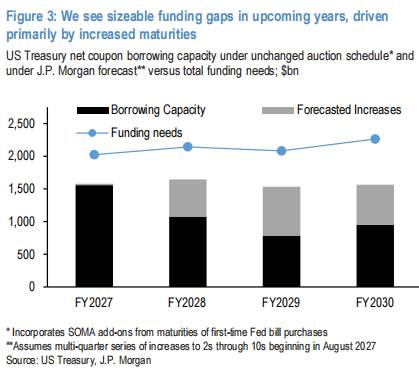
There will be a large funding gap in the next few years
However, there are doubts about the elasticity of demand for short-term bonds: the growth rate of monetary funds has fallen to its slowest rate in years, foreign official holdings have declined in recent months, the stablecoin scale has stagnated for 18 months, and traders have been forced to take on more supply. In contrast, long-term demand is hot: demand for terminals for 30-year auctions since this year is the strongest in history.
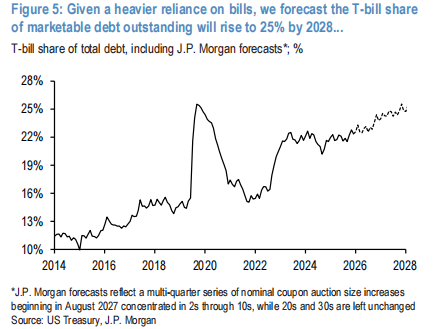
The trend of short-term debt as a share of negotiable debt rose to 25%
Position changes
In terms of positions, the bank's US bond customer survey showed that the long-term overbalance had risen to the highest level since November 2025. It is recommended to continue to hold 10s/30s as a steep strategy and eliminate the 10-year IOTA (interest rate spread between inflation swaps and TIPS) bulls. The transaction lost 2.5 basis points since the position was opened.
In terms of data, the average daily turnover of US CPI inflation swaps this year was 11.6 billion US dollars, an increase of 57% over the previous year, which is equivalent to 48% of TIPS's turnover. Technically, the 2-year US Treasury yield is blocked at 4.60%-4.63%. Unless the S&P 500 index falls below the key support of 7,500-7,600 points, the front-end interest rate is expected to fluctuate in the fourth quarter, looking at 5.00%; the lower short-term support is 4.825%. If the yield continues to decline, the 4.35%-4.43% area is a more solid bottom area.