
JK Lakshmi Cement Fell While Sales Rose
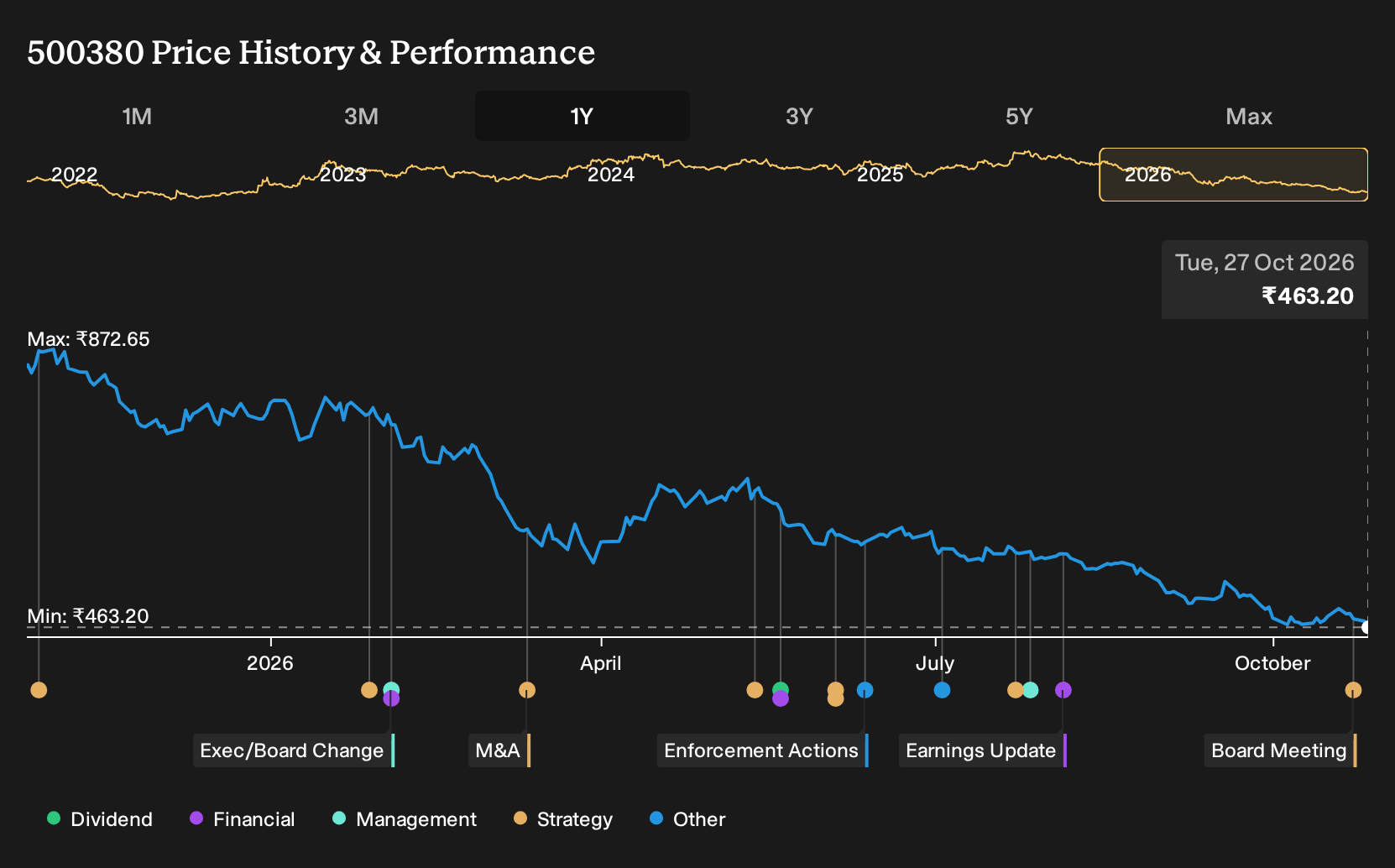
If you had looked at JK Lakshmi Cement in late October 2025 and decided to sit it out while analysts argued over fair values and earnings paths, the past year might feel like a bullet dodged. Investors who held JK Lakshmi Cement over the past year are down 44.1%, including dividends. With revenue later reported higher but net margin sliding from 8.6% to 5.7%, which early warning, debt risk or cost assumption would you have wanted to stress test more carefully?
The useful thing about a Narrative is that the reasoning is checkable: the assumptions sit beside the argument, and together they imply an estimated Fair Value you can disagree with.
The easy part of this move is behind JK Lakshmi Cement. Zero in on 195 high quality undervalued stocks for companies trading below our estimates.
The Two Stories Investors Had To Weigh On JK Lakshmi Cement
The shares cost ₹850 at the start of the period, and anyone looking at JK Lakshmi Cement then had to choose between two well-argued stories, not a clear outcome.
The bullish Narrative put Fair Value at ₹962, 13% above the start price. It leaned on multi-year capacity expansions in high-demand regions and an assumption that cost optimisation could trim ₹100 to ₹120 per tonne within 12 to 24 months.
The bearish view set Fair Value at ₹685, 19% below the start price. That case focused on rising environmental and royalty costs, including limestone royalties lifting from ₹105 to ₹251 per tonne on the Northeast project.
What The Results Changed For JK Lakshmi Cement
The clearest data point for JK Lakshmi Cement was the Q1 2027 print. Revenue reached ₹19,047.8m versus ₹17,409.3m a year earlier, yet net income slipped to ₹1,080.2m from ₹1,501.7m and net margin moved from 8.6% to 5.7%. Higher sales with thinner profitability supported the cautious view that rising costs could squeeze earnings.
The takeaway is simple. When a thesis rests on cost savings per tonne, you need to track reported margin and absolute profit, not just volume or revenue lines, in every result that follows.
What You Would Be Paying For Today With JK Lakshmi Cement
JK Lakshmi Cement now trades at ₹463 after a 44.1% loss over the past year, and the selected Narrative’s Fair Value sits above that level rather than below it.
The current Narrative focuses on capacity, mix and energy initiatives. A buyer today would need to believe heavy capex and fuel risk can be managed without significantly impacting margins.
"The main execution risk is whether JK Lakshmi Cement can carry out its heavy CapEx plan while containing rising fuel and packaging costs through higher renewable energy usage, digital efficiency measures and a better geographic mix."
That disagreement has a full argument behind it. → Uncover the higher Fair Value this Narrative argues for
Which Company Could Surprise You Next?
Passing on this one could have spared you a loss. Where might you find the opposite surprise? Start looking for companies whose prices leave room for a better outcome than investors expect. These three trade below our estimated value.
- Company 1 - 33% below our estimate - expands a broad nutrition portfolio while tightening distribution reach through dense retail coverage.
- Company 2 - 18% below our estimate - supplies test systems linked to higher AI server power and data center demand.
- Company 3 - 49% below our estimate - ramps higher grade ore feed and pursues new underground deposits to extend mine life.
That is three of the list. See every one of the 207 solid balance sheet companies →
Have feedback on this article? Concerned about the content? Get in touch with us directly. Alternatively, email editorial-team@simplywallst.com