
This Defense Stock Just Raised Its Dividend by More Than 2%
Huntington Ingalls Industries (HII) raised its quarterly dividend ahead of its Oct. 29 earnings report. On Oct. 21, the largest military shipbuilder in the U.S. declared a payout of $1.41 per share, up from $1.38. That’s a 2.2% increase, bringing the annual payout to $5.64 per share and the forward yield to about 2%.
The company also recently won a $5.1 billion contract from the U.S. Department of Defense to refuel and overhaul the USS Harry S. Truman, a nuclear-powered aircraft carrier, as well as a U.S. Navy contract to build 10 ROMULUS unmanned surface vessels. The latter deal is part of the Medium Unmanned Surface Vessel (MUSV) program.
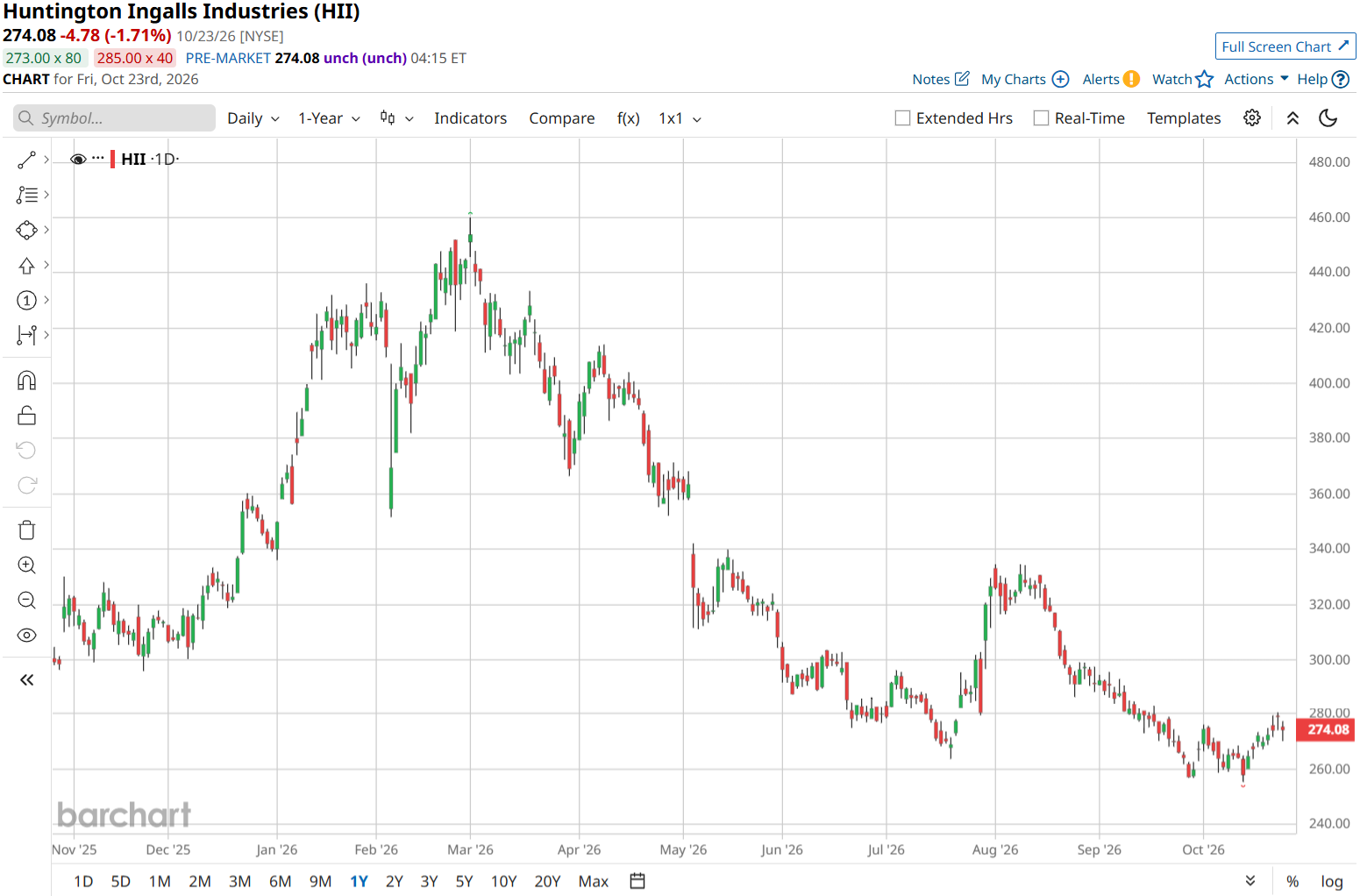
Still, shares of HII stock have struggled. Huntington Ingalls Industries trades about 40% below its March 2026 peak of $460. Analysts expect third-quarter earnings of $4.41 per share, nearly 20% above EPS of $3.68 last year, while the dividend raise suggests management has some confidence in its ability to keep paying shareholders.
Is that enough to make HII stock worth buying for income? Let’s take a closer look.
The Numbers Behind the Higher Payout
Huntington Ingalls Industries builds military ships and supplies defense technology and services. Shares of HII stock have fallen 7% over the past 52 weeks and 17% year-to-date (YTD).
HII stock trades at 14.8 times forward earnings, which is below the sector median of about 19.3 times, giving investors a lower price for each $1 of expected earnings.
Shareholders are still getting a dividend increase. Huntington Ingalls Industries recently raised its quarterly payout by $0.03 to $1.41 from the $1.38 per share paid in each of the previous four quarters. The dividend is payable on Dec. 11, 2026, to shareholders of record on Nov. 27, 2026.
That puts the annualized payout at $5.64 and the yield at about 2%. The company has a record of 14 years of dividend increases. Before the latest raise, its forward payout ratio was 32.63%, leaving room between expected earnings and dividend payments.
The company's Q2 fiscal 2026 results showed higher sales and profits. Revenue grew 11% year-over-year (YOY) to $3.42 billion, while operating income rose 29% YOY to $210 million. Operating margin improved 86 basis points to 6.1%. Segment operating income increased 30% YOY to $224 million, and segment operating margin rose 97 basis points to 6.6%. Net earnings also climbed about 37% YOY to $208 million, with diluted EPS up almost 37% YOY to $5.27.
Newport News Shipbuilding revenue rose more than 15% YOY to $1.85 billion, with segment operating income of $111 million. Its operating margin also improved to 6% from 5.1%. Meanwhile, Ingalls Shipbuilding revenue grew nearly 17% YOY to $845 million, generating $58 million in segment operating income, although its margin fell to 6.9% from 7.5%. Mission Technologies' revenue also dropped 4% YOY to $760 million, although its margin improved to 7.2% from 4.6%, with operating income of $55 million.
New contract awards totaled $6.7 billion in Q2, taking the backlog to $57.3 billion. Cash flow was weaker. Operating activities used $31 million, compared with generating $823 million a year earlier, while free cash flow fell to -$150 million from $730 million.
Navy Demand Supports the Growth Case
In late September, Huntington Ingalls Industries won a U.S. Navy contract to build 10 ROMULUS unmanned surface vessels under the MUSV program. The order moves the Navy closer to using autonomous vessels across its fleet rather than just testing them.
To meet growing demand, the company has expanded its unmanned systems facility in Pocasset, Massachusetts. The site is used to develop, build, and integrate REMUS underwater vehicles and ROMULUS surface vessels, and the 10,000-square-foot addition increases the existing 40,000-square-foot facility’s size by 25%.
The extra space adds production capacity for the U.S. Navy’s Lionfish small unmanned undersea vehicle. In July, the Navy awarded an option-year contract to continue Lionfish production. The facility will also support REMUS 620 production and work on Odyssey Autonomous Control Solutions, including simulation, modeling, and autonomy hardware for ROMULUS vessels.
In August, the company's Mission Technologies division also secured a $2.2 billion STRINGRAI task order supporting U.S. Southern Command. The company will lead a team providing surveillance, tracking, intelligence, network services, reconnaissance, analysis, and interception capabilities. These tools will help SOUTHCOM and partner nations “to detect, monitor, and disrupt illicit activity across Central America, South America, and the Caribbean.”
What Does Wall Street Think of HII Stock?
Huntington Ingalls Industries will release its next earnings report on Oct. 29 before the market opens. Analysts expect September-quarter earnings of $4.41 per share, up 20% YOY from $3.68. For full-year fiscal 2026, analysts expect EPS of $18.51, a 20% YOY increase from $15.39.
Still, analysts have questions about margins. During the Q2 earnings call, Citi analyst Judd Goddin asked whether shipbuilding margins could hold up. TD Cowen analyst Gautam Khanna also questioned how contract terms could affect the company’s long-term margin goals.
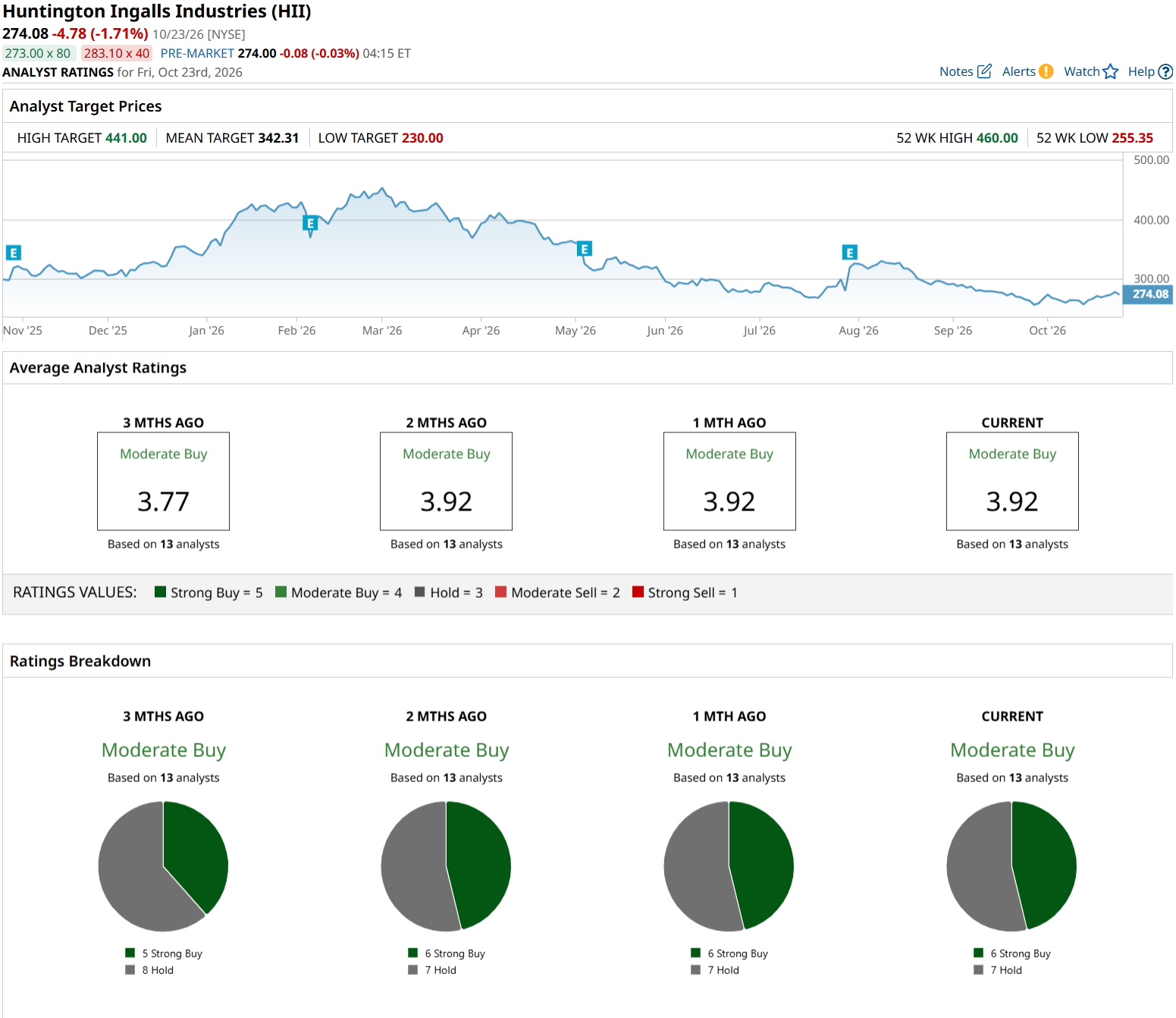
Some price targets have come down as well. On Oct. 9, TD Cowen kept its “Buy” rating for HII stock but cut its target from $360 to $340. On Oct. 14, Sanford C. Bernstein also maintained a “Market Perform” rating while lowering its target from $327 to $304.
Overall, HII stock has a consensus “Moderate Buy” rating on Wall Street based on 13 analysts with coverage. The average price target of $342.31 suggests potential upside of about 22% from current levels.
Conclusion
HII stock looks more compelling as a dividend-growth stock than a high-yield income play. The 2.2% raise is modest, but earnings growth, a sizable backlog, and a below-sector valuation strengthen the case for patient investors. The weak quarter for cash flow keeps this from being a clear-cut buy on the dividend alone. On balance, I lean toward shares moving higher over time, provided earnings growth holds and cash generation improves. The Oct. 29 earnings report could test that view quickly, with margins and cash flow likely to matter more than the payout increase itself.
On the date of publication, Ebube Jones did not have (either directly or indirectly) positions in any of the securities mentioned in this article. All information and data in this article is solely for informational purposes. For more information please view the Barchart Disclosure Policy here.