
AutoZone (AZO) Replaces Its CFO, Is The Stock Trading At A Discount?
AutoZone (AZO) just announced a reshuffle in its top finance roles, with Chief Financial Officer Jamere Jackson set to depart for FedEx and Vice President and Controller J. Scott Murphy taking on principal financial officer responsibilities.
The recent finance leadership changes come at a moment when AutoZone’s 30-day share price return of 11.07% suggests short term momentum is building. However, the year to date share price return is down 3.44%, and the 1-year total shareholder return has declined 16.36%, compared with materially stronger 3 and 5-year total shareholder returns of 29.17% and 79.27% respectively.
Compare AutoZone's leadership shake-up with other businesses facing similar turning points by scanning our hand picked 30 resilient stocks with low risk scores that aim to pair resilience with measured risk.
AutoZone now trades at a discount to both analyst targets and some intrinsic value estimates after a sharp 30 day rebound. Is that a cautious market mispricing, or a fair response to recent leadership upheaval and mixed returns?
Most Popular Narrative: 13% Overvalued
AutoZone last closed at $3,190.07 while the leading narrative fair value sits at $2,829.08, so the gap points to a market price that runs ahead of that framework and keeps questions about execution right in focus.
Asked directly whether SG&A would need to re-accelerate, the CFO was unambiguous on the prior call: “We don’t anticipate a re-acceleration in SG&A.” The reasoning offered was specific. New-store SG&A load was lapping, productivity initiatives were running, and per-store expense growth had already slowed from 4% to 3% sequentially.
None of that held. Total operating expenses grew 8.9% this quarter, SG&A deleveraged 101 basis points, and per-store SG&A growth went straight back to 4%, precisely the direction the prior commentary said would not happen. Management’s explanation this time was that the deleverage was “driven primarily by our growth initiatives,” the same initiatives that were supposed to be moderating.
See why 2 investors see AutoZone as 13% overvalued.
Result: Fair Value of $2,829.08 (OVERVALUED)
Still, the AutoZone narrative could be shaken if DIY traffic weakness persists, or if SG&A continues to run ahead of prior cost discipline messages.
Find out about the key risks to this AutoZone narrative.
Another View on AutoZone's Valuation
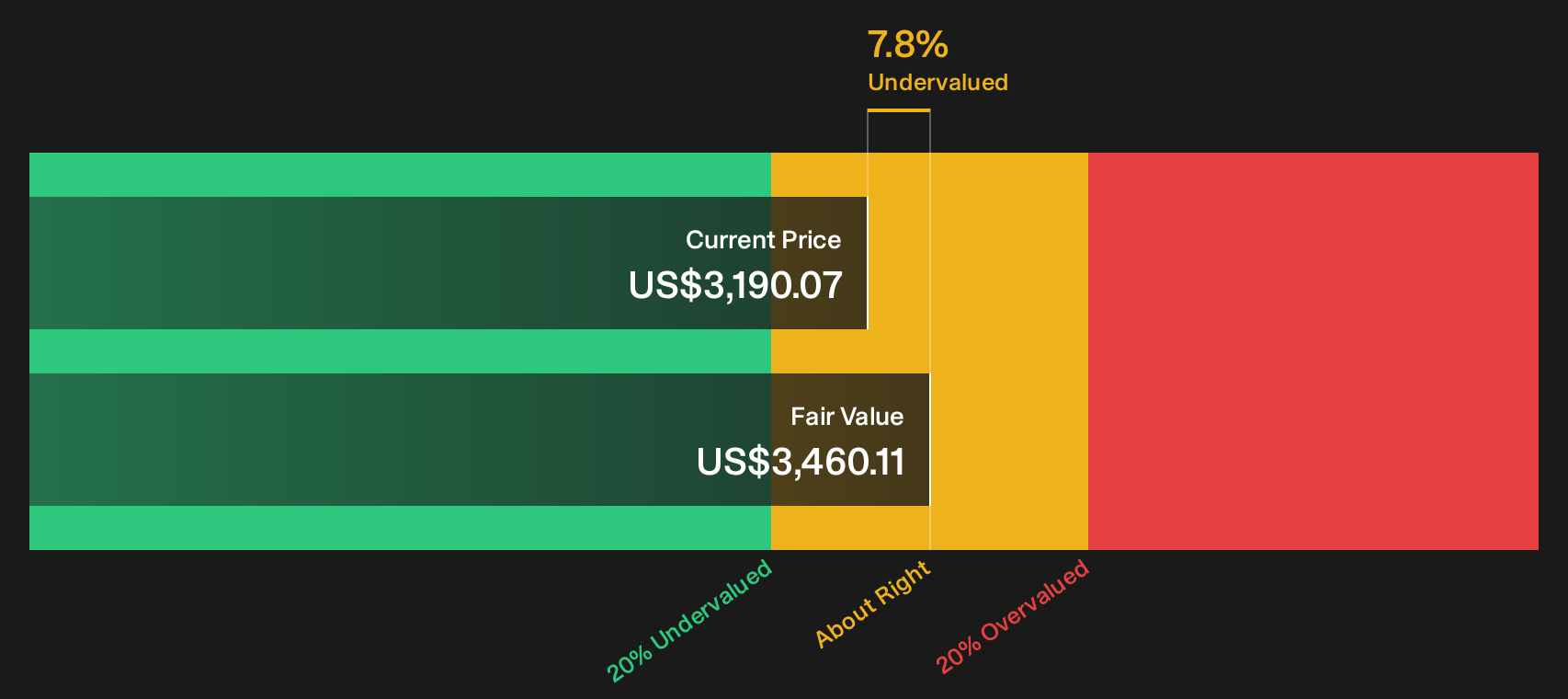
The first narrative pegs AutoZone as roughly 13% overvalued, yet the current share price of $3,190.07 sits about 7.8% below one fair value estimate based on our DCF model at $3,460.11. One method leans cautious, the other signals upside. Which set of assumptions do you find more convincing?
For readers who want to see how this cash flow based view is built line by line, there is more detail in the Look into how the SWS DCF model arrives at its fair value.
Next Steps
Sentiment on AutoZone is clearly split, with some investors focused on execution risks while others highlight long term strengths and cash flow support. Move quickly to test those views against the underlying data by weighing up the 3 key rewards and 2 important warning signs
Looking for more AutoZone sized ideas?
If you stop here, you only see part of the opportunity set. Use the Simply Wall Street Screener to compare AutoZone with other ideas that might fit your style.
- Target reliability by lining up companies that focus on predictable financial strength through the list of solid balance sheet and fundamentals (24 results).
- Chase quality at a sensible entry point with the help of our 29 high quality undervalued stocks.
- Build an income focused shortlist that prioritises durable payouts using the 5 dividend fortresses.
Have feedback on this article? Concerned about the content? Get in touch with us directly. Alternatively, email editorial-team@simplywallst.com