
Apple Just Became the Most Valuable Company in the World. It Faces a Key iPhone Test.
Surging capital inflows and robust underlying fundamentals continue to push market capitalizations to unprecedented, historic highs. Driven by relentless hardware innovation, expanding high-margin digital services ecosystems, and unmatched global brand loyalty, top-tier technology leaders are increasingly securing their dominance at the apex of global financial markets.
Marking another major milestone in financial history, Apple (AAPL) briefly reclaimed its position as the most valuable company in the world last week. Let's take a closer look.
About Apple Stock
Apple is a leading global technology company known for its iPhone, Mac, iPad, Apple Watch, and AirPods product lines. The company's ecosystem also includes services such as the App Store, Apple Music, iCloud, and Apple Pay. With growing investments in artificial intelligence (AI), software innovation, and premium consumer devices, Apple continues to strengthen its competitive position across global tech markets.
AAPL stock has delivered strong returns in 2026, supported by robust iPhone demand, resilient services revenue, and investor optimism surrounding the company's AI strategy. Shares have gained approximately 27% year-to-date (YTD), outperforming the S&P 500's ($SPX) roughly 13% gain over the same period.
The stock's total return so far this year has exceeded the broader S&P 500, highlighting its strong performance in 2026. However, the S&P 500 Information Technology Index ($SRIT) remains the more relevant sector benchmark for Apple. On Oct. 26, the index rose 1.5% while AAPL shares edged 1.1% lower, indicating that the stock did not participate in that day's tech-sector advance. Currently, the S&P 500 Information Technology Index is up about 25% YTD.
Apple Reports Strong Q3 Results
Apple reported third-quarter fiscal 2026 revenue of $109.4 billion for the period ended June 27, representing a 16% year-over-year (YOY) increase. Diluted EPS reached $2.02, up 29% YOY. The company exceeded analyst expectations of approximately $109 billion in revenue and EPS of $1.89, benefiting from stronger iPhone and Mac sales as well as continued growth in Services.
Apple recorded a gross margin of 50.1% in Q3, including a “favorable impact of approximately 2 percentage points from tariff refunds.” Net income reached $29.79 billion, while operating cash flow set a June-quarter record at $34.4 billion. Revenue from iPhone, Mac, and Services each reached new June-quarter highs, and Apple's active installed base achieved an all-time record across major product categories and geographic markets. However, the tariff-related benefit added approximately $0.11 to diluted EPS, making underlying profitability and potential component-cost pressures important considerations for investors. Meanwhile, Apple's growing Services ecosystem continues to support recurring revenue and customer retention.
Looking ahead, Apple is scheduled to report Q4 results on Nov. 2. Analysts currently estimate revenue of approximately $113.3 billion and EPS of $1.98, although these are consensus forecasts rather than official company guidance. Management has highlighted AI innovation, including the introduction of an updated Siri experience, alongside continued strength across its product and services portfolio. Investors will monitor iPhone demand, Apple Intelligence adoption, Services growth, memory costs, and gross margins for signals about the company's next growth phase.
Apple Becomes the World’s Most Valuable Company
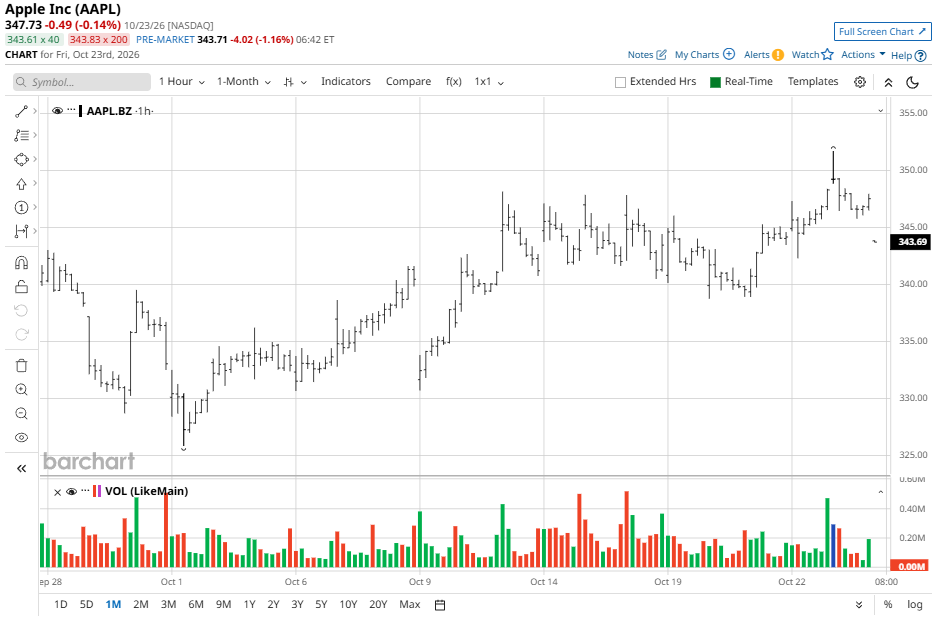
Shares of AAPL stock climbed to a record $351.73 in trading on Oct. 23, pushing Apple's market capitalization to approximately $5.1 trillion and allowing it to briefly overtake Nvidia (NVDA) as the world's most valuable publicly traded company.
Apple has gained around 27% in 2026, outperforming several “Magnificent Seven” peers, supported by investor optimism and the global launch of its iPhone Duo. However, the rally has pushed Apple's valuation to approximately 36.2 times forward earnings, raising concerns about further upside.
Last week, Loop Capital downgraded AAPL stock to “Hold” from “Buy” and reduced its price target to $330 from $370, citing lower iPhone shipment estimates and potential gross margin pressure. Investors will watch upcoming earnings, iPhone demand, and Apple's ability to justify its premium valuation.
Should You Buy AAPL Stock?
Apple's position as one of the world's most valuable companies highlights its strong brand and investor confidence. However, its premium valuation and concerns about iPhone shipments warrant caution.
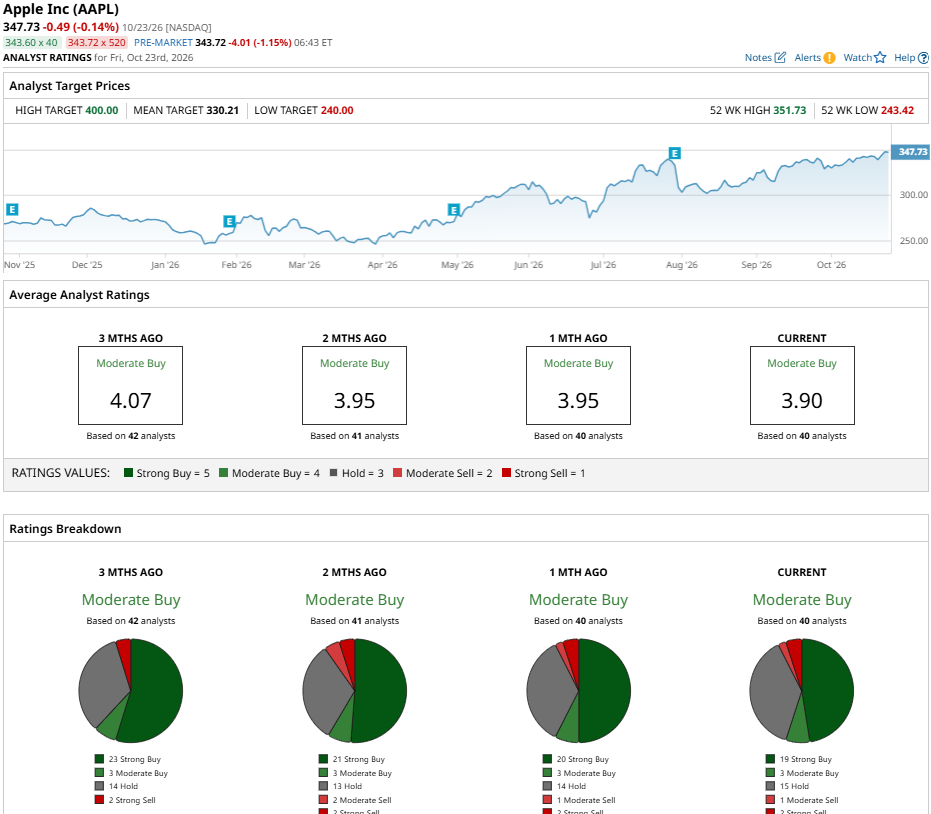
Wall Street analysts maintain a consensus “Moderate Buy” rating for Apple stock. Across 40 analysts with coverage, 19 have a “Strong Buy” rating, three have a “Moderate Buy,” 15 analysts have a “Hold” rating, one analyst has a "Moderate Sell," and two have a “Strong Sell” rating. The mean price target of $330.75 implies potential downside of more than 4% from current levels.
On the date of publication, Ruchi Gupta did not have (either directly or indirectly) positions in any of the securities mentioned in this article. All information and data in this article is solely for informational purposes. For more information please view the Barchart Disclosure Policy here.