
Ford's Maverick Hybrid Sales Just Surged 60%. Here's Exactly Why Investors Should Care.
Key Points
Ford's third-quarter U.S. sales declined 6.6%, but the Maverick was a major bright spot.
Its Maverick Hybrid sales jumped nearly 60% during the third quarter.
Ford finds that many of its hybrids are more profitable than their gas-powered counterparts.
If you only glanced at Ford Motor Company's (NYSE: F) third-quarter U.S. sales results, you might have walked away a tad disappointed. After all, the Detroit automaker reported a 6.6% decline in U.S. vehicle sales, which remains Ford's profit engine.
However, buried beneath that headline was one vehicle putting up numbers that deserve a second look from investors: the Maverick Hybrid. And its success could tell us something important about what American consumers actually want.
Missed AI’s "Act 1"? Act 2 Could Be 15x Bigger. Most investors think they missed the AI boat because they didn't buy Nvidia in 2005. But according to our analysts, we’re only at the end of "Act 1"—the R&D phase. "Act 2" is the global rollout. Continue »
A little truck making big moves
Ford sold 27,793 Maverick Hybrid pickups during the third quarter, a whopping 59.6% increase compared to the prior year. That was a third-quarter record, and it helped push the hybrid pickup's sales to a record 74,300 vehicles through September.
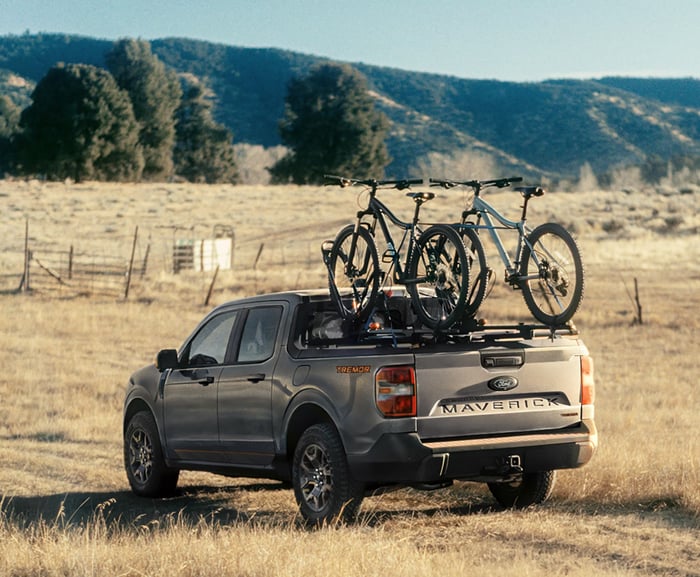
Ford's Maverick. Image source: Ford Motor Company.
Here's where things get a little interesting. Ford sold 41,970 Mavericks overall during the quarter, meaning the hybrid accounted for roughly two-thirds of the nameplate's sales. That's impressive for a vehicle offering customers an alternative to the traditional gasoline-powered pickup.
It's also worth putting Ford's broader sales decline into context. Management attributed much of the weakness to its planned phaseout of the Escape and Lincoln Corsair. Excluding those vehicles, Ford estimated its overall sales volume was essentially flat compared to the prior year. In other words, the headline decline doesn't tell the entire story.
Why investors should care
Here's where the Maverick hybrid's success becomes particularly intriguing. Investors might assume hybrid vehicles are less profitable than their gasoline counterparts because of the additional costs of batteries and electric motors. But Ford CEO Jim Farley has previously stated that many of the company's hybrids are actually more profitable than their gasoline equivalents.
In fact, Farley has specifically pointed to the F-150 Hybrid as delivering higher margins than its traditional gasoline counterpart -- which is really a bit surprising. Now, that doesn't necessarily mean the Maverick Hybrid enjoys the same advantage. Ford doesn't give us that level of transparency, and investors shouldn't assume its lower-priced pickup generates similar margins.
But consider the possibility. If the Maverick Hybrid is among Ford's more profitable hybrid offerings, its rapidly growing sales could do more than increase revenue. It could also improve the profitability of Ford's Maverick lineup, especially given that hybrid sales in the U.S. are thriving while adoption of full EVs remains slower than originally anticipated. That's a much more compelling development than a simple sales record.
What it all means
For long-term Ford investors, the Maverick Hybrid's sales surge is an encouraging sign that the company understands an important segment of the market. It's not going to transform Ford's financial results overnight, and investors should still pay close attention to profitability and margins as the company tries to counter the long-standing "low-margin industry" narrative.
But sometimes the most revealing automotive trends aren't found in the biggest vehicles or the flashiest technology. Sometimes they're hiding in a smaller hybrid pickup that's quietly winning over customers, and if it makes better margins while it's at it, that's a big win.
Daniel Miller has positions in Ford Motor Company. The Motley Fool has no position in any of the stocks mentioned. The Motley Fool has a disclosure policy.