
Micron Just Unveiled a New Bonus Plan. What That Means for MU Stock.
Micron Technology (MU) stock is in focus after the memory-chip giant unveiled a new global employee bonus plan that ties quarterly payouts to company profits, adding a new dimension to its strategy as artificial-intelligence (AI)-driven demand continues to fuel record earnings. Starting in fiscal 2027, eligible employees will receive quarterly bonuses based on a formula that considers profit after tax and projected capital spending, with payouts split equally between cash and shares.
The move follows months of pressure from Micron’s Taiwan workforce for a greater share of the company’s AI-fueled profits, including demands for a fixed percentage of operating profit. While the plan could help Micron retain talent and ease labor tensions, it also introduces an additional cost tied directly to profitability.
Now it remains to be seen whether the new compensation structure could weigh on margins and earnings or instead help Micron maintain the workforce needed to capitalize on booming demand for high-bandwidth memory and other AI-related chips.
About Micron Technology Stock
Micron Technology is a semiconductor company that designs, develops, manufactures, and sells memory and storage products globally, including DRAM, NAND flash memory, HBM, solid-state drives (SSDs), and other memory modules. Headquartered in Boise, Idaho, Micron operates multiple business units serving cloud/data-center, mobile and client, automotive/embedded, and enterprise segments worldwide. Micron boasts a $1 trillion market cap, putting it among the largest and most valuable players in the global semiconductor industry.
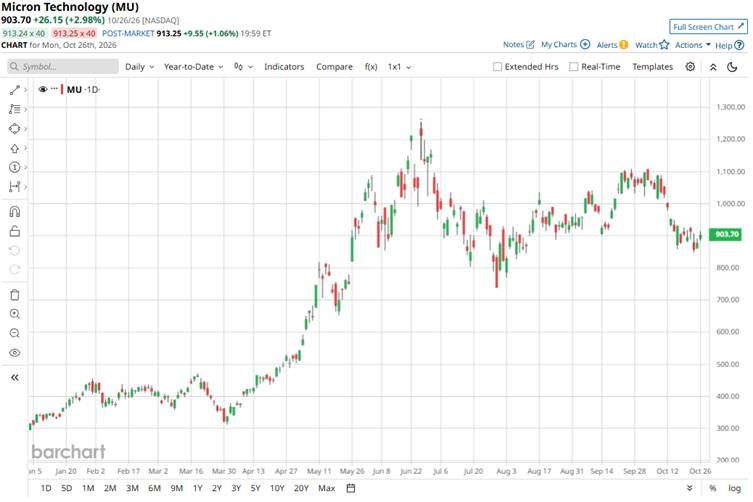
Micron Technology stock has delivered exceptional long-term gains, but the shares have recently entered a period of consolidation following an extraordinary AI-fueled rally. MU has surged 312.6% over the past year and 216.6% year-to-date (YTD), while its five-year return stands at roughly 1,139.3%, underscoring how dramatically investor sentiment toward the memory-chip maker has improved as AI infrastructure has accelerated demand for DRAM and high-bandwidth memory.
However, that massive run has also left the stock vulnerable to profit-taking and shifts in sentiment. MU has slumped 16.5% over the past month and remains about 28% below its 52-week high, reached on June 25.
Plus, the selling intensified on Oct. 22, when Micron plunged 6.3%. While Micron’s new profit-linked bonus program could add pressure to margins, the announcement alone does not appear to explain the stock’s recent weakness. MU’s Oct. 22 selloff came amid a broader semiconductor retreat and renewed concerns over AI spending and valuations. The subsequent rebound of 2.5% on Oct. 23 and nearly 3% on Oct. 26 suggests investors viewed the bonus plan as a manageable cost rather than a major threat to Micron’s long-term earnings outlook.
However, the stock still seems to be trading at a discount compared to industry peers at 4.84 times forward earnings.
Strong Q4 Results
Micron Technology delivered a record fiscal fourth quarter and full-year 2026, with results released on Sept. 30, as surging AI-related demand for memory and storage drove a dramatic improvement. In fiscal Q4, revenue jumped 379.1% year-over-year (YOY) to $54.2 billion.
On an adjusted basis, net income climbed to $38.4 billion, or $33.42 per share, from $3.5 billion, or $3.03 per share, exceeding expectations. Gross margin was another major highlight, expanding to 86.8% from 44.7%, while operating income surged to $43.8 billion from $3.7 billion. Operating cash flow also jumped to $44 billion from $5.7 billion, underscoring the strength of Micron’s underlying cash generation.
For the full fiscal year, Micron’s transformation was even more striking. Revenue surged 256% to $133.2 billion. Adjusted net income rose to $86.8 billion from $9.5 billion, with adjusted EPS increasing to $75.52 from $8.29. Full-year gross margin more than doubled to 80.7% from 39.8%, while operating income soared to $99.3 billion from $9.8 billion. Operating cash flow climbed more than fivefold to $89.7 billion from $17.5 billion, while adjusted free cash flow reached $62.3 billion.
Micron also provided a strong fiscal Q1 2027 outlook, reinforcing the AI-driven demand story. The company expects revenue of $61.5 billion, plus or minus $1.5 billion. On a non-GAAP basis, Micron expects gross margin of roughly 86.3%, operating expenses of approximately $2.1 billion and adjusted EPS of $38.15, plus or minus $1.00.
The company said AI demand is tightening memory supply and demand into fiscal 2027 and 2028, with most of its 2027 high-bandwidth memory output already contracted. Long-term customer commitments also increased to $32 billion, up from $22 billion in June.
Meanwhile, the consensus EPS estimate of $177.03 for fiscal 2027 reflects an increase of 136.5%, while the EPS estimate of $207.57 for fiscal 2028 indicates a 17.3% rise YOY.
What Do Analysts Expect for Micron Stock?
Most recently, Bank of America analyst Vivek Arya reiterated a “Buy” rating on Micron Technology and maintained a $1,550 price target after meeting with Micron executives in New York and Boston. Arya said he came away “incrementally more positive on memory,” with the meetings reinforcing his view that the current memory upcycle could prove considerably more durable than previous cycles.
Earlier this month, D.A. Davidson analyst Gil Luria raised his Micron Technology price target to a Street-high $3,000 from $2,100 on Oct. 7, while maintaining a “Buy” rating.
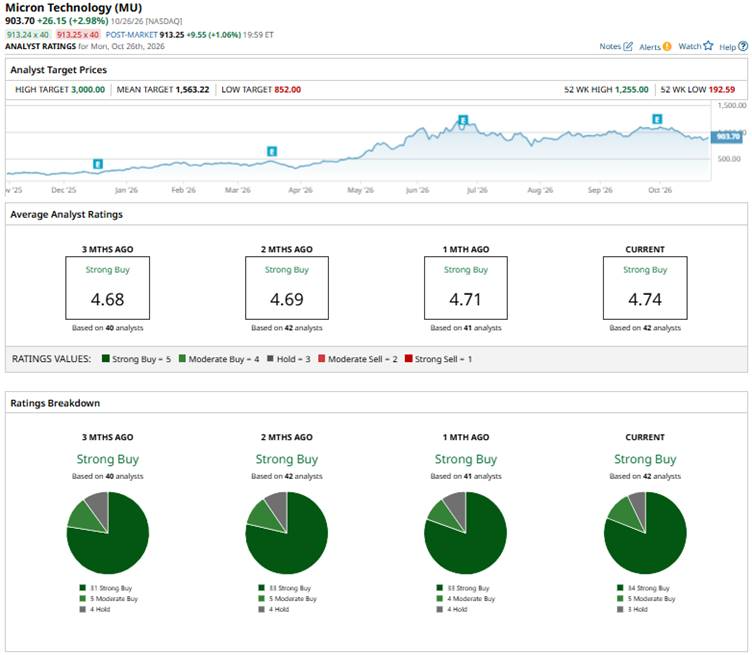
Overall, MU has a consensus “Strong Buy” rating. Of the 42 analysts covering the stock, 34 advise a “Strong Buy,” five suggest a “Moderate Buy,” and three analysts are on the sidelines, giving it a “Hold” rating.
While the average analyst price target of $1,563.22 suggests an upside of 73%, D.A. Davidson’s Street-high target price of $3,000 suggests that the stock could rally as much as 232%.
On the date of publication, Subhasree Kar did not have (either directly or indirectly) positions in any of the securities mentioned in this article. All information and data in this article is solely for informational purposes. For more information please view the Barchart Disclosure Policy here.