
The Bet Rio Tinto Group Holders Made
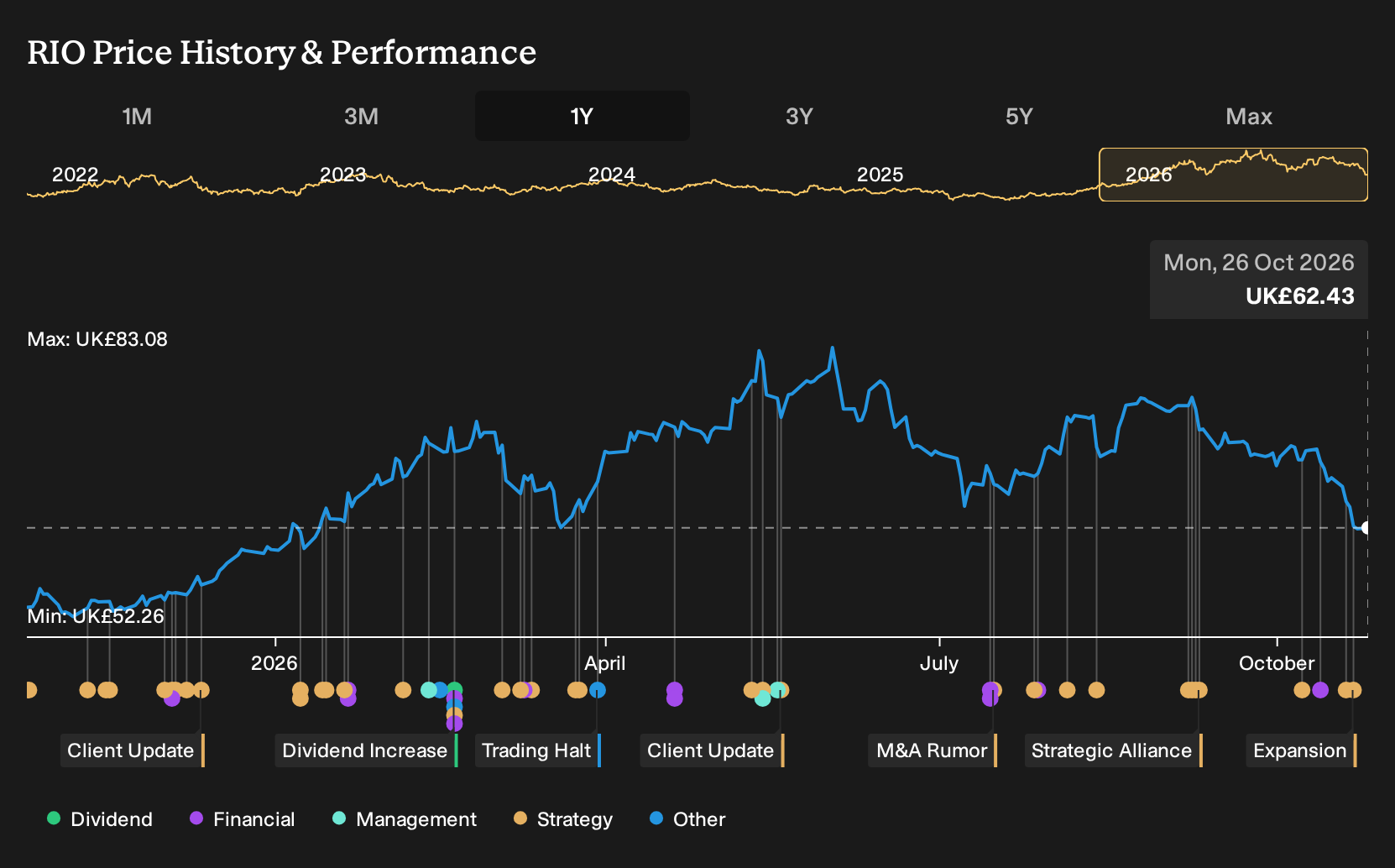
If you had read only the July 2025 debates about Rio Tinto Group’s aging Pilbara assets, rising costs, and decarbonization spend, a smooth ride would not have felt like the base case. For Rio Tinto Group shareholders, the return over the past year was 22.7%, including dividends. That gain landed alongside fresh headlines on record iron ore shipments, higher copper output, class action risk, and big-ticket growth projects. If you were deciding back in October 2025, which of those conflicting signals should have mattered most?
Rio Tinto Group is not the only name tied to this theme. Zero in on 16 top copper producer stocks and compare how each one is priced.
The Argument You Would Have Been Weighing Up On Rio Tinto Group
The shares cost £53.25 at the start of the period, and anyone looking at Rio Tinto Group then had to choose between two sharply different stories that both sounded plausible.
In the bullish case, the fair value was set at £67.78. This was a notional price implied by optimistic assumptions about the business, built on global decarbonization and urbanization lifting demand for critical minerals and supporting higher production and margins.
On the cautious side, the bearish view put fair value at £39.91. This was anchored to worries that aging Pilbara iron ore assets, rising costs, and decarbonization spending could erode profitability over time.
What The Results Changed For Rio Tinto Group
Rio Tinto Group then reported H1 2026 revenue of US$31,028m and net income of US$6,664m, alongside a higher net margin of 21.5% versus 16.8% in H1 2025. That shift in profit quality and efficiency leaned toward the optimistic case that assumed stronger earnings power, although ongoing class action risk still echoed the cautious story.
The episode turned on one assumption: that decarbonization and growth projects would show up in higher profitability. For any other miner, track net margin trends against major project spending to see if that promise is actually appearing in the numbers.
What Rio Tinto Group’s Price Already Bakes In
Today Rio Tinto Group trades at £62.43. The selected Narrative’s Fair Value sits above the current price and is based on the idea that expansion in copper and lithium projects can support resilient earnings and cash generation despite cost, geopolitical, and commodity price pressures.
For an investor considering today’s level, the key question is whether Rio Tinto Group can keep delivering large growth projects on time and on budget so that higher copper and lithium volumes translate into durable profitability.
"Operational efficiency, timely project delivery, and a high-quality asset base strengthen earnings stability, investor confidence, and access to premium contracts and capital. Persistent operational, market, and geopolitical pressures threaten cost efficiency, market stability, and long-term growth, while expansion into new commodities increases execution and financial risks."
The price and this Narrative do not agree. → Uncover what this Narrative says Rio Tinto Group is actually worth
Looking Beyond Rio Tinto
After you have sized up Rio Tinto, another question comes next. Where else does demand for iron ore and copper show up for investors?
Another miner leans on both materials, with iron ore driving a large share of revenue. Copper has become a bigger swing factor as electrification expands across industries.
This business also digs up coal and other metals, but its core remains iron ore and copper together. That mix connects traditional steelmaking activity with energy transition spending.
Scale in those pits can influence costs, bargaining power, and future project choices. The unresolved issue is how that blend will navigate the next commodity cycle.
It is written up in full, assumptions and all. → Explore the Narrative that puts this company 109% above its price
Have feedback on this article? Concerned about the content? Get in touch with us directly. Alternatively, email editorial-team@simplywallst.com