
Herc (NYSE:HRI) beats Q3 2026 sales expectations but full-year sales guidance misses expectations significantly

Equipment rental company Herc Holdings (NYSE:HRI) reported revenue ahead of Wall Street’s expectations in Q3 2026, with revenue up 4.6% year on year to $1.36 billion. On the other hand, the company’s full-year revenue guidance of $4.51 billion at the midpoint came in 8.9% below analysts’ consensus estimates. Its non-GAAP profit of $3.91 per share was 33.8% above analysts’ consensus estimates.
For more on Herc, read our free full research report.
Herc (HRI) Q3 2026 highlights:
- Revenue $1.36 billion vs S&P analysts’ consensus estimates of $1.34 billion (4.6% year-on-year growth, 2% beat)
- Adjusted EPS $3.91 vs S&P analysts’ consensus estimates of $2.92 (33.8% beat)
- Adjusted EBITDA $603 million vs analysts’ consensus estimates of $580.7 million (44.2% margin, 3.8% beat)
- Revenue guidance The company lifted its revenue guidance for the full year to $4.51 billion at the midpoint from $4.43 billion, a 2% increase
- EBITDA guidance $2.13 billion at the midpoint for the full year, above analysts’ consensus estimates of $2.09 billion
- Operating margin 23.6%, up from 13.1% in the same quarter last year
- Free cash flow margin 7.3%, up from 2.3% in the same quarter last year
- Market capitalization $4.25 billion
“Our team delivered an exceptional third quarter, leveraging our scale, broad equipment offering, deep customer relationships and superior project execution to capitalize on accelerating customer demand,” said Larry Silber, chief executive officer. “Equipment rental revenue increased 12% on an average OEC fleet that increased less than 2%, resulting in a 360 basis point improvement in dollar utilization. Expert fleet management drove high time utilization and disciplined fleet deployment, while pricing improvement and a higher specialty mix further enhanced fleet efficiency.
Revenue growth
A company’s long-term revenue performance is one signal of its overall quality. Any business can have short-term success, but a top-tier one grows for years. Herc’s revenue grew at a strong 19.5% compounded annual growth rate over the last five years. Its growth beat the average industrials company and shows its offerings resonate with customers.
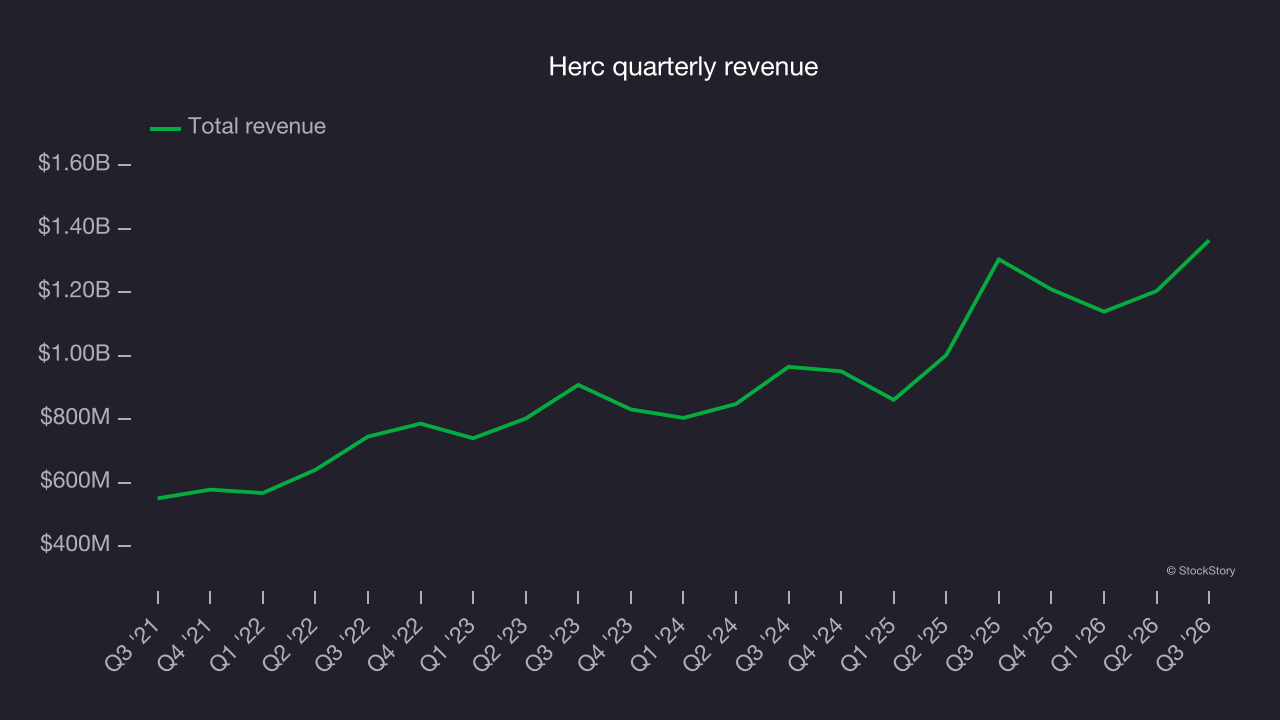
Long-term growth matters most, but within industrials, a half-decade historical view may miss cycles, industry trends or a company capitalizing on catalysts such as a new contract win or a successful product line. Herc’s annualized revenue growth of 19.4% over the last two years aligns with its five-year trend, suggesting its demand was predictably strong. 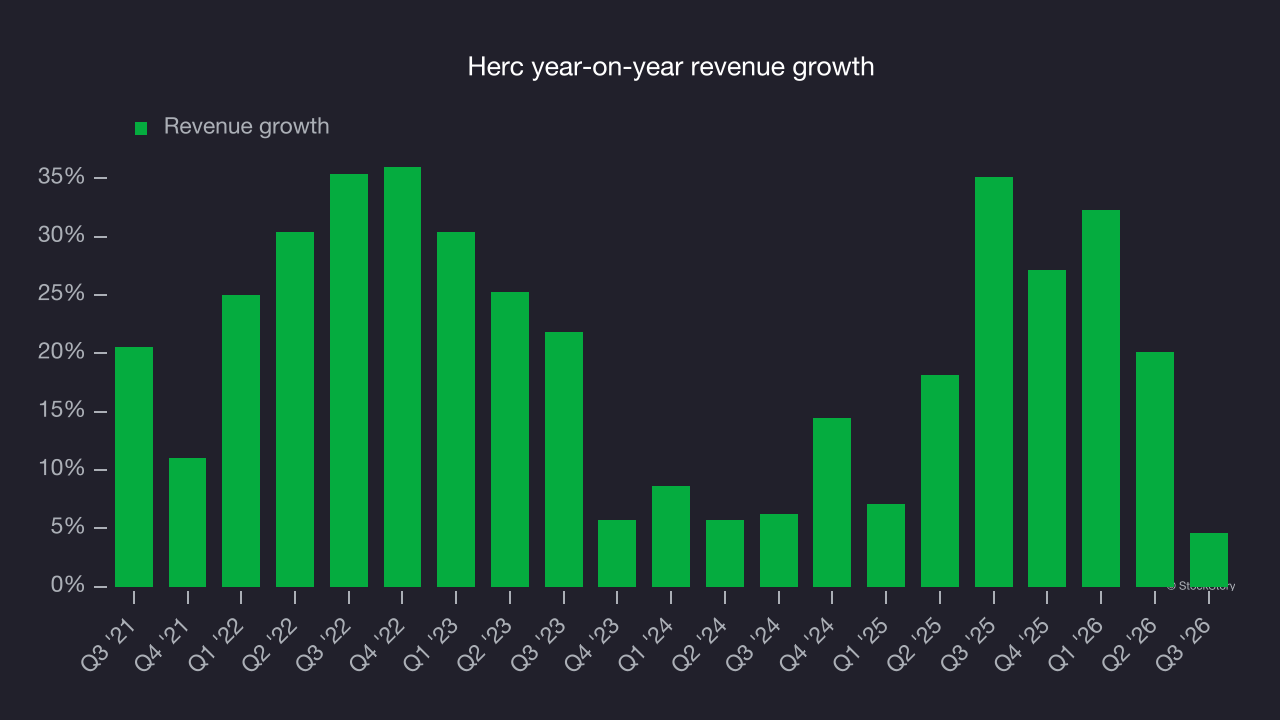
Herc also breaks out the revenue for its most important segment, Equipment rentals. Over the last two years, Herc’s Equipment rentals revenue (aerial, earthmoving and material handling) averaged 18.7% year-on-year growth. 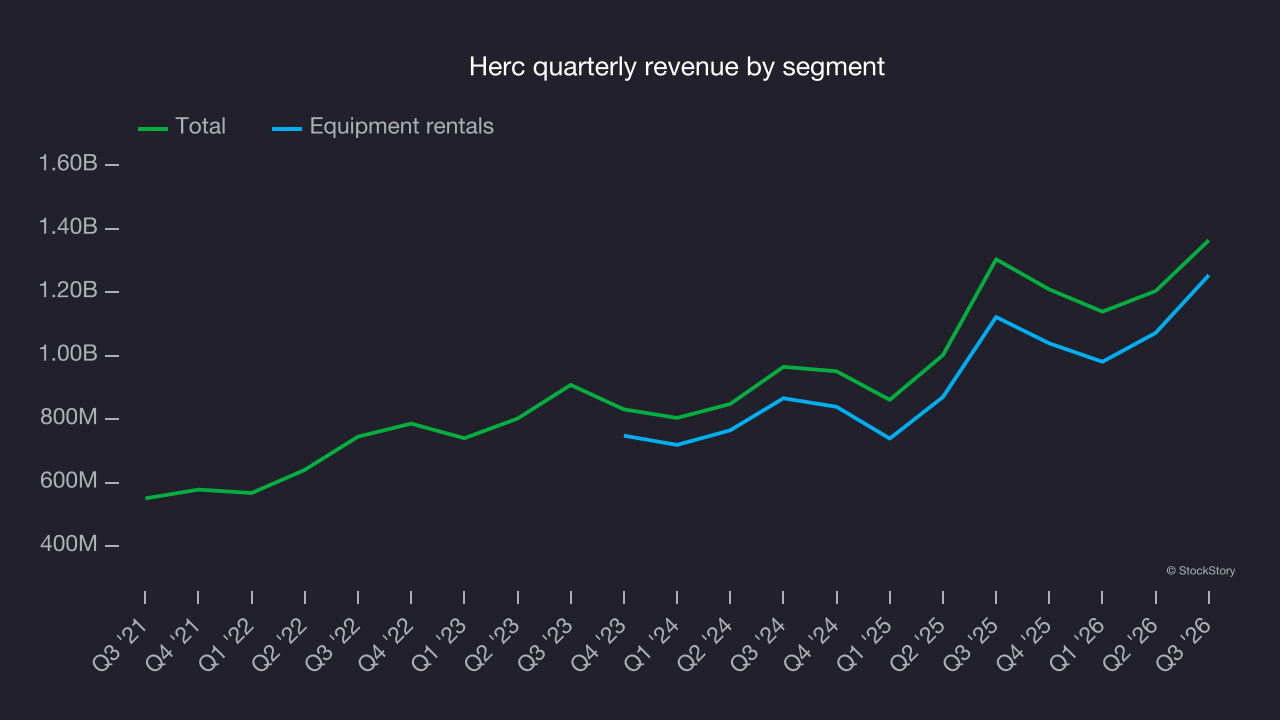
This quarter, Herc reported modest year-on-year revenue growth of 4.6% but beat Wall Street’s consensus estimates by 2%.
Looking ahead, sell-side analysts expect revenue to grow 7.9% over the next 12 months, according to S&P, a deceleration versus the last two years. Still, this projection is above average for the sector and suggests the market is forecasting some success for its newer products and services.
Operating margin
Herc has performed well over the last five years. It demonstrated high profitability for an industrials business, with an average operating margin of 17.1%. That result is unsurprising given its favorable gross margin baseline.
Analyzing the trend in its profitability, Herc’s operating margin decreased by 4.6 percentage points over the last five years. This raises questions about the company’s expense base because its revenue growth should have given it leverage on its fixed costs, resulting in better economies of scale and profitability.
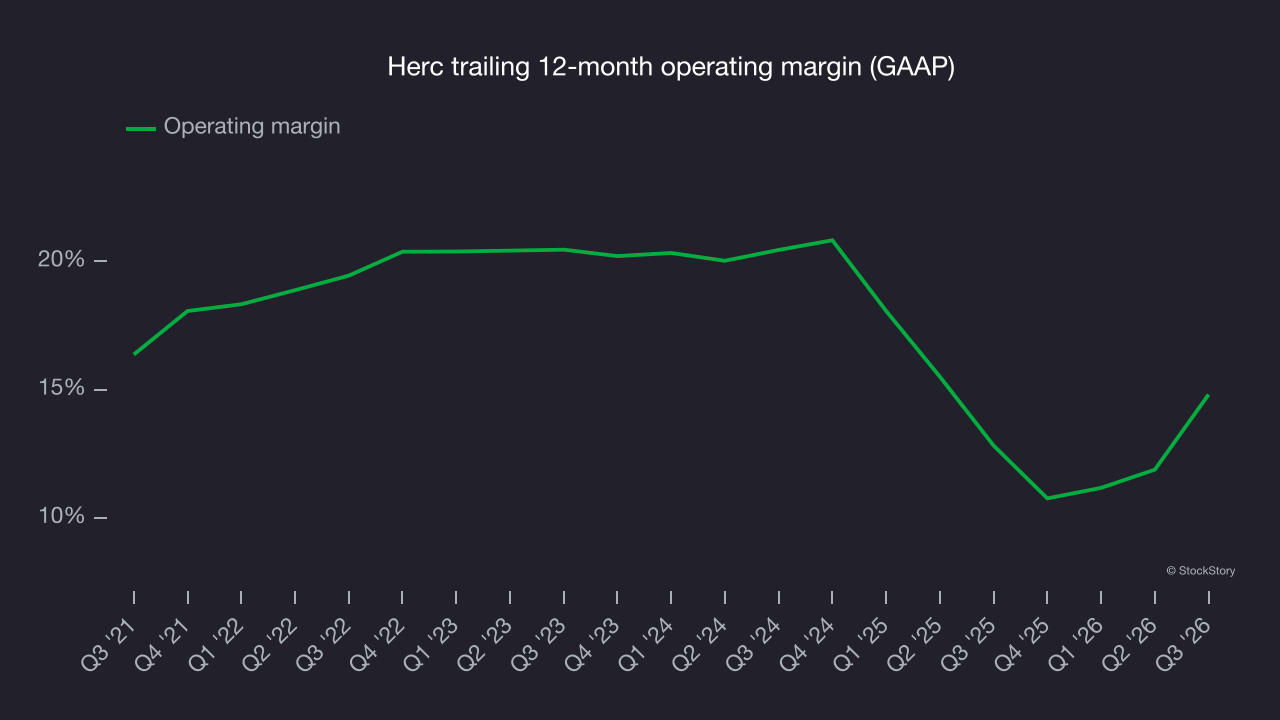
In Q3, Herc generated an operating margin of 23.6%, up 10.5 percentage points year on year. The increase was solid, and operating margin rose more than gross margin, suggesting greater efficiency in expenses such as marketing, R&D and administrative overhead.
Earnings per share
Revenue trends explain a company’s historical growth, but the long-term change in earnings per share (EPS) points to the profitability of that growth. For example, a company could inflate its revenue through excessive spending on advertising and promotions.
Herc’s EPS grew at a weak 3.6% compounded annual growth rate over the last five years, lower than its 19.5% annualized revenue growth. However, its operating margin actually improved during this time, telling us that non-fundamental factors such as interest expenses and taxes affected its ultimate earnings.
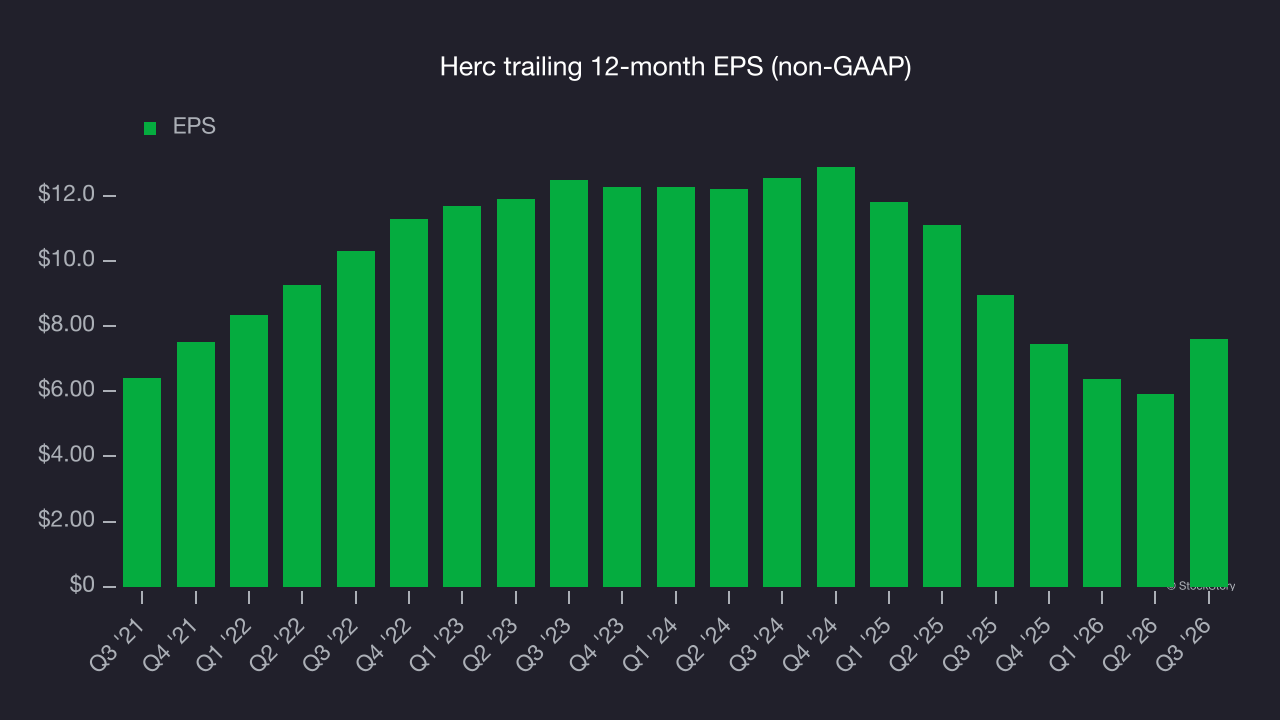
A closer look at Herc’s earnings helps explain the drivers of its performance. As noted earlier, Herc’s operating margin expanded this quarter but declined by 4.6 percentage points over the last five years. Its share count also grew by 9.8%, meaning the company not only became less efficient with its operating expenses but also diluted its shareholders. 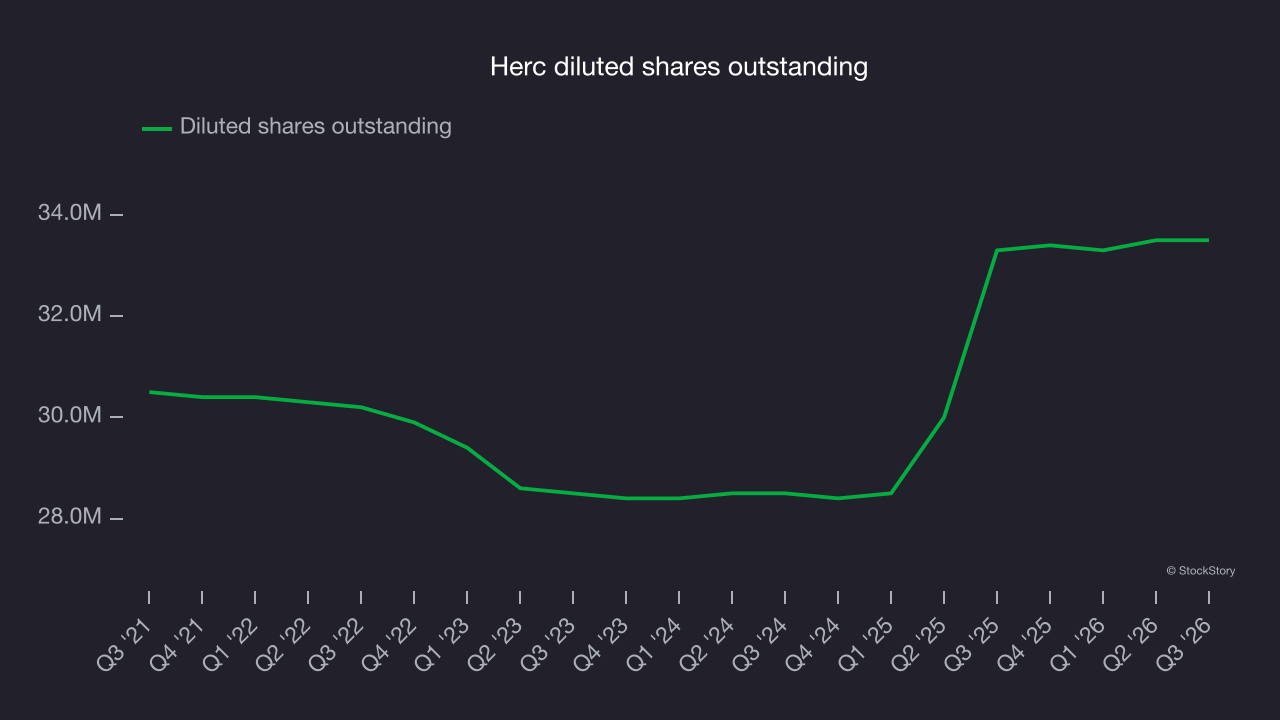
As with revenue, examining EPS over a more recent period can provide insight into an emerging theme or development for the business.
For Herc, its two-year annual EPS declines of 22.1% show it’s continued to underperform. These results were clearly poor.
In Q3, Herc reported adjusted EPS of $3.91, up from $2.22 in the same quarter last year. This result easily cleared analysts’ consensus estimates, a positive for shareholders. Over the next 12 months, Wall Street expects Herc’s full-year EPS to grow 72.8% from $7.62 to $13.17, according to S&P.
Key takeaways from Herc’s Q3 results
Herc’s EPS beat and above-consensus full-year EBITDA guidance gave the quarter some key positives, but its full-year revenue outlook fell short of expectations. Shares rose 4.9% to $133.33 immediately after the results.
Herc had a solid quarter, but the bigger picture matters when deciding whether the stock is a buy. The latest quarter matters, but not nearly as much as longer-term fundamentals and valuation. For more on Herc, read the full research report here (it’s free).