
Will Earnings Report Change WEX Stock Narrative
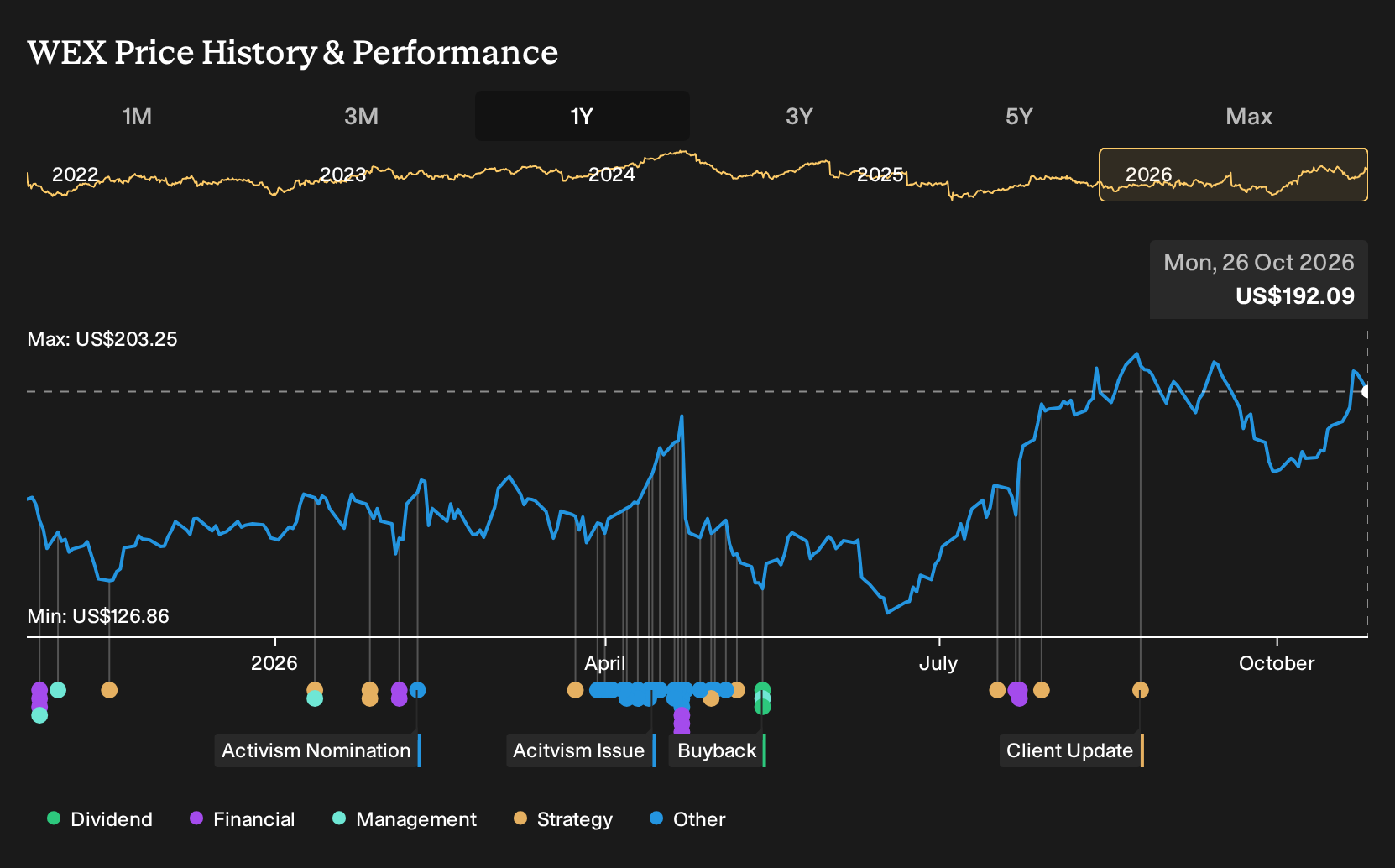
- WEX reported that its third quarter 2026 results were scheduled for October 28, with consensus estimates pointing to higher revenue and earnings supported by demand across its core payment and account management offerings.
- The key angle for investors is how sustained demand across WEX’s mobility, corporate payments and benefits platforms could influence operating mix and capital allocation decisions over time.
- We will now look at how WEX’s investment narrative could be affected by the upbeat earnings expectations tied to core segment demand.
Scan how WEX’s setup compares with other payment and fintech names showing strong momentum using our hand picked 29 high quality undervalued stocks as a starting universe.
WEX Investment Narrative Recap
For a shareholder in WEX, the key belief is that the platform continues to find ways to grow payment volume and fee revenue across Mobility, Corporate Payments and Benefits without letting cost or credit losses offset that progress. The main near term swing factor is how the upcoming third quarter 2026 release confirms or softens the current demand tone across fuel, embedded payments and healthcare benefits.
The biggest operating risk right now centers on mix and disruption. Electric vehicle adoption, pressure on over the road fuel volumes, tougher AP automation competitors and heavier regulatory and cybersecurity scrutiny could all weigh on margins. The scheduled earnings update appears important for insight into how those cross currents are being managed, but it does not by itself redefine the long term WEX narrative.
A particularly relevant detail tied to this earnings setup is that WEX has been focusing on product and channel expansion, especially embedded payments and direct accounts payable. Direct AP volumes were reported to be 20% higher in the second quarter of 2026, with expectations for mid teens growth in the back half of the year, and that trend will be closely watched as investors evaluate third quarter traction.
If that AP and embedded payments engine continues to scale, it could be significant for the near term catalyst around operating leverage, because software and automation heavy flows often carry different economics than legacy fuel cards. Execution missteps, slower than anticipated customer onboarding or aggressive pricing from competitors could all influence how quickly that opportunity translates into ongoing revenue and earnings progress for WEX.
What Current Forecasts Assume For WEX
Analysts are effectively asking you to underwrite a very specific version of WEX’s future. The story on paper links modest top line expansion with a step up in profitability and a tighter share count over the next few years.
On revenue, the consensus framework builds around 3.3% annual growth over the coming three years. That is a steady, not explosive, pace, which puts more pressure on margin progress and capital allocation to do some of the heavy lifting in the model.
Profitability today is framed at a 12.6% margin. The same group of forecasts points to 16.9% three years out. That sort of margin profile usually implies a mix shift toward higher value software, data and benefits flows, along with tighter cost control across WEX Bank, Mobility and Corporate Payments.
Earnings sit at US$350.7 million in the latest snapshot of “today” used in the report. Consensus points to US$519.6 million by 2029, with earnings per share of US$14.91 on that same timetable. The more optimistic projections push profit as high as US$589.2 million, which gives you a sense of the spread in analyst views even when they start from the same business footprint.
To connect those earnings to the share price, the analysis assumes WEX trades on a 16.2x P/E multiple in 2029. This is slightly lower than 16.4x today and a touch below the 16.6x figure quoted for the broader US Diversified Financial group. That puts the spotlight on execution, because the valuation is not assumed to stretch; it is assumed to compress modestly.
Share count is expected to decline by about 0.6% a year for the next three years. Given the existing buyback authorization and the focus on directing more free cash flow into repurchases, this framework treats shrinking equity as a support for per share earnings even if reported profit tracks the middle of the forecast range.
On top of that, the Simply Wall St work uses a discount rate of 8.82% to pull those cash flows and earnings back to present value. That rate sits in the background, but it matters when you think about what kind of implied return you are underwriting when you buy into the WEX equity story.
WEX's narrative projects US$3.1 billion revenue and US$519.6 million earnings by 2029. This setup assumes 3.3% yearly revenue growth and an earnings increase of roughly US$169 million from US$350.7 million today.
On current numbers, the consensus price target sits at US$195.36 per share, compared with a US$168.66 spot price in the report. The bullish end of the range reaches US$224.00, while the most cautious estimate is US$172.00, so there is a clear band of disagreement around how much of the 2029 forecast should already be in the price.
To line up with that central target, you would need to be comfortable that WEX reaches US$3.1b of revenue and US$519.6 million of earnings in 2029 and that the stock is valued on 16.2x those earnings, using a discount rate around 8.8%. The gap between those conditions and your own expectations is where your personal risk and return assessment really sits.
Uncover why WEX's fair value indicates that WEX is consistent with its current price.
Exploring Other Perspectives
One alternate view on WEX leans hard into the risk that its embedded payments pipeline takes longer to convert than hoped. Those analysts plug in only 1.9% annual revenue growth and about US$3.0b in 2029 revenue, with earnings of roughly US$478.0 million. That is a much more cautious story. With third quarter results still ahead, this earnings release can be treated as a fresh checkpoint to compare several such narratives before deciding which version of WEX’s future appears closest to your own expectations.
Explore 3 other WEX fair value estimates, including one that suggests it could be worth just $195.36.
Decide For Yourself
Don't just follow the ticker. Dig into the data and build a conviction that's truly your own.
- A great starting point for your WEX research is our analysis highlighting 3 key rewards and 2 important warning signs that could impact your investment decision.
- See our latest analysis for WEX. The report includes a comprehensive fundamental analysis summarized in a single visual, the Snowflake, making it easy to evaluate WEX's overall financial health at a glance.
Looking for more WEX investment ideas?
If the WEX story has sharpened how you think about risk, return and forecasts, it can be useful to compare that view with other businesses that screen well on quality, valuation and resilience.
- For investors who want potential upside without ignoring fundamentals, start by reviewing our curated 21 high quality undiscovered gems that might not yet be on every watchlist.
- If capital preservation and stability matter most to you, consider scanning companies in our 30 resilient stocks with low risk scores to see which businesses pair lower risk scores with solid financial footing.
- For readers who care about balance sheet strength before anything else, filter candidates through our list of solid balance sheet and fundamentals (24 results) and focus only on businesses with sturdier financial foundations.
Have feedback on this article? Concerned about the content? Get in touch with us directly. Alternatively, email editorial-team@simplywallst.com