
Will Earnings Beat Change Cadence Design Systems Stock Narrative
- Cadence Design Systems reported Q3 2026 results with revenue of US$1.63b and GAAP net income of US$289.75m, and raised full year 2026 guidance alongside fresh GAAP targets for Q4.
- The business pushed deeper into AI with the Maestro AI Model Portfolio and new agentic AI deployments like Nokia’s AuraStack rollout, tying product progress directly to design productivity and customer demand.
- We will now look at how Cadence Design Systems' stronger guidance and Maestro AI launch reshape the existing investment narrative.
Cadence Design Systems Investment Narrative Recap
To own Cadence Design Systems, you need to believe its AI centric design tools, IP and hardware can keep finding new workloads as chip and system complexity climbs. The raised 2026 guidance, with GAAP net income for the year now guided to US$1.331b to US$1.347b, supports that thesis in the near term. The key short term swing factor remains execution on AI driven offerings without letting cost inflation or Hexagon integration spend erode profitability.
The biggest risk still sits in that mix of premium P/E expectations, Hexagon integration drag and export control exposure. Q4 guidance for a GAAP operating margin of 30% to 31% suggests management is planning to hold margins even while absorbing extra operating expenses. If Maestro and the AI Super Agents do not see sustained usage or if China or integration headwinds intensify, that combination could test both earnings delivery and investor patience.
The Maestro AI Model Portfolio launch is the announcement that ties closest to the latest results and guidance. Management is not just adding another tool. Maestro sits on top of existing EDA and SDA platforms with reinforcement learning loops, which is meant to translate directly into higher engineering throughput and more stickiness for Cadence Design Systems within customer workflows.
Initial internal results that point to up to 30% better quality of results and up to 5x greater token efficiency compared with a general foundation model go straight to the core catalyst. If customers keep adopting AI Super Agents powered by Maestro, Cadence has a clearer path to defend margins and broaden its usage based, higher margin software layers. The flip side is execution risk. If those gains do not generalize at scale, the AI revenue layer that underpins a lot of optimism around the business could look less certain.
Cadence Design Systems' current analyst narrative points to revenue of US$8.4b and earnings of US$2.0b by 2029, which assumes revenue grows at 12.9% per year and earnings rise by about US$600m from US$1.4b today.
Uncover why Cadence Design Systems' fair value indicates a 26% potential upside to its current price that could narrow quickly.
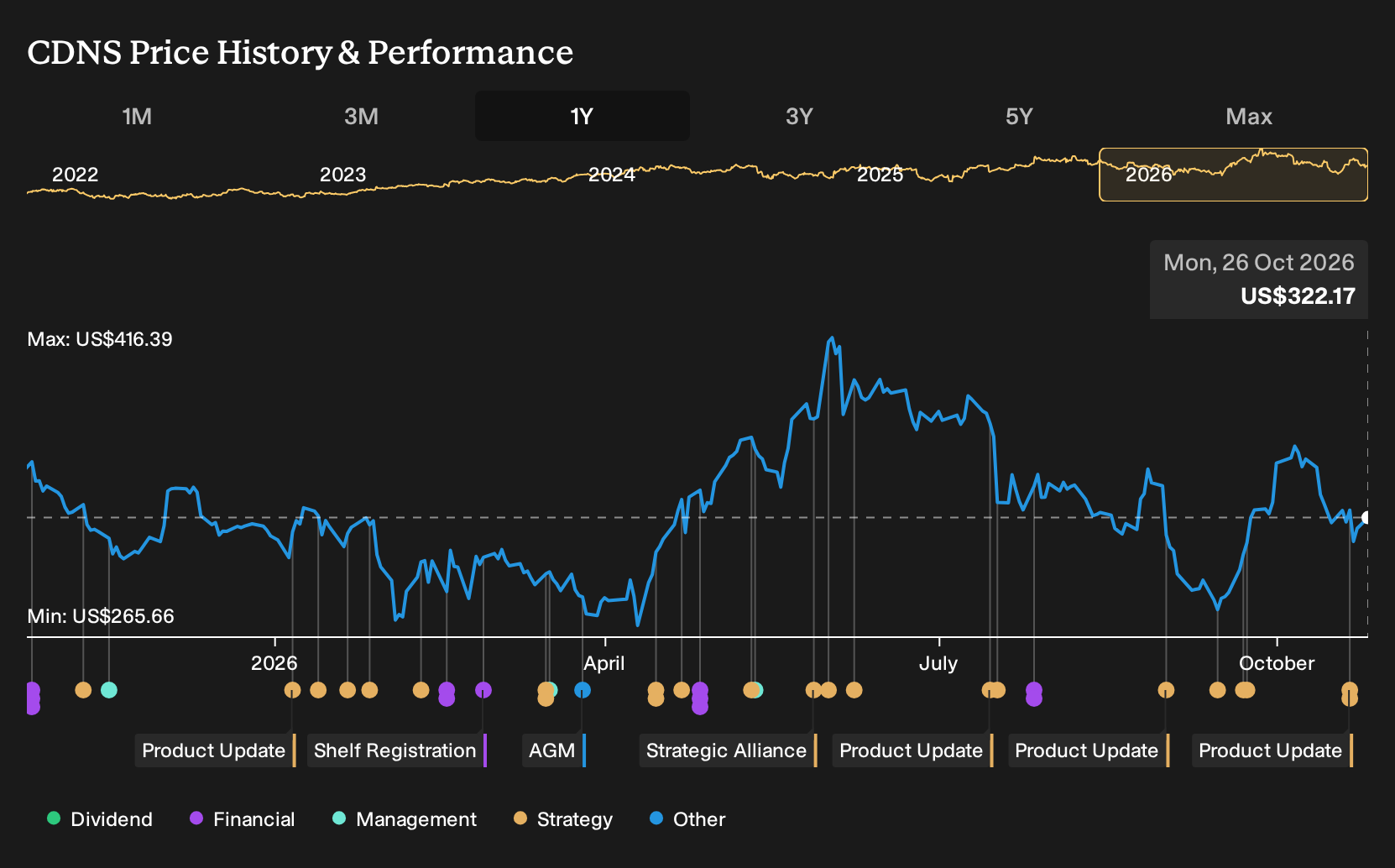
Exploring Other Perspectives
One alternate view places Maestro’s AI monetization risk at the center of the discussion for Cadence Design Systems. The most cautious analysts were only modeling revenue at about US$8.1b and earnings near US$1.7b by 2029 before this guidance and Q3 update. That is a much more pessimistic path. It shows how far opinions can differ and why it can help to compare several narratives before deciding what this new information might mean for you.
Explore 5 other Cadence Design Systems fair value estimates, including one that suggests as much as 38% downside from the current price.
Decide For Yourself
Don't just follow the ticker. Dig into the data and build a conviction that's truly your own.
- A great starting point for your Cadence Design Systems research is our analysis highlighting 3 key rewards that could impact your investment decision.
- See our latest analysis for Cadence Design Systems. The report includes a comprehensive fundamental analysis summarized in a single visual, the Snowflake, making it easy to evaluate Cadence Design Systems' overall financial health at a glance.
Looking For More Investment Ideas Beyond Cadence Design Systems?
If the Cadence Design Systems story has sharpened your thinking about AI, cash flows and balance sheet strength, it can help to compare it with other listed businesses that share some of those qualities but with very different risk profiles.
- For investors who care most about resilient balance sheets and steady fundamentals, start with this curated list of solid balance sheet and fundamentals (24 results) that can help you compare Cadence Design Systems with companies that carry less financial strain.
- If you want to focus on mispriced quality, scan a carefully filtered set of companies trading below internal estimates of fair value by checking out the 29 high quality undervalued stocks and see how they differ from Cadence Design Systems on valuation checks.
- Income focused investors can build a watchlist around stronger cash distributions by reviewing the 5 dividend fortresses and weighing those payouts against the more growth oriented profile of Cadence Design Systems.
Have feedback on this article? Concerned about the content? Get in touch with us directly. Alternatively, email editorial-team@simplywallst.com