
The rebound in the British stock market hit a “big budget test”! Tax increases, treasury bond yields, and consumer pressure affect market nerves
The Zhitong Finance App learned that since this year, the UK FTSE 100 Index and FTSE 250 Index have risen 8% and 9% respectively, both outperforming the 5.6% increase of the European Stoxx 50 Index. Since this month, UK large-cap stocks have been particularly strong, fueled by the strengthening of the energy, essential consumer goods and healthcare sectors, which account for about 40% of the FTSE 100 index's weight. Meanwhile, lower valuations and more stable UK Treasury yields boosted mid-cap stocks.
However, at a time when global investors are once again optimistic about the UK market, the fall budget to be announced this Wednesday will be a major test for the country's stock market. At that time, the “punishers” of the bond market will evaluate potential tax increases or consumer support policies to weigh the relationship between these measures and the UK government's limited fiscal space.
The fall budget is expected to benefit the market, but there are differences in risk and return conditions in different industries
The British Burnham government will announce the fall budget on October 28. After the former Chancellor of the Exchequer raised more than 60 billion pounds (about 80 billion US dollars) in the two budgets, the current British Chancellor of the Exchequer John Healy has no intention of introducing another large-scale and impressive fiscal plan. A few words that Healy and Treasury officials have used repeatedly recently — “do no harm,” “keep the current direction,” and “focus on the key points” — seem to have set the tone for the upcoming fall budget.
According to reports, Healy will fund a short-term spending plan aimed at catering to public opinion by raising bank taxes to help voters and businesses that are under pressure due to rising energy costs caused by the US-Iran war. The fall budget will also include a series of measures aimed at reducing the regulatory burden on enterprises, such as simplifying corporate reporting requirements; the government will also extend the suspension of import tariffs on products in various industries, covering fields such as chemicals, plastics, and hydrogen energy. Meanwhile, key issues such as welfare system reform and long-term investment in defense will be postponed.
The market anticipates that this fall budget will not involve large-scale policy adjustments, but may support households and businesses mainly through reallocating spending. The core of the budget is whether it can strike a balance between maintaining fiscal credibility, supporting economic growth, and avoiding further damage to consumption.
If the British government proposes a credible fiscal plan that not only stabilizes public finances but also avoids an obvious impact on consumption, the yield on British treasury bonds may fall, and the risk premium in the stock market may also narrow. And if the British government fails to convince investors that public finances are sustainable, or if budget measures increase pressure on inflation, financing, and consumption, long-term treasury yields may continue to rise and limit the continuation of this round of market conditions in the UK stock market.
Citigroup strategists led by Beata Mantai said, “We believe that the FTSE 100 index has a tactical reason to outperform the market because the UK stock market can effectively hedge against geopolitical risks. However, in the medium term, we are still under-represented in the UK market in our global portfolio.”
Citigroup economists expect that the British government will introduce a budget that is beneficial to the market and prioritizes maintaining fiscal credibility. However, the bank's industry analysts believe that there are differences in the risk-return situation in different industries.
UK utilities, for example, face disproportionate downside risks. If the government focuses on energy affordability, it may push for structural reforms, and the market may not have fully taken into account the possible impact of these reforms.
According to Citibank analysts, UK homebuilders are being pulled by two forces: on the one hand, the new “Your First Home” (Your First Home) plan may boost demand; on the other hand, high UK Treasury yields are putting pressure on housing affordability.
For the banking industry, this budget bill could be a key point in eliminating uncertainty. Analysts said that the market has basically absorbed the possibility of increasing bank surcharges, and the reaction of the British treasury bond market after the budget was announced is probably the more important factor affecting the valuation of the banking sector.
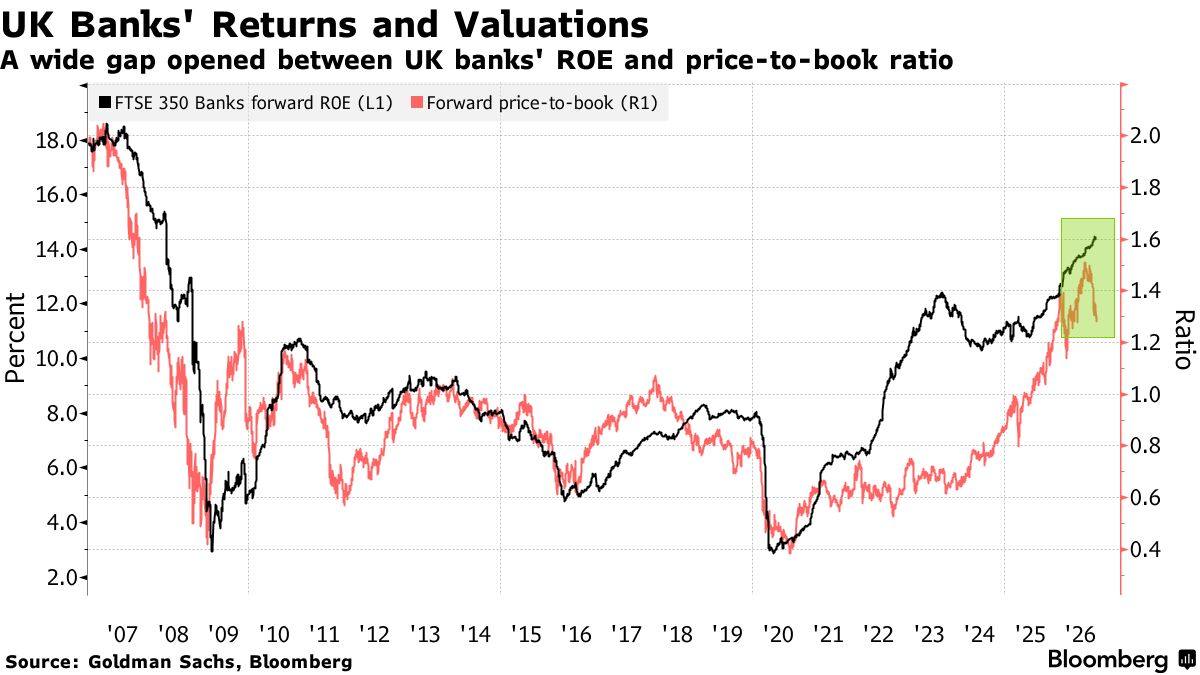
Measured at book value, there is already a clear gap between the Bank of England's valuation and its return on equity, and this gap is more prominent than in the rest of Europe. This indicates that, despite the Bank of England's higher return on equity and rising spreads on mainland European sovereign bonds, investors may still apply a higher risk premium to the Bank of England.
In addition to paying 25% corporate tax, banks in the UK are currently also required to pay 3% bank surtax and bank tax. Goldman Sachs Group analysts pointed out that for every 1 percentage point increase in the Bank of England surtax, it is expected that Barclays Bank (BCS.US)'s net profit forecast for 2028 will be dragged down by about 0.5%; for Lloyds Bank (LYG.US) and NatWest Group Plc (NatWest Group Plc)'s 2028 net profit expectations, the drag is slightly higher than 1%.
Goldman Sachs strategists led by Sharon Bell said, “Raising bank surcharges will have a significant impact. After the budget is announced, if we want to push for a revaluation, the key is whether the risk premium unique to the UK can be reduced and whether the market's confidence in the UK economy can be strengthened.”
Furthermore, after the budget is announced, the next major risk event will be the Bank of England's interest rate decision announced on November 5. The market has almost completely absorbed expectations of interest rate hikes, and this will be the first of the four interest rate hikes the market expects the central bank to raise interest rates by the end of July next year.
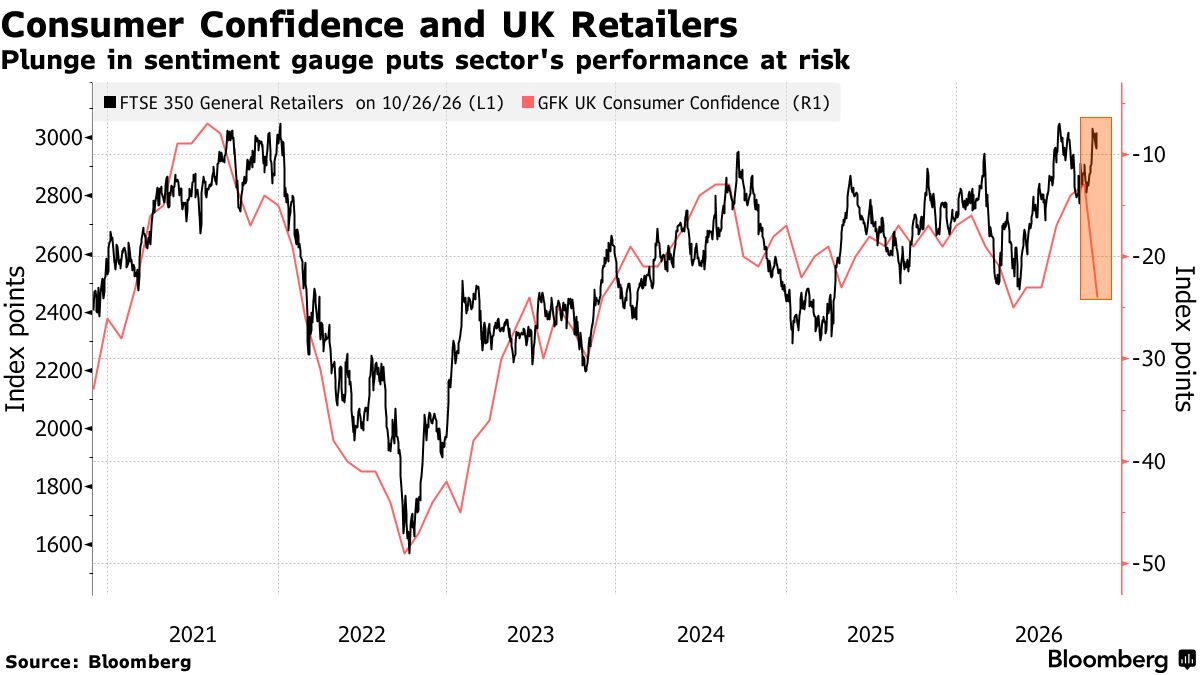
This series of interest rate hikes will have a severe impact on consumers and drive up mortgage costs for many households. It's no surprise, then, that UK consumer confidence experienced its biggest decline this month since the COVID-19 pandemic. This puts the retail sector at risk, particularly when the budget fails to provide substantial support.
The UK stock market is back in favor
In October, the UK stock market benefited from a shift in the allocation of positions of global investors and a shift in capital to more defensive assets. According to Morningstar data, since 2026, UK large-cap exchange-traded funds (ETFs) have attracted an estimated net inflow of $3.4 billion, the highest annual level since 2020.
Investors have renewed their confidence in the FTSE 100 Index, partly reflecting their desire to invest in some of the strongest companies in the London market, such as HSBC Holdings (HSBC.US), British Petroleum (BP.US), Shell (SHEL.US), and Rolls Royce Holdings.
Morningstar analyst Michael Bourne said, “Investors are looking at the UK market with a fresh perspective. Capital inflows from passive funds usually follow market performance, but this also reflects investors' desire to diversify their investment in large US technology stocks and further broaden the scope of stock asset allocation.”
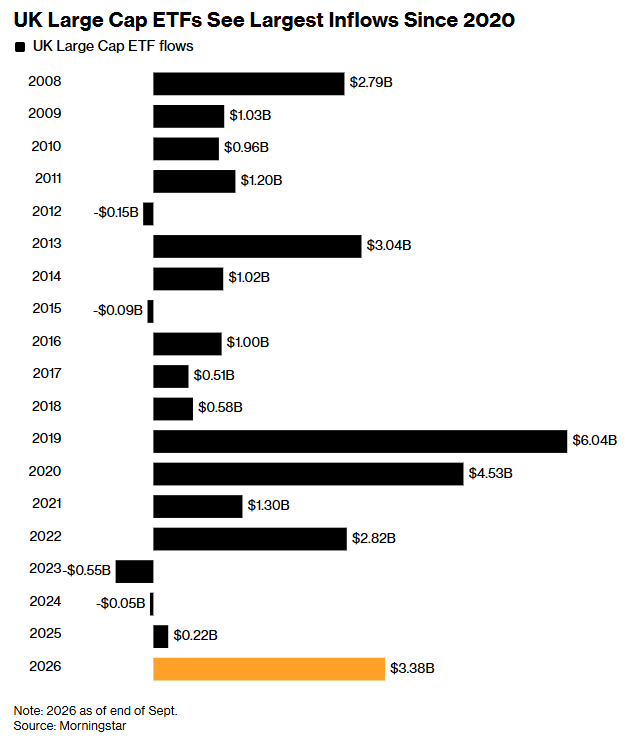
UK large-cap ETF capital inflows hit a new high since 2020
Meanwhile, according to a fund manager survey released by Bank of America earlier this month, investors' net underallocation ratio for UK stocks is currently 26%, down from 35% in September. However, this level is still 0.8 standard deviations below the long-term average, meaning investors still have room to further increase their exposure to UK stocks.
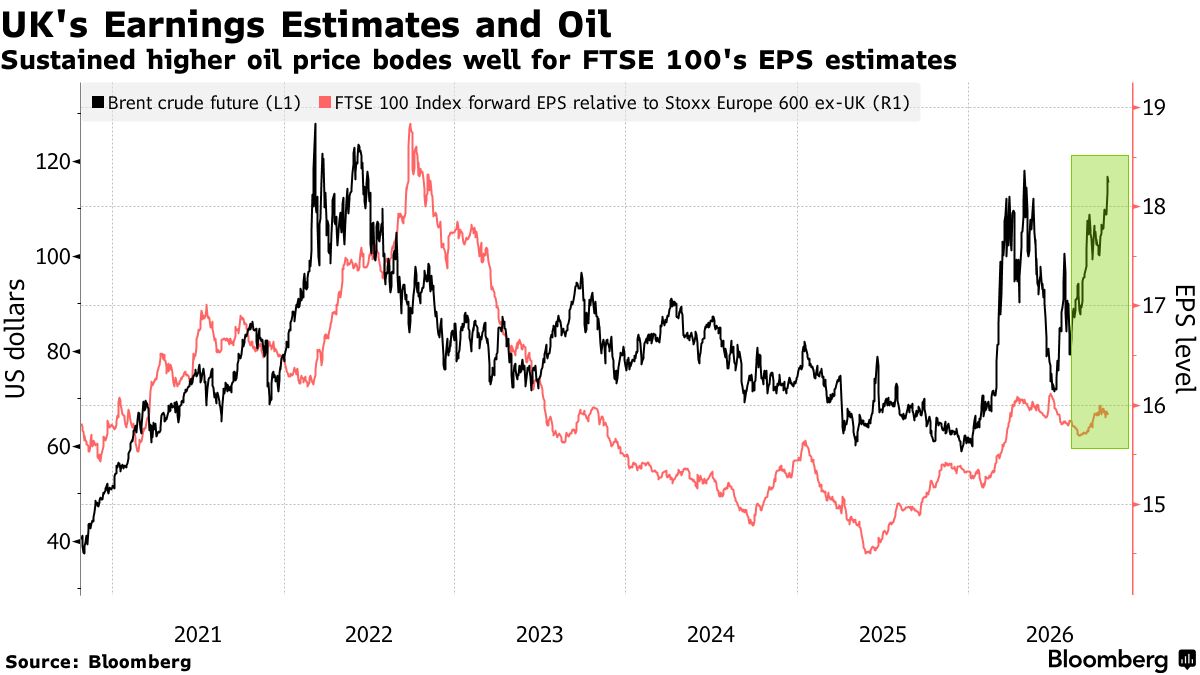
However, one of the main potential threats to the outlook for UK large-cap stocks is oil prices. The war in the Middle East kept the price of Brent crude oil above $100 per barrel, and the energy sector is the main force driving the FTSE 100 index's profit growth. As analysts expect oil prices to fall next year, the market predicts that the FTSE 100 earnings per share increase will fall to only 5% in 2027, compared to 30% in 2026.
Despite this, the valuation of the UK stock market is still low, which may provide some buffer for large and mid-cap stocks. With a 30% discount compared to global stocks, the FTSE 350 is still one of the main attractions of the UK stock market.
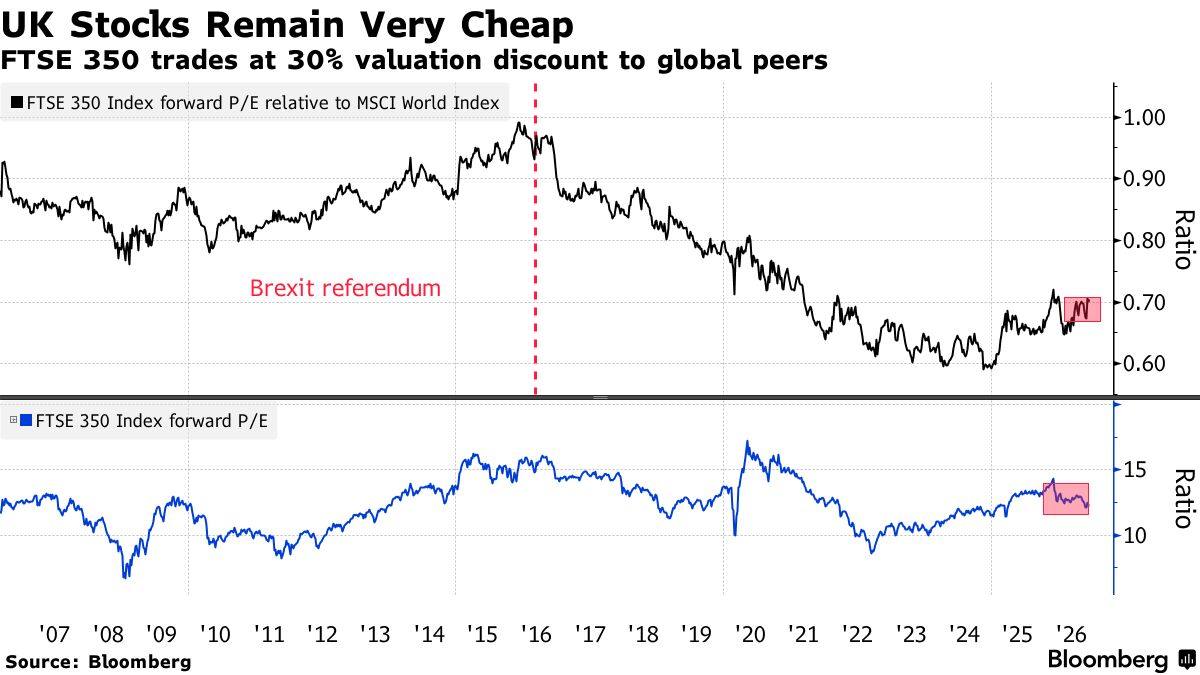
The UK stock market is not only a low-cost way to diversify investment exposure, but it is also one of the most active markets for mergers and acquisitions in Europe, particularly in the mid-cap sector. A team of HSBC strategists led by Duncan Thomas said, “The market generally expects that the UK economic policy will remain relatively stable and that the budget will benefit the market. This limits the upside of the FTSE 100 Index, especially when the main impact of the budget is reflected in the strengthening of the pound.”
The team maintained an overall neutral stance on the UK market and stated: “By comparison, UK mid-cap stocks look more attractive. In recent months, UK economic activity data has continued to be better than expected, driving the FTSE 250 index to outperform the market. We believe this trend is likely to continue.”