
Risk appetite has fallen below zero, and the window to increase stock positions has finally opened? Goldman Sachs insists on “overallocating” stock assets under the semiconductor rebound trend
Although the semiconductor sector of the global stock market has begun a major counterattack, the credit market is still raising the financing threshold for some AI-related technology companies. On October 23 and 26, the Philadelphia Semiconductor Index rose 0.44% and 2.82% respectively, with a cumulative rebound of about 3.27% over the two days; the NASDAQ 100 index had a cumulative decline of about 6.24% in the two weeks ending the 23rd — which means that after recording the worst two-week period decline since April 2025, the NASDAQ finally rebounded significantly by 1.09% on the 26th. However, based on the October 6 closing high, Fee Half and Nasdaq 100 are still about 16.15% and 6.25% lower, respectively. The rebound is repairing pessimistic pricing, and there is still clear room to recover lost ground.
The fragmentation of the global corporate credit bond market is even more obvious. At a time when major Wall Street financial giants such as Morgan Stanley and Goldman Sachs continue to be bullish on the stock market, recent market conditions can be described as showing the tension of a major rebound in semiconductor-led technology stocks and the financial fragmentation and division shown by the corporate credit bond market.
From September 25 to October 26, CoreWeave's five-year credit default swap (CDS) spread soared from 835 to 1,148 basis points, Meta rose from 98 to 121 basis points, and Microsoft only rose from 52 to 55 basis points. Under the assumption of a 40% recovery rate, CoreWeave corresponds to a 5-year cumulative implied default probability of about 62% — this indicator includes a risk premium and cannot be considered an actual default prediction. On October 26, the five-year credit default swap (CDS) interest rate spread for CoreWeave (CRWV.US), which is at the core of the “AI computing power sell-off storm” and the “AI bubble bursting argument,” was about 1,148 basis points; under the assumption of a 40% recovery rate, the model estimate corresponds to a 5-year cumulative implied default probability of about 62% — this indicator also focuses on the credit risk premium, which is not directly equivalent to the company's actual default probability over the next five years.
In terms of cash bonds, according to data collected by the media on October 22, the yield on CoreWeave bonds due in 2031 reached 15.76%; SoftBank's five-year CDS rose to 432 basis points on October 20, and the maximum dividend on US dollar bonds issued in September reached 9.75%. The quotes of these different dates and instruments together explain that the stock market can be traded ahead of time to recover profits, and these institutional creditors in the credit bond market are still constantly questioning whether the capital required for the AI computing power infrastructure expansion frenzy can continue to be put in place against the backdrop of the risk of geoenergy inflation and the surge in AI financing costs driven by high US bond yields.
The Zhitong Finance App learned that the “GOAL Kickstart” research report recently released by Wall Street financial giant Goldman Sachs, which focuses on financial market risk appetite and stock and bond allocation positions, shows that technology-led risk reassessment has significantly reduced market congestion, but credit pressure has not been lifted; profit support, declining valuation, and position reduction are still sufficient to support Goldman Sachs's financial market strategist team's “gentle pro-risk” (pro-risk) asset allocation position biased towards optimistic predictions in the stock and treasury bond markets.
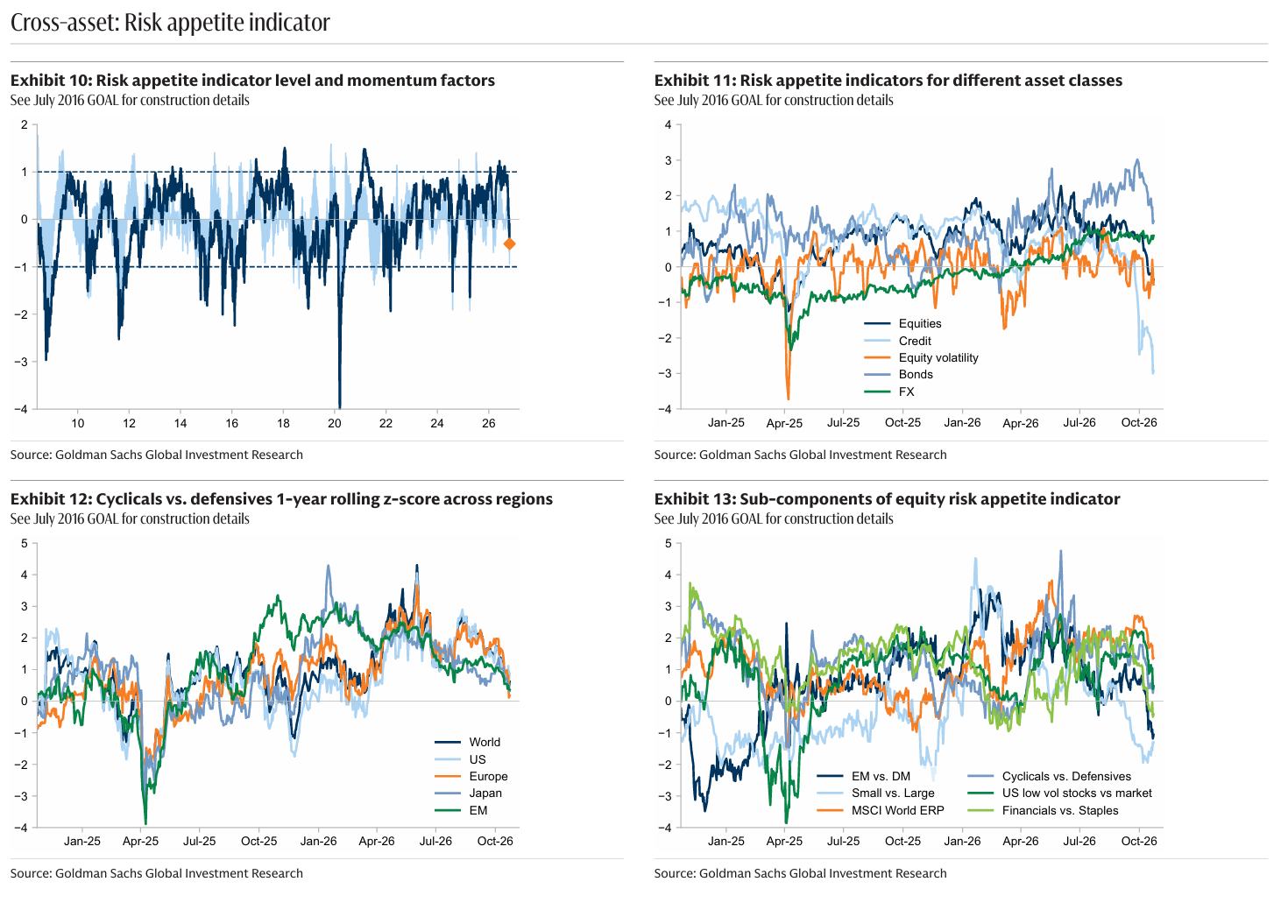
The report lowered the risk appetite index compiled exclusively by Goldman Sachs to -0.5, the decline in excess credit returns, the rebound in major treasury bonds, pressure on European assets, and leading quality and defense style, explained in the same cross-asset framework, and cross-validated using valuation, profit correction, capital flow, volatility, liquidity, and recession models. As a result, Goldman Sachs maintains “overallocation” of 3-month and 12-month term stock assets, while at the same time “under-allocated” credit bond markets, short-term “overallocation” cash, and 12-month term “overallocation” treasury bonds. Goldman Sachs's views and allocation positions can be described as clearly supporting “selective dips to increase exposure to stock assets,” but the report did not announce that the market had reached a definite bottom and ushered in a new round of bull market, as when US stocks plummeted in April 2025.
Goldman Sachs Research reports that semiconductors took the lead in counterattacking, yet the AI credit market is still repricing financing costs and cash flow payment times. As a result, global capital shows a clear tension of “stock search and repair, and credit continues to be stratified.” Goldman Sachs's risk appetite index fell to a negative range. It has yet to touch the historically stronger reverse buying range, but technology profit expectations have remained resilient, valuations have declined, and position congestion has declined, which has improved the expected return on stocks. This is the underlying basis for Goldman Sachs to maintain stock overallocations for 3 and 12 months — opportunities to increase positions depend on the relationship between profit and purchase price, and whether the market can stabilize in the future depends on whether the financial reports of tech giants, AI financing, and central bank policies can be improved together.
Furthermore, at a time when Meta Muse and OpenAI's GPT-6 Astra are fully detonating a wave of AI agents, “AI FOMO transactions” (meaning investors are worried about missing out on rising opportunities in AI-related assets, and are therefore chasing down or making up for previously reduced technology stock allocation positions) can be described as making a comeback. Looking at the underlying architecture of AI computing power infrastructure, Muse and Astra are expected to further expand the scope of use of AI agents. The massive expansion of AI inference workloads brought by them will also increase the demand for model inference, tool execution, and state management, while deepening the competitive pressure on some software companies. According to the AI capital expenditure forecast and outlook of the J.P. Morgan strategist team, hyperscale cloud vendors will spend about 950 billion US dollars in 2026, 1.4 trillion US dollars in 2027, and 3 trillion US dollars in 2030.
With regard to the global AI trading and technology stock sell-off market — that is, the memory chip sector, which has recently been hit hard, market bullish sentiment and fundamental optimism are still strong. According to KeyBanc's recent Asian research data, AI data centers are still absorbing the supply of AI computing power resources such as storage on a large scale, driving the price increase to 2027. The agency predicts that the HBM hybrid price is expected to rise sharply by 80% to 100% in the first quarter of 2027. At the DRAM memory price level, KeyBanc predicts that the fourth quarter of 2026 will rise 15% to 20% month-on-month under the strong price increase base in the third quarter, and 10% to 15% in the first quarter of 2027; in terms of future NAND pricing, it is predicted that the fourth quarter of 2026 will rise by about 20% month-on-month under the strong base in the third quarter, and another 10% to 15% in the first quarter of 2027.
Risk appetite falls below zero: optimism in the credit market recedes, and the semiconductor sector is once again influencing global pricing
According to the Goldman Sachs research report, the Risk Appetite Index (RAI), compiled exclusively by Goldman Sachs, fell to about “-0.5,” the lowest point since April 2025; historically it fell below -1, and was particularly close to -2, which formed a stronger reverse signal. However, Goldman Sachs strategists emphasized that the current more clear trajectory of positive change is that rising risk assets are less constrained by positions compared to late summer. This deterioration in indicators is mainly due to credit segmentation and dragging down the “global growth” factor; the rise in treasury bonds of major economies improved the “monetary policy” factor, providing a certain cushion for AI stock sell-off.
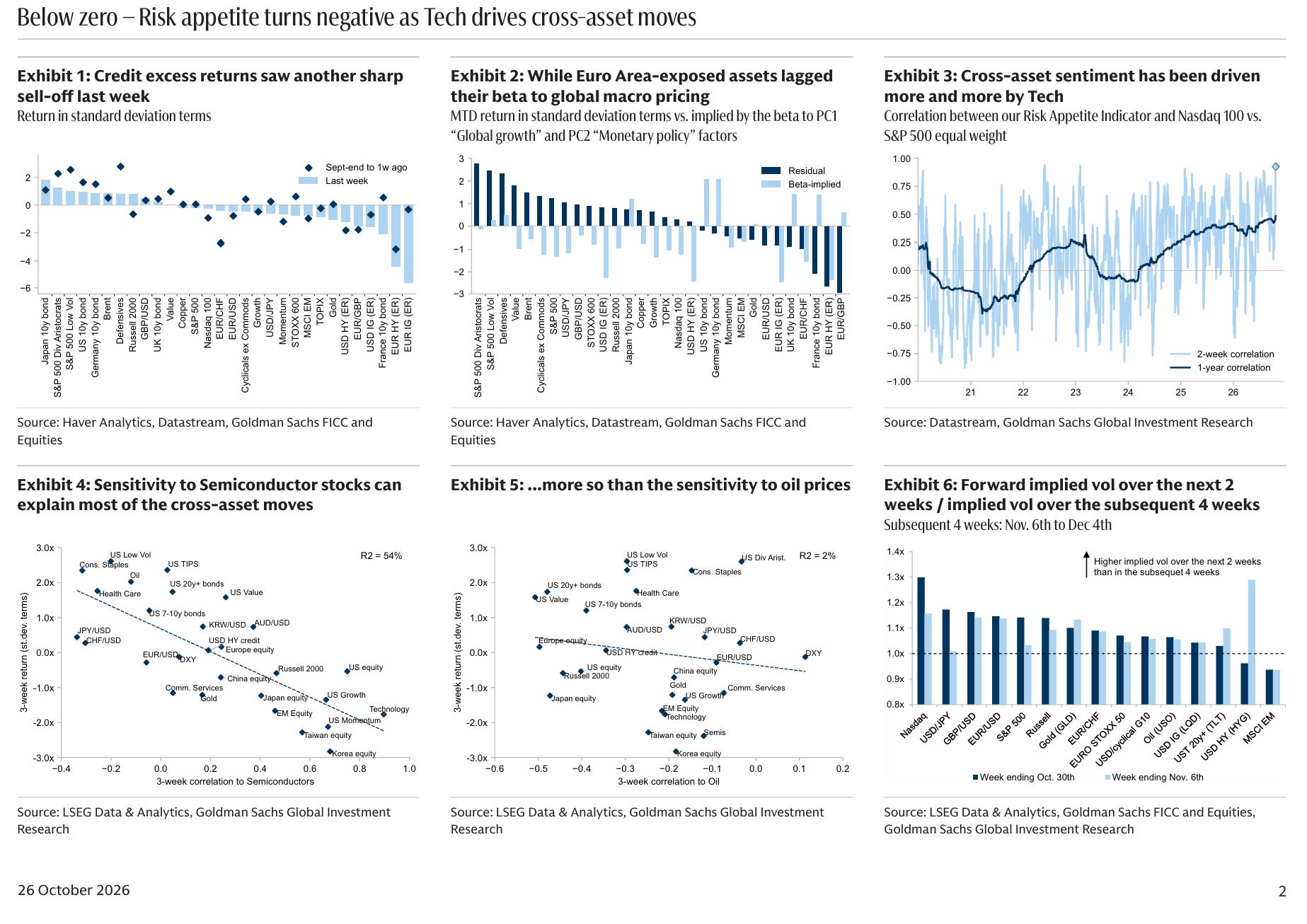
The widening spread on French and German treasury bonds also made the performance of Europe-related assets weaker than growth and policy factors could explain; the relatively strong quality, defense, and value style mitigated the impact of the decline in technology momentum trading on the general market. The decline in excess credit returns here indicates that credit performance deteriorates after matching treasury bond returns are excluded. It does not mean that all corporate bond prices have plummeted at the same time.
The semiconductor sector accounts for the vast majority of global technology stocks (more than 50%), making it the absolute center of global cross-asset pricing — that is, the semiconductor sector is reinfluencing the global capital market pricing system, especially macro-capital flows and cross-asset pricing systems, all depending on the face of semiconductors. Goldman Sachs provided very direct graphical statistical evidence of this trend: the short-term correlation between RAI and the “NASDAQ 100 versus S&P 500 equivalent index performance” was close to 1 recently; the cross-sectional fit between asset returns and semiconductors in the past three weeks was about 54%, and the fit for oil prices was only about 2%. The US dollar has also recently shown stronger procyclical characteristics.
The options market, on the other hand, focuses risk on the next two weeks: technology stocks pay more attention to this week's earnings reports from Microsoft, Google's parent company Alphabet, and Amazon; long-term US bonds and high-yield credit are more focused on next week's US midterm elections; this week's Federal Reserve, Bank of Japan, and ECB decisions are also critical. Goldman Sachs economists' benchmark is still the Federal Reserve's suspension in October and interest rate hikes in December, so the logic of the recent rebound in the global bond market, especially the long-term treasury bond market, is based more on the return of incremental capital brought about by a slight easing in oil prices and a continuous surge in yield, and cannot be directly interpreted as a full-scale interest rate cut transaction has already begun.
Overallocated Stocks and Underallocated Credit Bond Markets: Goldman Sachs Bets on Technology's Profit Growth Resilience and Valuation Repair
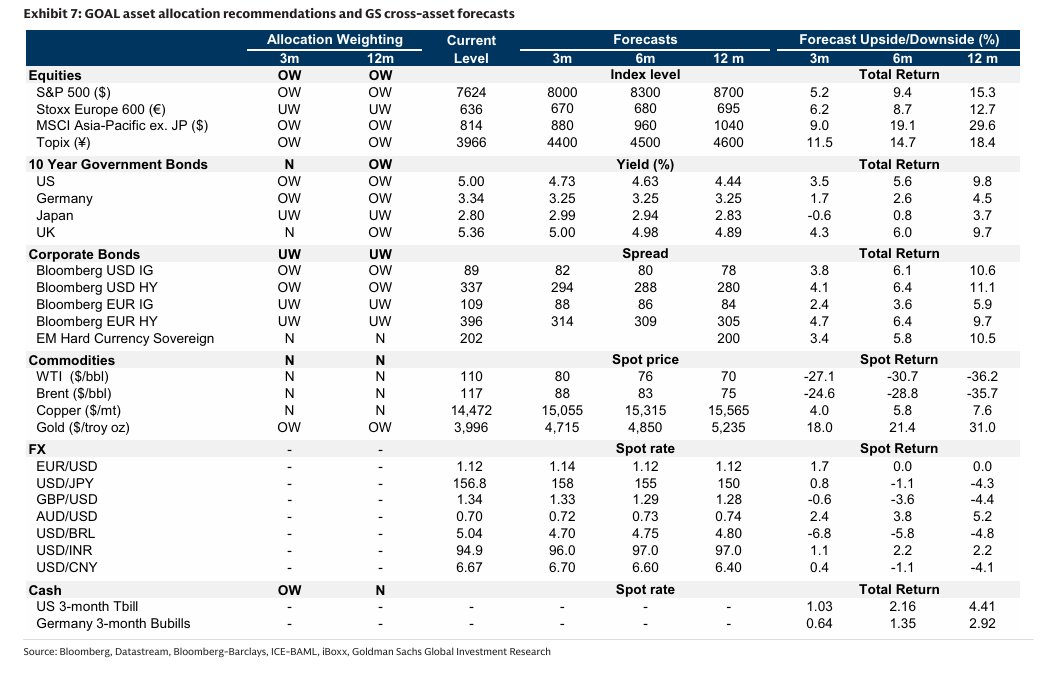
Goldman Sachs's allocation has a clear hierarchy: it is most optimistic that stock assets have been overallocated for 3 and 12 months, and it has shown a low allocation position on credit bonds; cash is overallocated for a short period of time, the treasury bond market is overallocated for a period of 12 months, and overall products are neutral and gold is overallocated. The internal stock preference is for the US, Japan, and the Asia-Pacific region, except for Japan, and Europe; internal credit favors US dollar investment grade, high yield bonds, and low euro credit. This does not contradict the low allocation of credit categories.
The Goldman Sachs strategist team's target points for the S&P 500 index for 3, 6, and 12 months were 8,000, 8300, and 8,700 points, respectively. The expected total return in the Goldman Sachs chart was 5.2%, 9.4%, and 15.3%, respectively, including dividends; the total expected return for 12 months in Asia Pacific excluding Japan was 29.6%. The cross-asset forecast also includes a 12-month US 10-year Treasury yield of 4.44%, gold $5235, and Brent crude oil of $75. Goldman Sachs's combinatorial logic is to continue to participate in the continuous profit growth trajectory of technology stocks dominated by the semiconductor sector, while retaining the impact of cash, treasury bonds, and gold hedging events.
South Korea's memory chip stocks and the Korea KOSPI Index, where two major memory chip giants, SK Hynix and Samsung Electronics hold 50% of the weight, provide outstanding examples of this difference in expectations. Another Goldman Sachs Korea market strategy report lowered Korea's KOSPI index target from 12,000 points to 9,000 points, but it still corresponds to more than 60% room for growth as of the weekend report; the Goldman Sachs Korea Strategy Team believes that the semiconductor valuation implied a 65% profit decline in 2027 was excessively pessimistic; Samsung Electronics and SK Hynix were only about 3 times the forward price-earnings ratio at the time. KOSPI fell about 40% from the June high, but the profit forecast for the next 12 months during the same period increased by about 22%.
The Goldman Sachs Korea team pointed out in the research report that both Samsung Electronics and SK Hynix are currently trading at a forward price-earnings ratio of about 3 times, which is the lowest level in history. Based on the 72% fit-for-market ratio (R²) relationship between net market ratio and return on net assets revealed by monthly data for the past 20 years compiled by Goldman Sachs, the 2027 ROE implied by the current 2.6 times net market ratio of the Korean memory chip sector is only 23%, while the ROE predicted by market consensus is as high as 45%, which is enough to see serious discounts on the valuation of Korean memory chip giants given by the market.
This difference is also prominent at the index level: KOSPI fell by about 40% from the June high, but the profit forecast for the next 12 months increased by about 22% during the same period; the KOSPI index's record low forward price-earnings ratio of about 4 times is extremely low among the 18 trillion dollar major markets covered by relevant statistics. However, the storage industry's low price-earnings ratio may also include concerns about unsustainable profits at cyclical highs. The key point of Goldman Sachs's bullish judgment on South Korea's two largest memory chip giants and KOSPI, the benchmark index for the Korean stock market is: as long as the actual profit decline is less than the degree of pessimism implied in stock prices, compounded by a fall in risk premiums, the Korean stock market and the two major South Korean memory chip giants, which account for 50% of the market value of the Korean stock market, may achieve strong valuation recovery during the period of a slowdown in profit growth.
Global capital has also begun to re-bet on the Korean stock market and memory chips. The capital flow compiled by Goldman Sachs shows that from October 1 to 23, Korean retail investors made net purchases of 315.4 billion won in leveraged products related to the two companies; as of the 22nd, South Korean investors had net purchases of SOXL (that is, the Philadelphia Semiconductor ETF with the code “SOXL”) of about US$3.548 billion, accounting for an astonishing 73.9% of the net purchases of US stocks during the same period. The main logic of trading opportunities in the Korean stock market and the memory chip and semiconductor sector presented by Goldman Sachs comes from the pessimistic scenario where actual profit performance is better than the stock price implied. The return of leveraged funds reflects that this judgment is being transformed into positions.
Wilson's latest judgment from Morgan Stanley's chief stock market strategist adds to the time dimension of the rebound: the availability and cost of AI capital, AI security and resistance to data center construction, midterm elections, and the liquidity of the Federal Reserve are three sets of factors that need to be digested in the coming weeks. He maintained the optimistic rise of S&P's 8,000 point target at the end of the year, stressing that “the internal adjustments in the US stock market have entered the final stage, but the index may still experience the final round of decline.” At the same time, he maintained the tactical path of falling 7100-7,200 points first, believing that liquidity is both the biggest risk and a potential catalyst for the formation of the final low. Goldman Sachs focuses on “improving the expected return on adjusted stocks”, and Wilson focuses on “what events can end the adjustment” — however, apparently the two together support investors to prepare for stock exposure for the year-end market, but Goldman Sachs's “8,000 points in 3 months” and Wilson's “8,000 points by the end of the year” are different forecast periods.
Why are global financial markets “acting on the face of the semiconductor sector”: AI links profits, capital requirements, and financing costs
Combined with the understanding of industrial mechanisms, technology stocks have become the “anchor” of the market, stemming from AI simultaneously influencing corporate profits, physical investment, and capital supply and demand. After the expansion of intelligent applications, GPUs and special purpose integrated circuits (ASICs) undertook model computation, CPU operation tools and task orchestration, high-bandwidth memory (HBM) and server DRAM support models and concurrent environments, enterprise-grade SSDs preserve long-lasting state, networks, electricity, data center optical interconnect systems, high-performance CPUs, and data center underlying power equipment and cooling systems to jointly guarantee the delivery of computing power resources services.
Muse, Astra, and Meta's latest open source Muse Spark Open are expected to jointly further expand the scope of use of AI agents. The massive expansion of AI inference workloads brought by them will also increase the demand for model inference, tool execution, and state management, while deepening the competitive pressure on some software companies. Accelerators such as GPUs and TPUs undertake model computation; high-performance server CPUs run browsers, virtual machines, product search, database queries, and transaction orchestration; HBM and server DRAM carry model data, context, and concurrent working environments; enterprise-grade SSDs store product indexes, task records, and persistent states, and high-speed networks and optical interconnections support distributed data exchange.
Technology giants' procurement budgets therefore also correspond to the revenue of chip, storage, equipment, and energy companies; expenses are implemented through cash flow, bonds, equity, and lease financing, which also affects credit spreads and capital costs. When the market revises AI return expectations, the impact will be transmitted along customer financing, equipment orders, supplier profits, and the Asian export chain, as well as the three global equity and bond markets and commodity markets; when AI financing costs and commercial business prospects improve dramatically, this chain also has the ability to reverse repair. The asset management business division under J.P. Morgan Chase also pointed out that the current financing dispute revolves more around capital costs and return on delivery, and that the ability of low-rated new clouds and high-rated cloud giants to withstand pressure is clearly different.
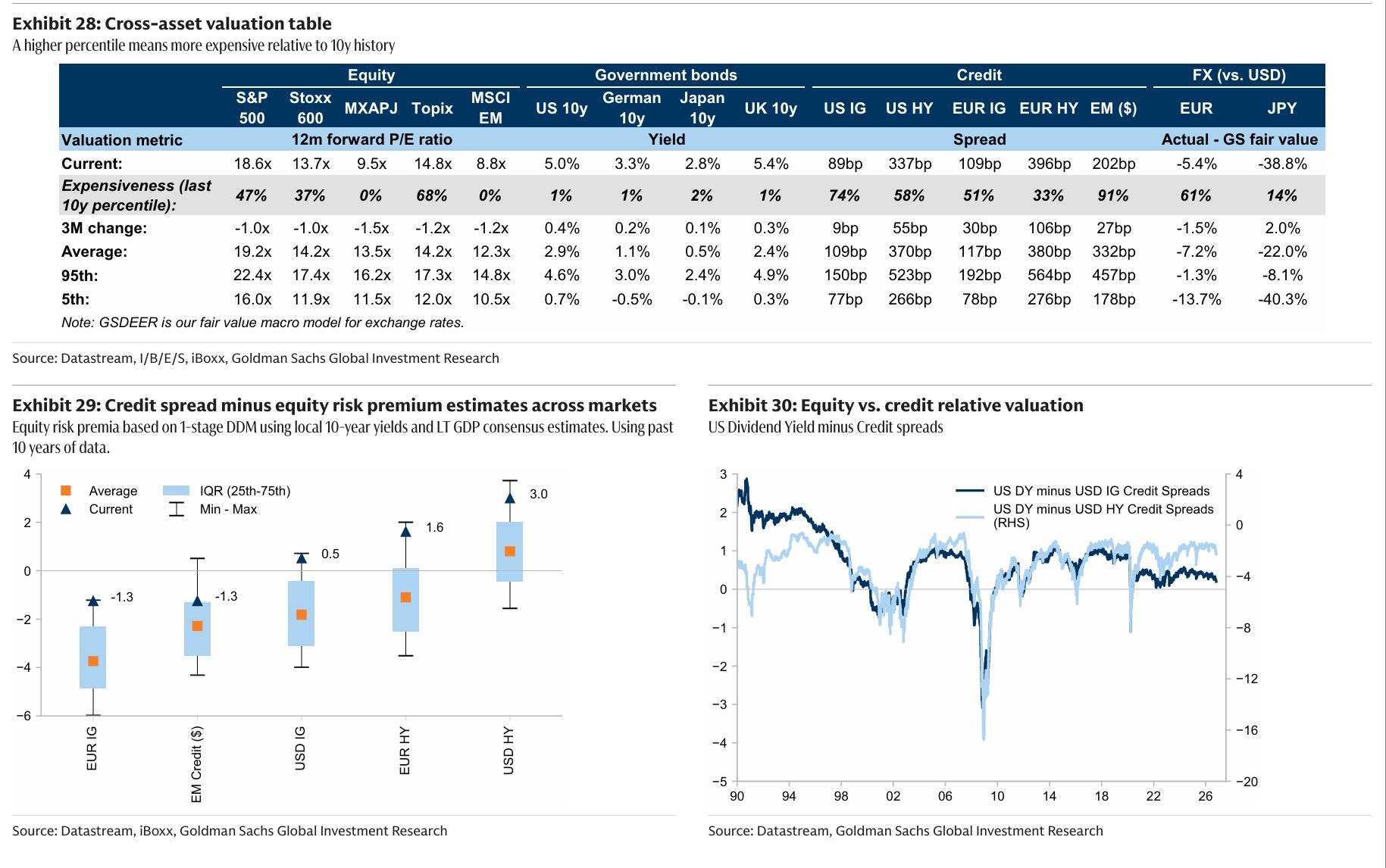
Goldman Sachs is still willing to take stock risks. In the end, there are three data supports: the price-earnings ratio of the S&P 500 index will decline to only 18.6 times in the next 12 months, below the 10-year average of 19.2 times; Asia Pacific excluding Japan is only 9.5 times; Goldman Sachs estimates the probability of a recession in the US in the next year of 15%. Technology profit forecasts are still being revised, although the breadth of the revisions has cooled down. In contrast, interest spreads on US investment-grade and high-yield bonds are 89 and 337 basis points, respectively, still below the 10-year average of 109 and 370 basis points respectively — higher absolute bond yields do not necessarily mean that credit risk compensation has been sufficient. Seen from this perspective, the underlying basis for Goldman Sachs's support for the low price layout is that strong profit growth resilience, declining purchase valuations, and significant reduction in position congestion have all improved the expected returns in the stock market; falling below zero risk appetite is only a background; it is not a sufficient condition for triggering purchases alone.