
Earnings Guidance Raise Altering The Investment Case For VeriSign Stock?
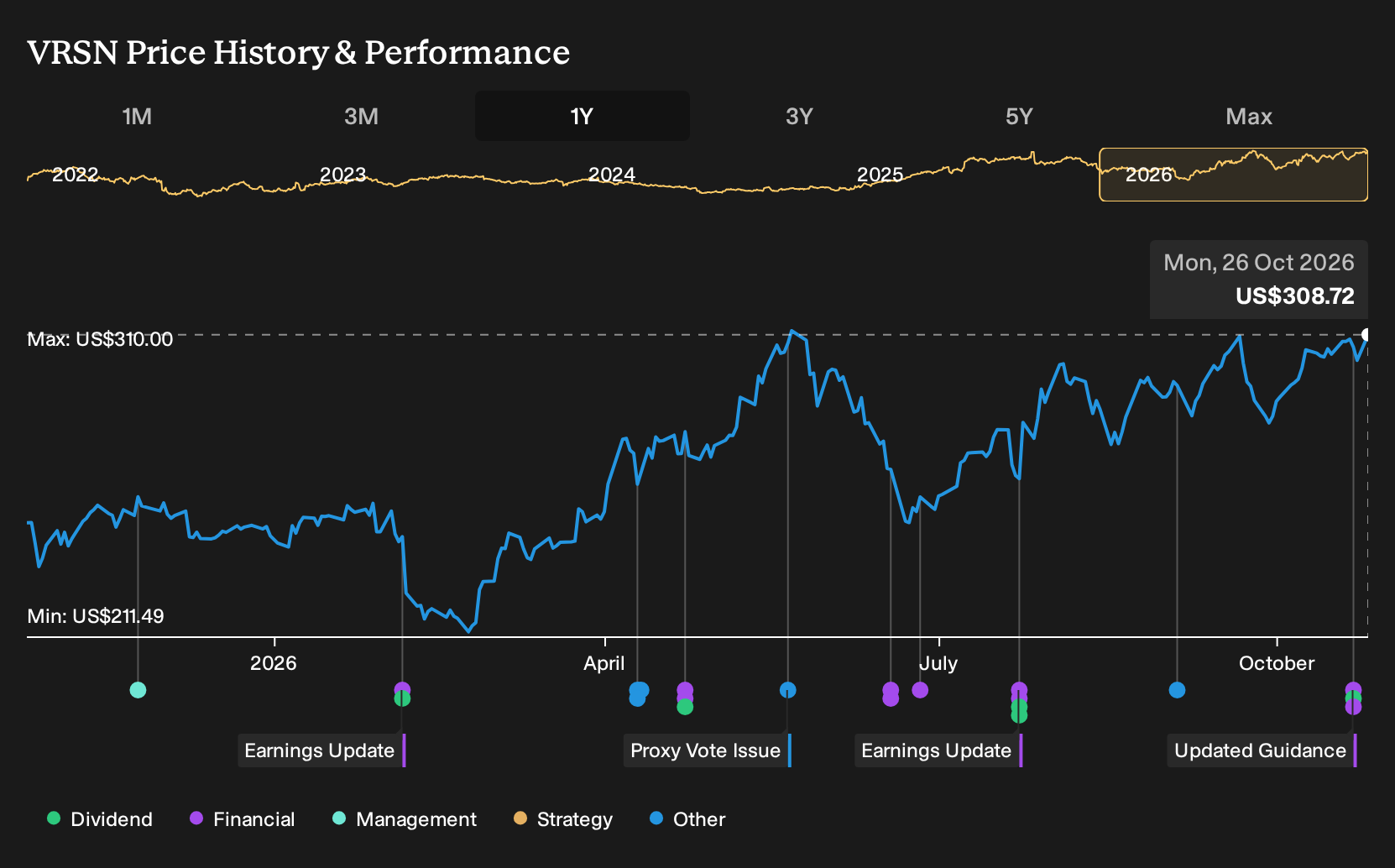
- VeriSign reported Q3 2026 sales of US$443 million and nine month sales of US$1.3065b, updated 2026 revenue guidance to US$1.755b to US$1.760b and operating income to US$1.188b to US$1.192b, and affirmed a US$0.81 per share cash dividend payable in November 2026.
- The combination of record new domain registrations, the planned launch of the unregulated .web domain, and the VeriSign Informed security service suggests that VeriSign is aiming to widen its revenue base beyond the regulated .com franchise.
- The updated 2026 guidance, which is anchored on domain demand, may influence how investors view VeriSign's investment narrative.
VeriSign Investment Narrative Recap
To own VeriSign, you need to believe its regulated .com and .net engine can stay resilient while new services like .web and VeriSign Informed slowly broaden the revenue mix. The latest Q3 results and updated 2026 guidance tie that story even more tightly to domain demand, which remains the key short term swing factor.
The biggest operational risk still sits with contract terms and demand quality. Any softening in registration trends or renewal behaviour could matter more than one quarter’s guidance tweak. The Q3 numbers and outlook do not radically change that risk balance; they simply show the business tracking the existing narrative.
The most relevant fresh data point for this story is the updated 2026 guidance, with revenue now expected between US$1.755b and US$1.760b and operating income between US$1.188b and US$1.192b. Management explicitly includes the US$7.5m Q3 expense in that operating range, which gives you a clearer sense of underlying profitability.
For a catalyst focused view, that guidance sits alongside record new registrations, the planned .web launch and upcoming wholesale price changes in .com and .net. Together, those levers keep the spotlight on execution in the core registry and how effectively VeriSign can translate domain momentum into durable earnings while carrying high debt and negative equity.
VeriSign Consensus Forecasts In Context
VeriSign's long term story in analyst models leans on steady domain activity feeding into measured top line expansion and higher profitability. The consensus set of assumptions does not rely on explosive change. It leans on compounding.
Across the next three years, analysts are building in revenue growth of 9.4% a year. Profit margins are assumed to move from 49.1% today to 51.0% in three years, which would mean a slightly richer cut of each incremental dollar of sales dropping into profit.
Earnings today are pinned at US$849.8 million in those forecasts, with consensus pointing to US$1.2b of earnings by 2029. That is an increase of roughly US$350 million, which is a meaningful step up in absolute profit, but not an aggressive stretch given the size of VeriSign's domain base and pricing levers.
The same models tie into the share count, with expectations that outstanding shares decline by about 3.13% each year over the next three years. If that plays out, any growth in total earnings would translate into faster growth in earnings per share, which is where the US$13.85 EPS estimate for 2029 comes from.
On these numbers, the analyst narrative aligns the 2029 outcome with a P/E of 31.1x compared with 31.9x today and a current US IT sector P/E of 22.8x. That framing matters if you are weighing whether a premium multiple for VeriSign can hold on the back of domain economics and margin stability rather than outsized headline growth.
VeriSign's narrative projects US$2.3b revenue and US$1.2b earnings by 2029. This implies 9.4% yearly revenue growth and an earnings increase of about US$350 million from US$849.8 million today.
Uncover how VeriSign's fair value indicates a 9% potential upside to its current price before the market closes that gap.
Exploring Other Perspectives
You might see VeriSign’s record Q3 domain registrations as a win, yet the most cautious analysts keep circling back to one thing: contract renewal risk. Before this update, they were pencilling in about US$2.2b revenue and US$1.1b earnings for 2029. That is a softer path than consensus, and the fresh guidance may eventually push those expectations in either direction.
Explore 5 other VeriSign fair value estimates, including one that suggests as much as 47% downside from the current price.
Decide For Yourself
Disagree with existing narratives? Extraordinary investment returns rarely come from following the herd, so consider your own analysis and judgment.
- A great starting point for your VeriSign research is our analysis highlighting 2 key rewards and 3 important warning signs that could impact your investment decision.
- See our latest analysis for VeriSign. The report includes a comprehensive fundamental analysis summarized in a single visual, the Snowflake, making it easy to evaluate VeriSign's overall financial health at a glance.
Looking For More Investment Ideas Beyond VeriSign?
If the VeriSign story has sharpened your thinking about quality, pricing power, and risk, it can be useful to line it up against a broader watchlist. The Simply Wall St Screener lets you move from a single stock view to a structured list of candidates that match the traits you care about most.
- If you want resilient balance sheets and room to breathe through cycles, start with a list of solid balance sheet and fundamentals (24 results) that filters for financial strength and durable fundamentals.
- For investors who prefer to anchor on value, scan a curated set of opportunities trading below their estimated worth with a focused 29 high quality undervalued stocks.
- If income is your priority, build your shortlist around cash returns to shareholders by zeroing in on 5 dividend fortresses that combine higher yields with an emphasis on stability.
Have feedback on this article? Concerned about the content? Get in touch with us directly. Alternatively, email editorial-team@simplywallst.com