
The power supercycle is more than AI! Damo: The “Three A's” forces have pushed the global electricity shortage to exceed expectations, and about half of the market demand has not yet been priced
The Zhitong Finance App learned that Morgan Stanley recently released the global power industry in-depth research report “Investigating AI: Agents, Aircons, Allshoring: All Not Incurable In”, which proposes a different judgment from the mainstream market narrative: the electricity consumption upgrade dominated by data centers and semiconductor fabs in the past three years is spreading to the industrial sector and the residential sector, AI agents (Agentic), air conditioning (Aircons), and industrial backflow/supply chain restructuring ( The “Three A” forces formed by (Allshoring) will push the global power shortage to exceed expectations. The bank raised its forecast for global electricity consumption growth from 2025 to 2030 by 10%. It is estimated that global electricity consumption will be about 36.3 trillion kilowatts by 2030, which is about 60 basis points higher than the IEA forecast, and said it is about 15% faster than market expectations.
Morgan Stanley's core conclusion is that the power supercycle is not the only main line of AI; industrial backflow, manufacturing expansion, semiconductor localization, and space cooling demand are jointly increasing the base load and peak load. The market is currently clearly underpricing power producers, midstream gas pipelines, grid operators, and coal producers, while growth expectations for the upstream power supply chain and renewable energy have been factored in.
Morgan Stanley estimates that about half of the electricity demand from AI agents, the Asian industrial supercycle, and new air conditioners/heat pumps is not yet reflected in the valuations of power generation companies, midstream natural gas, or coal producers.
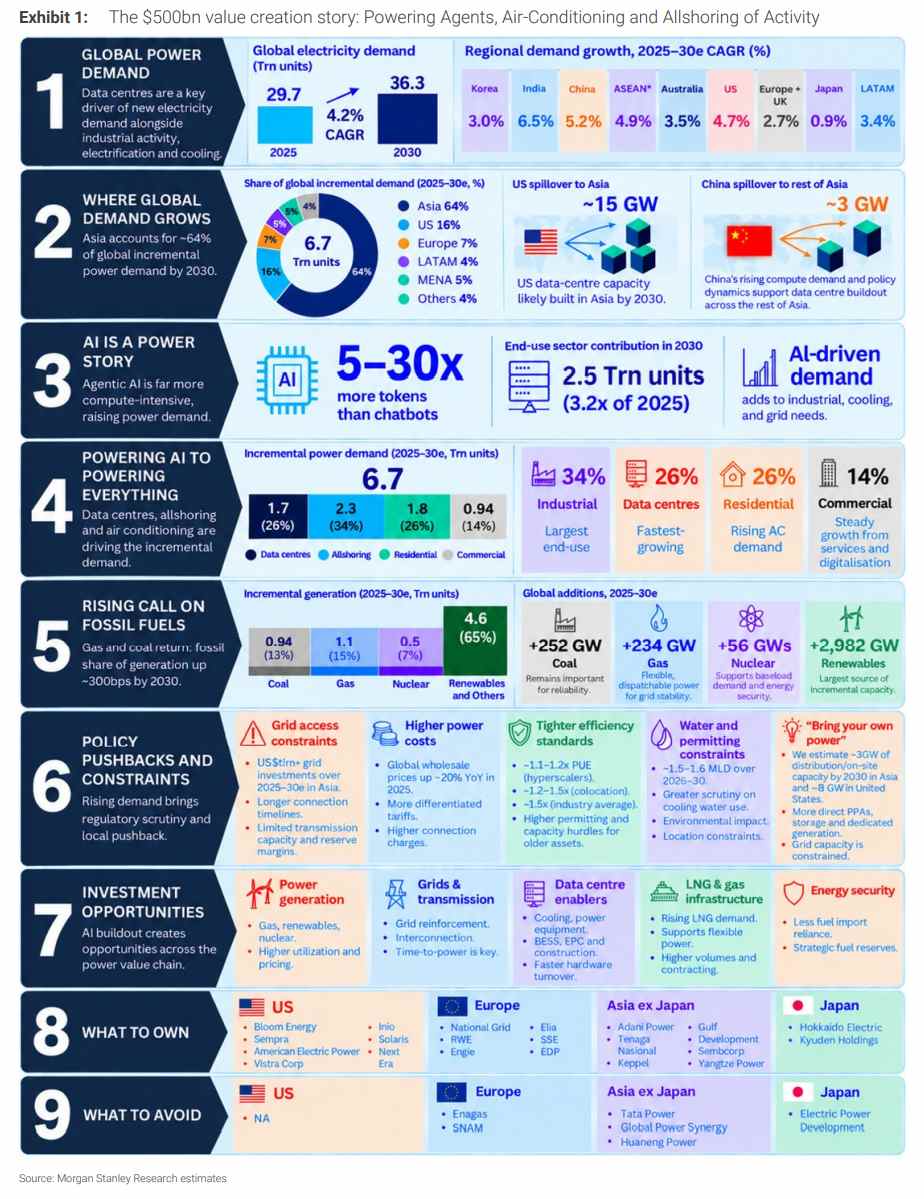
From “Designing AI” to “Combating Everything”
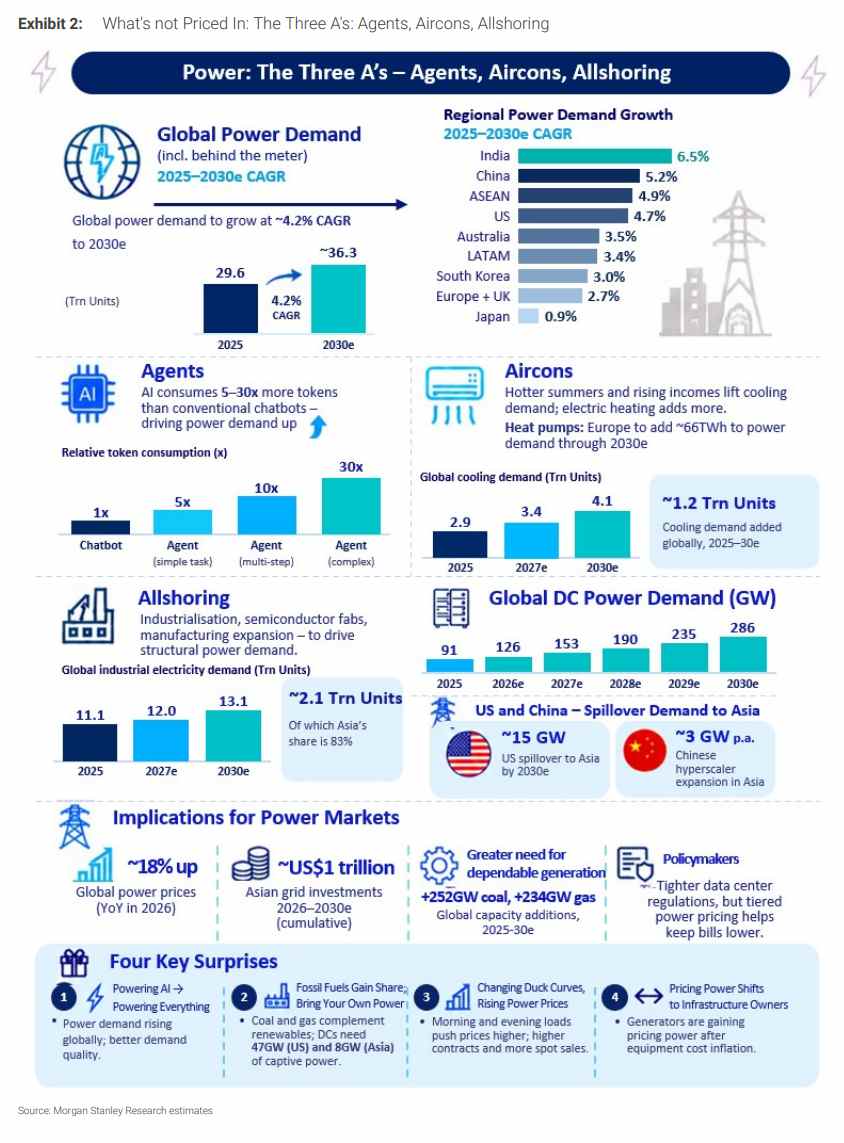
Morgan Stanley sees AI agents as the first increase in electricity demand. The Morgan Stanley US Internet team predicts that smart devices will form an annual market of 30 trillion US dollars by 2029, while AI agents consume 5 to 30 times more tokens than traditional chatbots; complex enterprise workflows may deploy 5 to 7 agent instances, each instance consumes about 15 times more tokens than traditional query tokens, and the end-to-end task token consumption can reach 375,000 to 525,000. According to the report, smart workloads already account for about 64% of the tokens exported by enterprises. The drop in token prices has not reduced total electricity demand; instead, it has boosted absolute computing power and power consumption through more widespread adoption and more complex tasks.
But the bank emphasized that AI isn't everything. The industrial sector's electricity consumption will almost double that of data centers by 2030; the Asian industrial sector will account for about 43% of the region's incremental electricity consumption, about 2.7 times the contribution of data centers, and China and India will contribute 97% of the world's incremental industrial demand. Global industrial electricity demand is expected to rise from 11.1 trillion units in 2025 to 13.1 trillion units in 2030, with Asia accounting for 83%.
The report regards steel, automobiles, semiconductors, defense, refining, chemical and related industries as the main carriers of “Allshoring”. It is estimated that electricity consumption will increase by about 2 trillion units by 2030. The compound growth rate from 2025 to 2030 is about 3.43%, about 1.5 times faster than in the past ten years.
Space cooling is the third increase. Global cooling power demand is expected to rise from 2.9 trillion units in 2025 to 4.1 trillion units in 2030, with a compound growth rate of about 7%, higher than the 4.2% growth rate of global electricity demand; cooling accounts for about 10% of global electricity consumption, yet accounts for about 30% of peak electricity demand. In India, cooling accounts for up to 40% of peak electricity demand under El Niño conditions in 2026.
The bank expects that the stock of air conditioners installed in Asia will increase from about 1.1 billion units to about 1.4 billion units in 2030; electricity consumption for cooling in Asia will rise from about 1.5 trillion units to 2.1 trillion units; and India's cooling demand will nearly double to about 280 billion units by 2030. Heat pump electricity consumption in Europe is expected to rise from 113 TWh in 2025 to 179 TWh in 2030, accounting for 3.8% to 5.4% of Europe's electricity demand. Morgan Stanley believes that the incremental cooling requirements without data centers may be as large as the incremental electricity demand of data processing centers.
Pricing power shifts from equipment vendors to infrastructure owners
Morgan Stanley believes there is a critical shift in pricing power in the electricity market. After equipment cost inflation over the past two years, power producers and grid operators began to gain stronger pricing power, while equipment suppliers faced resistance from consumers and policy makers to higher prices. Morgan Stanley predicts that commercial electricity price spreads will increase by an average of about 15% by 2028; wholesale electricity prices in Asia have risen by about 20% in the past year, and price spreads for generators in most regions have increased 2 to 3 times; and global electricity prices will rise by about 18% to 20% year on year in 2026. According to the report, power producers can counter high equipment prices by refurbishing existing equipment and delaying the deployment of new production capacity, while announcements to expand turbine and transformer production are expected to ease supply chain concerns.
The key basis for this judgment is that AI hyperscale companies are not sensitive to electricity prices. Morgan Stanley's analysis of the 100MW hyperscale AI project (self-contained power supply shell, GPU, and LLM) shows that when the electricity price rises from $120/MWh to $140/MWh and rises by about 17%, the return on the project was only affected by about 60 basis points, and ROE was still far above 30%; even if the price of electricity rose to about $160/MWh and increased 1.5 times, ROE remained high. The estimated 100 MW project has revenue of US$1.93 billion, electricity costs of US$116 million, EBITDA of US$1,802 million, net profit of US$714 million, net profit of 37%, and ROE of 33.6%. Based on this, the bank believes that power utilities have the ability to implement differentiated pricing for data centers to fund grid and generation capacity expansion and increase returns over the long term.
However, Morgan Stanley also indicated that the power system is facing a steeper load curve. India's duck curve is being reshaped into a double hump curve. Thailand moved to the evening due to peak electric vehicle charging, Australia's mid-afternoon Fukaya highlighted the value of energy storage and flexible power generation, while Japan's nuclear power restart reduced the flexibility of the power grid to absorb renewable fluctuations. Asia is expected to require about $1 trillion in grid investment by 2030. Data centers will partially cover grid upgrade costs through higher electricity prices, while tiered electricity prices will be used to cross-subsidize residential consumers.
Asia is the center of focus, and America's gap is spilling over
At the regional level, Morgan Stanley sees Asia as the center of the global electricity supercycle. Asia (including China) is expected to account for about 64% of the world's incremental electricity demand from 2025 to 2030; Asia will consume about 20 trillion units of electricity by 2030, accounting for more than half of the world; Asia's incremental electricity consumption is expected to be 4 times that of the US, and the consumption growth rate is 2.5 times that of Europe and the United Kingdom, and 1.2 times that of the US. The report predicts the compound growth rate of electricity consumption in Asia from 2025 to 2030, which is about 140 basis points faster than the current average of most Asian economies.
By country, the compound growth rate of India's electricity demand from 2025 to 2030 is expected to be 6.5%, China 5.2%, ASEAN 4.9%, the US 4.7%, Australia 3.5%, Latin America 3.4%, South Korea 3.0%, Europe and the United Kingdom 2.7%, and Japan 0.9%.
Japan's electricity demand will reverse a 20-year decline, but an inflexible nuclear power base caused the Tokyo metropolitan area to cut as much as 4.41 GW of local solar energy from March to April 2026, while importing electricity from the Tohoku region. Korea's data center electricity consumption is expected to increase from about 8 TWh in 2025 to about 30 TWh in 2038, a compound growth rate of about 10%, far higher than the overall electricity demand growth rate of about 2%; however, Korea Electric Power Corporation (KEPCO) debt reached 21 trillion won in the second quarter of 2026, and Samsung Electronics (Samsung Electronics) and SKHY.US (SKHY.US) have reportedly rejected KEPCO's plan to prepay a total of 25 trillion won of electricity bills over five years to fund grid investment. Power grid financing restrictions may restrict South Korea from undertaking AI The speed of the load.
On the US side, the bank estimates that the US data center will face a power shortage of 43 GW by 2028, with a cumulative shortage of 80 GW by 2029; even if “time-to-electricity” plans such as power generation, fuel cells, nuclear power, and site conversion are included in the meter, the net shortage in 2028 will still be about 43 GW, which is equivalent to 38% of the US data center's electricity demand. The US Electric Power Team expects the US data center to add about 116 GW of electricity from 2026 to 2028. After considering projects under construction, usable grid capacity and additional post-meter turbines, Bloom Energy (BE.US) fuel cells, and nuclear power plant data centers, the gap still reaches 70 GW, and after accounting for about 6 GW of Asia-Pacific spillover, the net gap is still 56 to 38 GW.
Morgan Stanley expects the shortage of about 15 GW of US data centers to spill over to Asia, including about 4 GW in Malaysia, 1.5 GW in Japan, 4 GW in other regions of ASEAN, 2 GW in Australia, and 3.6 GW in India and others; Chinese hyperscale enterprises plan to add 2 to 3 GW of capacity outside of China every year. Thailand has received a data center investment commitment of about US$25 billion, and Malaysia has approved about US$55 billion of data center projects since 2025. Of the 84 projects, 57 require about 6.2 GW of electricity, all supplied by Tenaga.
Natural gas is seen as a key bridge between AI and electricity security. The bank expects Asia (excluding China) to add about 19 GW of natural gas power generation capacity from 2025 to 2030, and underwrite about 20 million tons/year of LNG imports, equivalent to one-fifth of the new US shale exports; the world will add 252 GW of coal power and 234 GW of gas and electricity from 2025 to 2030; Asia will add about 303GW of coal power, 61 GW of gas power, 51 GW of nuclear power, and more than 2 TW of renewable energy, and about 3 TWh of energy storage. According to the report, natural gas, renewable energy, and energy storage are increasingly cooperative rather than competitive. Profits of midstream natural gas pipelines, LNG importers and related infrastructure should rise, but global conflicts have led to high LNG costs, and the market is not ready for this change in pricing.
On the European side, Morgan Stanley expects European electricity demand to grow by 1.7% in 2026 and 2.2% for the first time since 2014; data centers will contribute about 90 TWh of incremental demand from 2025 to 2030, accounting for 25% to 30% of the increase in European electricity demand, and data centers will increase their share of electricity consumption in Europe from nearly 3% in 2026 to about 5% in 2030 and about 8% in 2035. The report estimates that data center demand may drive up European electricity prices by about 2 Euros/MWh by 2030, the UK may exceed 3 Euros/MWh, and Europe as a whole may exceed 4 Euros/MWh in a bull market. Europe's electrification rate is only 21% in 2024, with an average annual increase of 0.1 percentage points since 2010; if it rises to 28% to 30% by 2035 according to the IEA path, the European electricity market will need to increase by about 1,400 TWh in the next ten years and add about 900 GW of power generation capacity, much of which comes from solar energy.
Electricity demand in Latin America is expected to grow at a compound rate of 3% to 4% from 2025 to 2030. Data centers will increase demand by about 1 TGW by 2030 (about 7.9 GW in Brazil) under a bull market scenario, which is equivalent to about 4% of total electricity demand, contributing about 80 basis points to the overall growth rate, but the traditional economy, industry, and electrification are still the main drivers. The electricity consumption of data centers in the Australian national electricity market is expected to increase from about 5 TWh in 2025-2026 to 34 TWh in 2035 to 2036, accounting for about 3% of the power grid; the Australian battery deployment is close to commercial market saturation. Since the beginning of 2026, BESS has commissioned 3.7 GW/9.8 GWH, and household batteries are 6 GW/1 GWH. The battery power capacity accounts for about 14% of the total system capacity of 117 GW, which may suppress future wholesale power generation prices.
Investment Strategy: 36 Winners and Avoidance Lists
Morgan Stanley selected 36 “Significant AI” winners from the global electricity value chain, covering reliable power generators, midstream gas pipelines, grid companies, integrated energy and energy storage suppliers, but remains selective about equipment suppliers on the grounds that pricing power is shifting to infrastructure owners. The bank believes that the stock valuation currently takes into account only one-third of the increase in electricity consumption under its benchmark situation, which is close to the mid-cycle consumption level of the past ten years; its preferred target 2028 EPS has room for improvement by about 14%, corresponding to a market capitalization of about 0.5 trillion US dollars.
Preferred winners listed by Morgan Stanley include: European Portuguese Power Company (EDP), German Rheinland Group (RWE); Asia Gulf Development, Keppel, Adani Power (Adani Power), Yangtze Power (Yangtze Power), Samsung SDI (Samsung SDI), Hokkaido Electric (Hokkaido Electric); US Bloom Energy, Solaris Energy (SEI.US)
The report also lists targets to be avoided: Asia KEPCO, Tata Power (Tata Power), Global Power Synergy, Huangen Power (Huangen Power), Electric Power Development Company (Electric Power Development); European Enagas and SNAM.
Logically, EDP's 2027 EBITDA of about 35% to 40% was exposed to Portugal. Portugal is one of the fastest growing markets for electricity demand in Europe. The compound demand growth rate from 2025 to 2030 is expected to be 4.5%. EDP has signed a memorandum of understanding with Start Campus and Merlin; RWE positions European data center power supply through a combination of renewable energy and flexible capacity, and has about 3GW of usable capacity (10 300MW sites) for monetization of powered land. On the US side, Bloom Energy is seen as a key beneficiary of the “time to power” shortage. Morgan Stanley expects to deploy 6 GW of fuel cells from 2026 to 2028, but recent site expansion suggests an upward trend; Solaris Energy is also listed as the first choice in the US. On the Asian side, Gulf Development, Adani Power, Sembcorp, etc. are providing back-up power to data centers. Changjiang Electric Power is regarded as a high-quality defensive hydropower utility, while Samsung SDI benefits from the demand for ESS, BBU, and UPS for data center backup power and grid-level energy storage.