
Caught Out By Charter Communications' 58% Fall? What Bears Saw
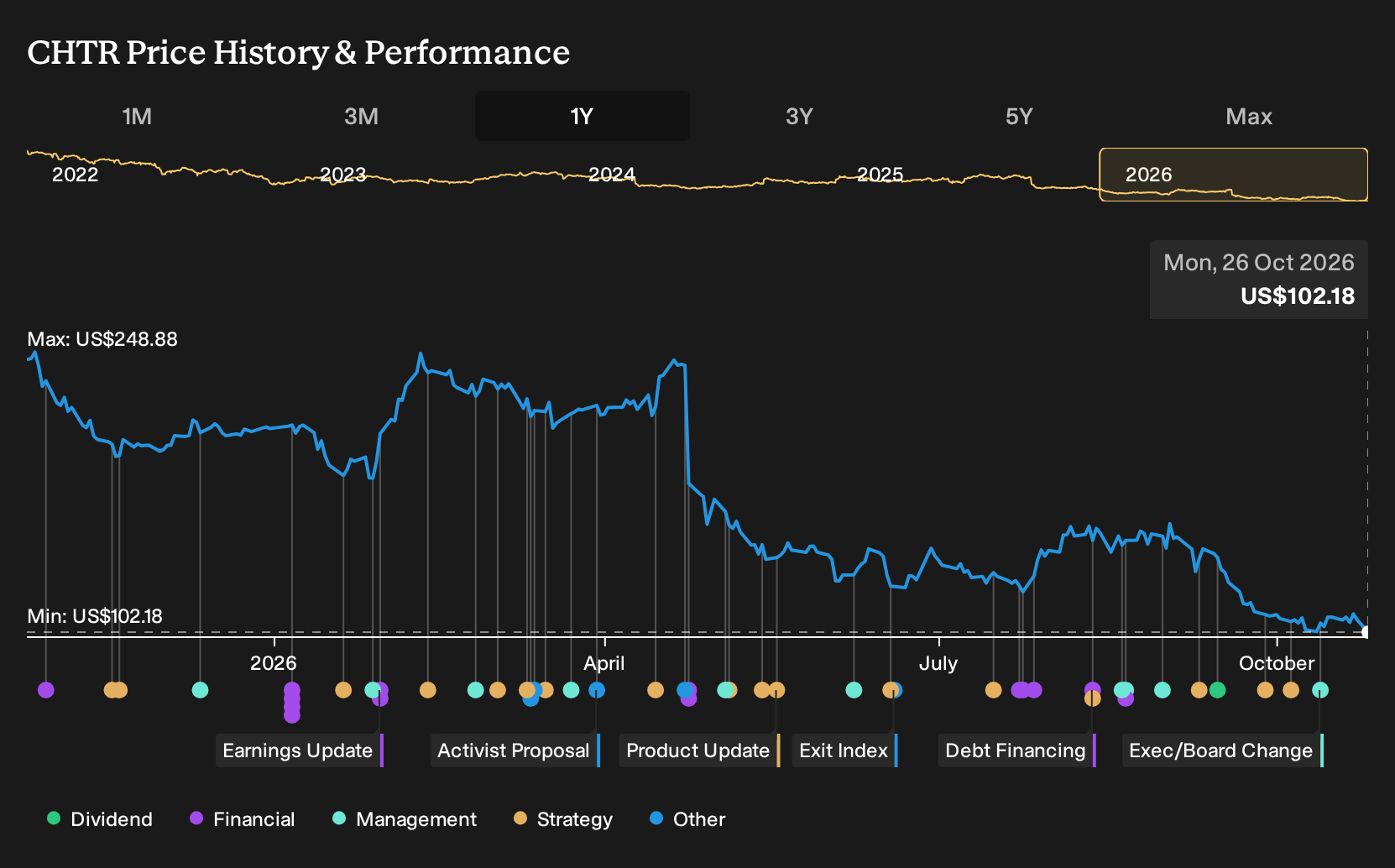
If you had looked at Charter Communications in late October 2025, with one group of analysts arguing for upside and another warning that 5G and heavy spending could crush broadband economics, it might have felt like just another industry debate. Holding Charter Communications over the past year would have meant a 58.4% loss, including dividends. If you were weighing that decision then, which assumptions on record about debt, competition, or shrinking broadband subscribers would you have pressed hardest?
Charter Communications is not the only name tied to this theme. Zero in on 55 AI infrastructure stocks and compare how each one is priced.
The Two Competing Stories Around Charter Communications
The shares cost US$244 at the start of the period, and investors in Charter Communications were weighing two very different stories about what that figure meant.
On the optimistic side, one camp saw a Fair Value of US$388, essentially the price implied if modest revenue growth of 0.9% and a profit margin assumption of 10.6% played out alongside a future P/E of 10.5x.
The cautious camp pointed instead to a Fair Value of US$230 and highlighted the risk that broadband and video subscriber declines, together with heavy capital spending and high debt, could pressure margins that were assumed to shrink toward 7.3%.
What The Results Changed For Charter Communications
The Cox Communications deal gave Charter Communications the scale story the optimistic case wanted, yet the measured results leaned the other way. Q2 2026 revenue slipped to US$13,526m from US$13,766m and net income edged down to US$1,292m from US$1,301m, even though net margin moved only slightly, from 9.5% to 9.6%. The evidence cut both ways.
The episode turned on one assumption: that bigger broadband and mobile bundles would quickly offset pressure on subscribers. When assessing another telecom stock with the same claim, track reported broadband customer counts next to net margin to see whether scale is adding quality, not just size.
What Charter Communications' Lower Price Now Demands You Believe
Today Charter Communications trades at US$102, far below where it started one year ago. The selected Narrative sees a Fair Value above that quote and anchors its argument in how enterprise value, debt pricing, and future cash generation interact.
The crux for any buyer is whether falling capital expenditure and steady free cash flow can reasonably support that higher figure in a slow or flat revenue world.
"CHTR closed Q-2 with 119mm shares. At the current price of $124 per share, that translates to a mkt. cap of roughly 14.7B. Additionally, the FMV of their bond debt is approximately 10B less than the principal."
Not everyone reads the same price the same way. → See the higher figure this Narrative lands on, and how it gets there
Find Your Own Contrarian Opportunity
Passing on this one could have spared you a loss. Where might you find the opposite surprise? Start looking for companies whose prices leave room for a better outcome than investors expect. These three trade below our estimated value.
- Company 1 - 32% below our estimate - contracts offshore support vessels into multi year energy projects where supply remains tight.
- Company 2 - 28% below our estimate - supplies grid testing and RF equipment as utilities upgrade aging power networks and infrastructure.
- Company 3 - 41% below our estimate - installs large LED displays as venues, advertisers and transport hubs switch from static signs.
Three companies from the same screener. Open all 29 potentially undervalued companies →
Have feedback on this article? Concerned about the content? Get in touch with us directly. Alternatively, email editorial-team@simplywallst.com