
Does Strong Earnings And Dividend Growth Change The Bull Case For Phillips Edison Stock (PECO)?
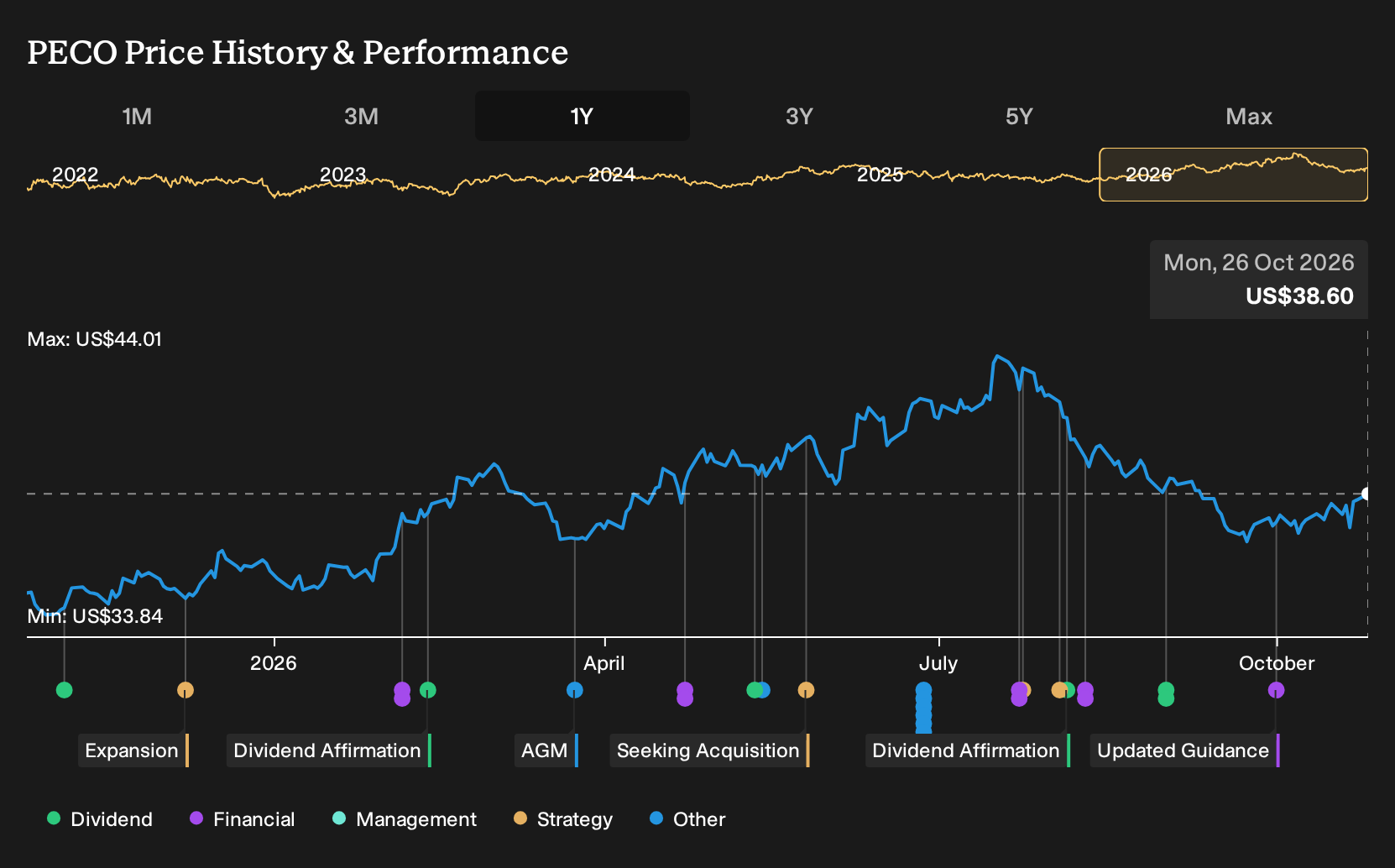
- Phillips Edison reported third quarter 2026 revenue of US$193.09 million and net income of US$62.68 million, with basic earnings per share from continuing operations of US$0.49. For the first nine months of 2026, the company reported revenue of US$573.45 million and net income of US$134.17 million.
- The business paired higher earnings with a 10.1% annualized dividend increase, a 48% payout ratio and a new US$350 million unsecured term loan that extends debt maturities while supporting acquisitions of grocery anchored centers.
- Attention now turns to how Phillips Edison’s investment narrative is shaped by stronger earnings and dividend growth supported by the new term loan.
Phillips Edison Investment Narrative Recap
To own Phillips Edison, you need to be comfortable with a straightforward story. The business is about keeping grocery anchored centers full, renewing leases at healthy spreads, and steadily adding new properties while managing debt. The latest earnings, with higher revenue and net income versus last year, support that operating backdrop rather than changing it.
For the near term, the key swing factor is how effectively Phillips Edison can keep pushing same center NOI and rent spreads while integrating new centers acquired this year. The biggest risk remains pressure from higher funding costs and inflation on both the REIT and its tenants, which could squeeze acquisition spreads and margin progression.
The new US$350 million unsecured term loan is the announcement that really ties into this earnings update. Management used the initial US$175 million draw to pay down existing term loans and revolver borrowings, which reshapes the maturity schedule and interest cost profile rather than expanding net leverage immediately.
For you as an investor, that financing move directly connects to the acquisition and redevelopment pipeline that analysts have been watching. A longer debt runway and a reduced interest rate on this facility can support ongoing capital recycling into grocery anchored centers, while still leaving interest coverage as a factor to track closely given prior concerns around earnings coverage of interest expense.
Phillips Edison's narrative projects US$869.8 million revenue and US$121.5 million earnings by 2029. This rests on analysts assuming 5.0% yearly revenue growth and an earnings decrease of US$22.2 million from US$143.7 million today.
Uncover why Phillips Edison's fair value indicates a 12% potential upside to its current price, which could narrow quickly.
Form Your Own Verdict
Don't just follow the ticker. Dig into the data and build a conviction that's truly your own.
- A great starting point for your Phillips Edison research is our analysis highlighting 2 key rewards and 3 important warning signs that could impact your investment decision.
- See our latest analysis for Phillips Edison. The report includes a comprehensive fundamental analysis summarized in a single visual, the Snowflake, making it easy to evaluate Phillips Edison's overall financial health at a glance.
Looking for more Phillips Edison style ideas?
If the Phillips Edison story has you thinking about where reliable income or resilient balance sheets might come from next, it can help to widen the lens and compare it with other listed businesses that share similar traits.
- For investors who want income but still care about financial strength, filter for companies that combine higher yields with robust coverage ratios using our 5 dividend fortresses.
- If you would rather focus on quality available at a discount, narrow your search to companies with solid fundamentals that trade below their estimated worth with the 29 high quality undervalued stocks.
- For a more conservative approach, concentrate on companies that aim to limit downside risk by pairing sturdy balance sheets with lower risk scores through the 30 resilient stocks with low risk scores.
Have feedback on this article? Concerned about the content? Get in touch with us directly. Alternatively, email editorial-team@simplywallst.com