
Goldman Sachs warns AI investment growth peaked in the fourth quarter: hyperscale enterprise spending peaked at 1.5% of GDP growth, and tech giants' valuations faced a major profit test
The Zhitong Finance App learned that Goldman Sachs expects that as the growth rate of AI investment spending of large technology companies approaches the expected peak compared to US GDP, the driving effect of such investment on the economy will reach an inflection point in the fourth quarter of 2026.
This forecast, led by chief economist JanHatzius (JanHatzius), raises a central question: can the profit growth of AI-related companies support current valuations after the pace of infrastructure investment expansion slows down. Goldman Sachs estimates that the year-on-year increase in investment by hyperscale cloud vendors as a share of US GDP is expected to hit a high of about 1.5% in the fourth quarter of 2026.
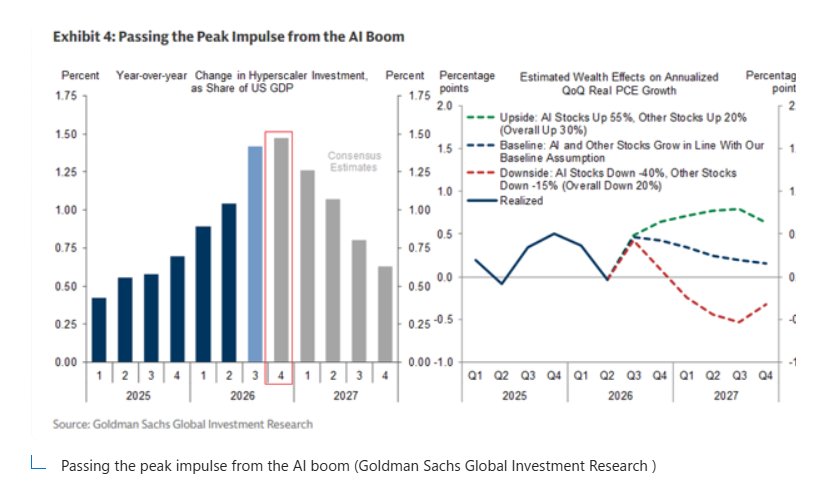
What needs to be clarified is that the forecast points to a peak in the growth slope of investment relative to the economy, which does not mean that total AI spending will decline. The report quoted estimates that leading cloud and technology companies such as Amazon (AMZN.US), Microsoft (MSFT.US), Alphabet (GOOGL.US), MetaPlatforms (META.US), and Oracle (ORCL.US) will have capital expenditure in the range of 725 billion to 800 billion US dollars in 2026, and continue to invest in data centers, semiconductors, and computing power infrastructure.
This inflection point in growth may reshape the contribution model of AI investment to economic growth. Companies are still likely to continue to increase investment, but the marginal economic boosting effect brought about by the year-on-year expansion of new investment will gradually weaken.
Goldman Sachs also deduced how the rise in the stock market can feed back the investment cycle: under the optimistic scenario, individual stocks in the AI sector rose 55% and the rest of the stocks rose 20%, and the appreciation of residents' wealth is expected to drive consumption. The above increase is only a scenario analysis assumption. It is not a Goldman Sachs benchmark market forecast. It is intended to show the linkage between equity valuation, residents' wealth, and consumer demand.
Right now, tech giants are about to disclose financial reports, and the market will usher in a round of reality testing. Microsoft and Alphabet will release financial reports on October 28 EST, followed by Amazon on the 29th. The market focuses on capital expenditure guidelines, cloud revenue growth, AI service demand, and free cash flow to determine whether huge infrastructure investments can deliver sufficient financial returns.
Goldman Sachs also estimates that hyperscale cloud vendors need about 300 billion US dollars in AI-related revenue every year to cover AI investments and achieve break-even. This figure highlights that the revenue threshold required for the industry to deliver on infrastructure promises is extremely high. Companies that are deeply tied to AI infrastructure and services, such as Nvidia, Microsoft, and Amazon, are particularly affected by this investment outlook.
If corporate profits fall short of expectations, the decline in capital expenditure growth may put pressure on current high valuations. Once again, Goldman Sachs's core judgment is that the year-on-year increase in investment by hyperscale cloud vendors compared to US GDP will peak in the fourth quarter of 2026; it is not inevitable that total AI infrastructure spending will fall.