
At a time when semiconductors are being hit hard, many tech players are focusing on AI applications! ServiceNow (NOW.US) stock price bucked the trend and surged, and Damo focused on “smart consumption+workflow upgrade”
The Zhitong Finance App learned that at a time when semiconductors were hit hard, the strong performance of ServiceNow Inc. (NOW.US), a software company focused on optimizing digital workflows, bucked the trend, highlighting that the stock market is re-evaluating strong profit opportunities for AI applications. From October 19 to 23, the company's stock price rose for five consecutive days, and the cumulative increase in the stock price was as high as 11.97%. During the same period, the Philadelphia Semiconductor Index fell 3.21%; on October 22, the price half fell by 6.72%, the Nasdaq Composite Index fell 2.60%, but ServiceNow rose 2.53%.
As of October 26, its closing price was $158.18, down 0.49% on the same day. Therefore, this strong round is mainly reflected in significant excess alpha earnings in the week before the earnings report. It also highlights that the market is optimistic that the company's performance is entering an accelerated growth trajectory against the backdrop of a big wave of AI smart applications. At the same time, its stock price is also expected to break away from the sluggish stock price trend in recent years against the background of AI-driven fundamental expansion.
According to the ServiceNow performance outlook research report released by Morgan Stanley on October 26, the agency's core bullish judgment is that demand for core workflows is steady, AI products and consumption charges are gradually being increased, and federal government procurement improvements have jointly created conditions for further acceleration of growth; however, stock prices have accumulated a cumulative increase of more than 70% over the previous three months, and further stock price increases require more solid business performance and positive future prospects to exceed expectations.
The Dama analyst team continues to maintain ServiceNow's most optimistic “gain” rating and a target price of $180. Compared with the share price of 158.96 US dollars used in the report, there is 13.2% increase space, which is 13.8% based on the closing price of October 26. The Damo research report suggests that the company's order indicators for the third quarter exceeded expectations and that profit forecasts for the next 12 months were moderately revised. However, the key to the bullish trading theme was whether organic growth improved after excluding acquisition contributions, and whether excessive quarterly performance could drive up the annual guidance.
The stock price first reached 70%, and financial reports need to cross the threshold of “organic growth and then acceleration”
As of October 23 as of the October 23 market used in the report, ServiceNow's stock price has accumulated a cumulative increase of more than 70% over the past three months, but Morgan Stanley's basic growth forecast for the third quarter is not aggressive: subscription revenue of about US$3,978 billion, total revenue of US$4,092 billion, and adjusted earnings of US$1.02 per share are all close to market consensus. What really determines the difference in expectations is the remaining performance obligation for the current period (cRPO, that is, contract-type revenue expected to be confirmed in the next 12 months) — market consensus and company guidelines all correspond to a growth rate of about 20% under the fixed exchange rate benchmark, but after deducting the contributions of Armis about 1.5 percentage points, Moveworks about 1.1 percentage points, and Veza/Pyramid about 0.4 percentage points, the organic growth rate was reduced to about 17%.
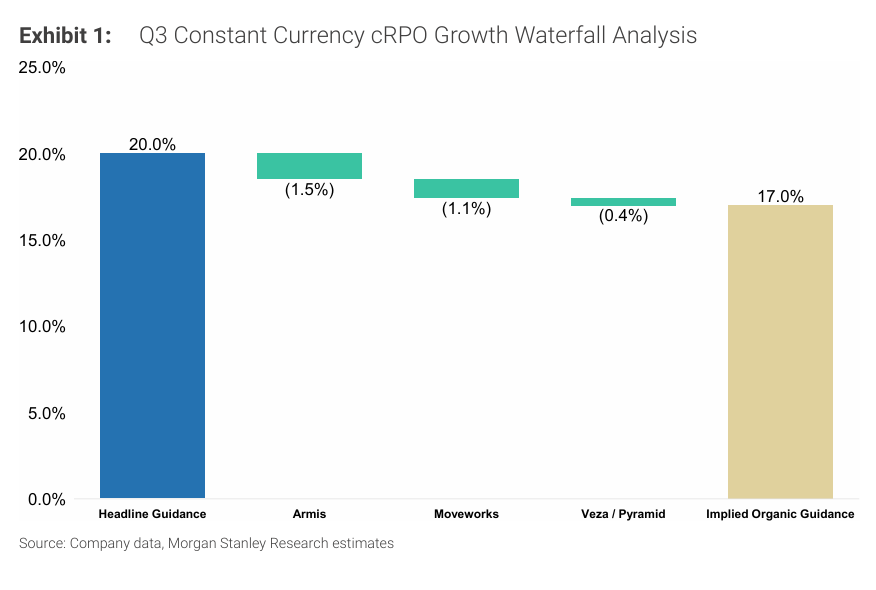
According to the agency's judgment, investors actually agree that ServiceNow's fixed exchange rate CRPO increase of about 22%, which is 2 percentage points higher than the guideline, and reflects a moderate acceleration in organic growth; at the same time, the company should include some of the excess growth in the annual subscription revenue guidelines. The average subscription revenue for the past eight quarters was about 1% higher than the consensus, which also meant that a normal margin of excess of expectations was not necessarily enough to continue to raise valuations.
Channel surveys and feedback led by Damo provided support for this expectation: IT operation management, IT asset management, security operations, and overall demand for customer service, human resources and field services was stable; partner performance generally met or slightly exceeded expectations, and the Dadao pipeline did not significantly weaken; federal government business improved compared to 2025, government procurement data showed multiple contracts of 1 million to 10 million dollars, and the public sector as a whole accounted for about 10% of the company's revenue.
In terms of AI application products, one partner said that more than 25% of its own customer base has deployed AI Control Towers, indicating that governance requirements are beginning to enter actual procurement. Dama said that the most important next step in the commercialization of AI for the company (ServiceNow) is for customers to shift from purchasing AI features to continuous consumption and additional usage credits such as Assist Packs. However, customers are still reviewing the hybrid fee model and token cost transparency; in addition, the company previously disclosed that some federal local deployment revenue was confirmed ahead of schedule from the third quarter to the second quarter, so this quarter's revenue pace needs to be judged comprehensively in conjunction with contract growth.
Behind the target price of $180: the strong premium for AI applications will eventually be realized by stronger cash flow
The Morgan Stanley model predicts subscription revenue to reach $15.77 billion, $18.887 billion, and $22.479 billion respectively from 2026 to 2028; adjusted operating margins will rise from 31.5% to 32.5% and 33.5%, and adjusted earnings per share will increase from $4.09 to $5.06 and $6.05. Adjusted free cash flow is expected to be approximately US$5.666 billion in 2026, with a profit margin of 35%, and further increase to approximately US$6.875 billion in 2027.
The “further acceleration” process described in the Damo research report mainly indicates that organic orders and AI product line consumption indicators have improved significantly recently, which does not mean that the growth rate will continue to rise in the coming year — the subscription revenue growth rate in the model will gradually decline from 22.4% in 2026 to 19.8% in 2027 and 19.0% in 2028. Damo said that the core mechanism that supports the continued growth of ServiceNow's revenue and free cash flow is: a high renewal rate to stabilize the revenue base, sell more workflows, AI functions and governance products to existing customers, and further significantly increase the value of customer contracts; as revenue grows faster than expenses, operating leverage is gradually released to promote an increase in profit margins.
At the valuation system level, the target price of 180 US dollars given by Damo uses a free cash flow forecast of about 11.8 billion US dollars for 2030, a 21 times final value multiplier, discounted at 11.9% of the weighted average cost of capital, and included in net cash. The target for the optimistic scenario is $220, which corresponds to the faster expansion of non-core workflows and AI products; under the pessimistic scenario, the target point is only $75, which indicates that new market expansion falls short of consistent expectations and that valuation multiples are clearly compressed. Compared to $158.18, this means about 39.1% increase and 52.6% decline space, respectively.
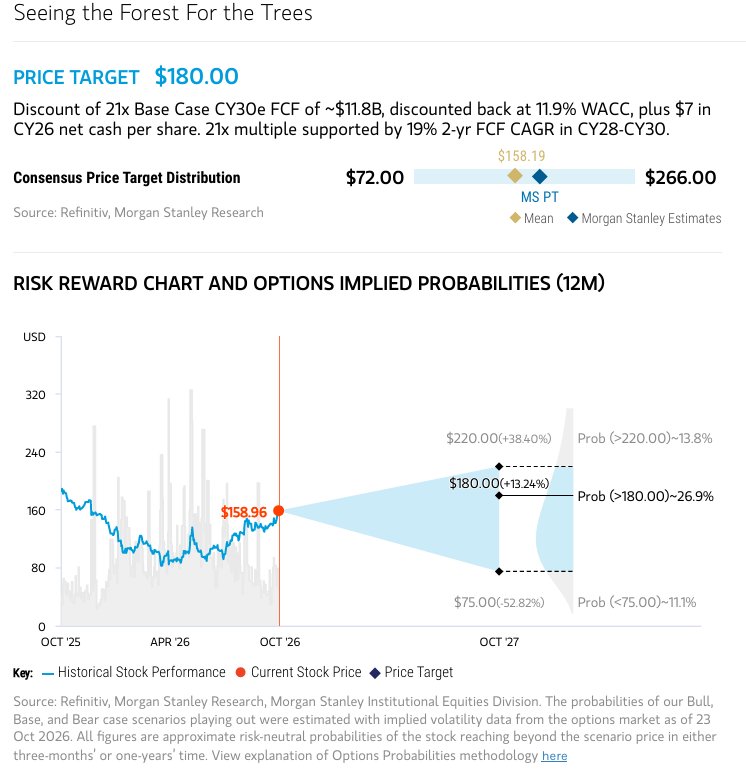
The huge target price difference between a bull market and a bear market shown by model estimates shows that market pricing is not only about how much money can be earned next season, but also whether ServiceNow can control enterprise workflows and intelligent system orchestration entrances for a long time. Next-generation enterprise digital operating product competition, sales execution, AI replacement of some manual seats, and post-acquisition integration and cash recovery will all affect this long-term premium; the 35% free cash flow rate in the report is adjusted, and it is not equivalent to all distributable cash after deducting acquisition expenses.
From enterprise workflows to intelligent governance, why are Wall Street analysts raising ServiceNow targets one after another?
ServiceNow specializes in enterprise workflow software, which is based on IT service management and extends to asset, operations, customer service, employee services and security risk management. Subscription revenue accounts for approximately 97% of total revenue. Its AI advantage comes from connecting large models to real business: Now Assist provides generation and support capabilities; Otto combines capabilities such as Moveworks to understand requirements, retrieve enterprise knowledge and assign tasks; intelligent orchestration connects operations across systems; and AI Control Tower is responsible for authority, governance, and audit.
AI big models/AI agents can propose solutions, and enterprises need reliable data context, approval chain, and execution control that ServiceNow has for a long time to pay for implementation. In the second quarter, the company's annual AI contract value exceeded 1 billion US dollars, and the number of AI agent application deployments increased nine times within nine months. On October 21, the company also announced the official use of Arc, a long-term operating agent in cooperation with the “AI chip hegemon” Nvidia, and will promote the execution of AI Passport, runtime, and hardware permissions; Arc is included in existing packages rather than separate price increases, and its commercial value is more likely to be realized through customer adoption, package upgrades, and subsequent consumption growth.
Senior analysts from other Wall Street financial institutions are also focusing on this transformation process recently: Bank of America maintained a “buy” on October 23, and the target price rose from $150 to $180, focusing on the expansion of AI adoption and incremental spending; Citibank maintained a “purchase” target of $170, optimistic about new AI products and improvements in federal business channels; Piper Sandler maintained an “increase” and target of $175, emphasizing organic growth and consumption growth in the fourth quarter; the three correspond to about 13.8%, 7.5%, and 10.6%, respectively, compared to $158.18 room for growth.
On October 26, Cantor Fitzgerald raised the target price of “additional holdings” to $201, corresponding to 27.1% space; Bernstein maintained “outperforming the market” and targeted $266, corresponding to a 68.2% space. His more optimistic judgment was based on renewing customers adopting the new package and increasing the effective price increase to drive growth. The goals of each company are still very different, but the common focus is clear: can the demand for AI application software product lines dominated by AI agents continue to transform into strong pay-side usage scale, contract scale expansion, and stronger free cash flow.