
Should Stronger Quarterly Profit Require Action From Travelers Stock Investors?
- Travelers Companies reported third quarter 2026 revenue of US$12,412 million with net income of US$1,917 million and diluted EPS from continuing operations of US$9.04, alongside a quarterly dividend declaration of US$1.25 per share payable on December 31, 2026.
- The sharp year to date step up in earnings per share from continuing operations, together with a steady dividend, points to an insurer leaning on underwriting discipline and capital strength rather than top line expansion alone.
- We will look at how Travelers Companies' stronger year to date earnings and steady dividend policy influence its broader investment narrative.
Scan insurer peers that also lean on earnings quality and balance sheet strength with our curated 30 resilient stocks with low risk scores as a starting point for further ideas alongside Travelers Companies.
Travelers Companies Investment Narrative Recap
To own Travelers Companies, you need to believe that underwriting discipline, casualty reserving and technology spend can keep earnings quality resilient even if premium growth stays muted. The third quarter numbers fit that story, with revenue broadly flat and earnings from continuing operations higher, which keeps attention on how sustainable current margins are into a softer pricing phase.
The nearest term swing factor is still underwriting performance in catastrophes and long tail casualty lines, where severity trends and reinsurance terms can move results quickly. The biggest risk remains a mix of heavier catastrophe losses or adverse casualty development that eats into the favorable loss trends supporting recent net income.
The most relevant fresh data point here is the third quarter and nine month earnings update. Revenue for the quarter was US$12,412 million compared with US$12,470 million a year earlier, while net income was US$1,917 million compared with US$1,888 million. Earnings per share from continuing operations were higher on both a basic and diluted basis.
Over nine months, Travelers Companies reported revenue of US$36,489 million versus US$36,396 million, with net income of US$5,836 million versus US$3,792 million. That step up in earnings, against essentially level top line, feeds directly into the key catalyst investors are watching: whether underwriting tools, conservative reserves and capital management can keep supporting returns if pricing pressure or higher catastrophe losses emerge from here.
Travelers Companies Consensus Assumptions
Analysts are not baking in rapid expansion for Travelers Companies. The current consensus leans on revenue staying broadly level over the coming three years while margins compress from 16.9% today to 10.1% by 2029. That combination implies earnings doing more of the adjustment work than the top line, which matters if you are weighing how much of the recent profitability looks cyclical rather than structural.
On the earnings side, forecasts point to profit of about US$4.8b by 2029 compared with US$8.3b today. That is a value drop of roughly US$3.5b in annual earnings under the base case, even though some analysts are pencilling in a more optimistic US$6.1b outcome. The market is also assuming a shrinking share count, with estimates for shares outstanding to fall about 7% a year over the next three years. As a result, per share metrics could tell a different story from headline profit.
Travelers Companies' narrative projects revenue of about US$47.9b and earnings of roughly US$4.8b by 2029. This implies broadly flat yearly revenue performance and an earnings decline of about US$3.5b from current earnings of around US$8.3b.
Valuation Anchored To 2029 Outcomes
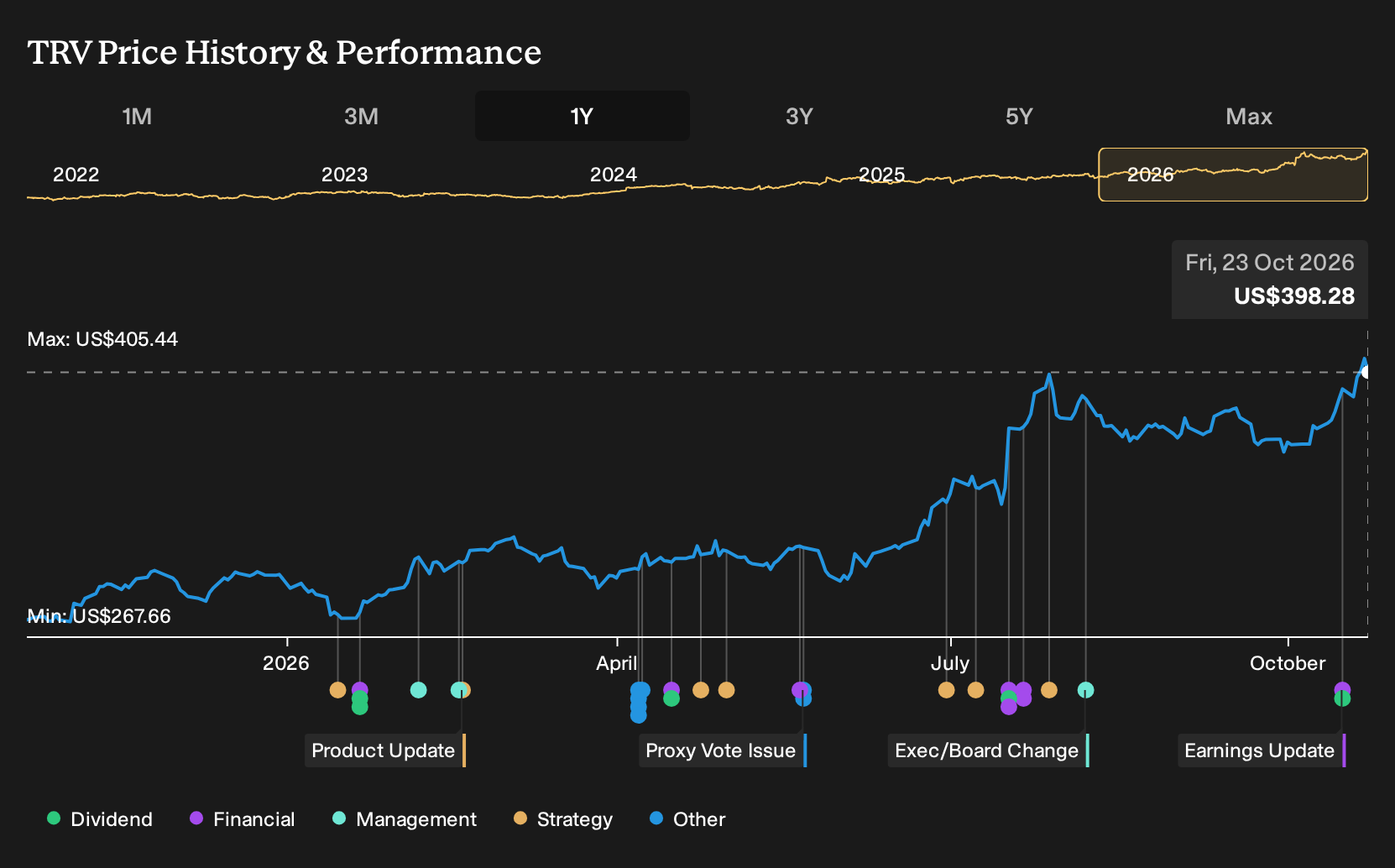
Pricing for Travelers Companies today is being judged heavily against those 2029 estimates. The analyst group sits around a consensus price target of US$371.92, close to the current share price of US$385.45. This signals a view that the stock is roughly fairly valued on average. The spread is wide though, with targets ranging from US$262.00 at the low end to US$450.00 at the high end, so conviction on the long term earnings path is far from uniform.
For that central target to stack up, you would need to accept a scenario in which 2029 revenue reaches about US$47.9b, earnings land near US$4.8b and the shares trade on a P/E of 15.6x. That multiple would be higher than both the current 9.5x attached to Travelers Companies and the 11.0x level cited for the broader US insurance group, so the implied re rating is doing as much work as the earnings profile. The discount rate used in the cited model, around 7.2% to 7.24%, also shapes how those distant cash flows are translated into present value.
For readers, the practical takeaway is straightforward. If you believe underwriting discipline, reserving habits and capital returns can support a higher earnings base or justify a richer P/E than 15.6x by 2029, then the consensus framework may look conservative. If you instead think margin compression toward 10.1% could be sharper, or that the sector struggles to support a premium multiple, then the current fair value arguments may feel optimistic.
Uncover why Travelers Companies' fair value indicates a 7% potential downside to its current price, which leaves little room for error.
Exploring Other Perspectives
One alternate angle on Travelers Companies leans heavily on the bond portfolio. The most optimistic analysts were modelling US$47.2b of revenue and about US$5.9b of earnings by 2029 before this report, helped by a more than US$100b fixed income book. You can treat this quarter as a fresh datapoint and compare both stories yourself.
Explore 3 other Travelers Companies fair value estimates, including one that suggests as much as 86% upside from the current price!
Reach Your Own Conclusion
Disagree with existing narratives? Extraordinary investment returns rarely come from following the herd, so trust your own analysis.
- A great starting point for your Travelers Companies research is our analysis highlighting 2 key rewards and 2 important warning signs that could impact your investment decision.
- See our latest analysis for Travelers Companies. The report includes a comprehensive fundamental analysis summarized in a single visual, the Snowflake, making it easy to evaluate Travelers Companies' overall financial health at a glance.
Looking For More Investment Ideas Beyond Travelers Companies?
If the Travelers Companies story has sharpened your view on quality, capital discipline and income, it can be useful to line that up against a broader watchlist. The Simply Wall St Screener lets you filter for other businesses that fit similar traits, then compare their fundamentals side by side before you commit any fresh capital.
- For investors who care most about valuation support and balance sheet quality, start with companies screened as having a list of solid balance sheet and fundamentals (24 results). These may be able to handle tougher conditions without stressing their finances.
- If your focus is on income and reliability, look toward steady payers offering strong cash returns through a 5 dividend fortresses. This may complement a core holding like Travelers Companies.
- Readers who want to search for opportunities that the market may be overlooking can begin with a 21 high quality undiscovered gems. This surfaces lesser known stocks with solid underlying numbers.
Have feedback on this article? Concerned about the content? Get in touch with us directly. Alternatively, email editorial-team@simplywallst.com