
Tesla (TSLA.US) vs SpaceX (SPCX.US): Behind Musk's merger game, a battle between cash flow and AI computing power
The Zhitong Finance App learned that Elon Musk said on Tuesday that the merger of its two companies, SpaceX (SPCX.US) and Tesla (TSLA.US), would be a “good idea” and that the two companies have set up a special committee to discuss the merger. After the news broke, SpaceX rose nearly 8% after the market, and Tesla closed up 3.4% the next day. After the merger, the total market value of the entity at the time was about 3.5 trillion US dollars, which is enough to dwarf any merger and acquisition in the past ten years.
Tesla, an established car manufacturer, is trying to reinvent itself around AI and robotics. The business is more stable, but costs are rising, and the market expects it to invest heavily to prove that the autonomous taxi and robot bets can be fulfilled. SpaceX is growing faster and is already profitable for the first time as a listed company in the third quarter, driven by AI and Starlink (Starlink). The company is spending heavily to maintain growth and is therefore dependent on additional financing.
Comparison of key financial indicators
Tesla's stock price rose 3.4% last Wednesday to close at $386.47, corresponding to a market capitalization of around $1.53 trillion. Earlier, Musk said the merger between SpaceX and Tesla was a “good idea.” SpaceX was listed in June at an issue price of 135 US dollars per share and raised 86 billion US dollars, making it the largest IPO in history. Its stock price jumped 7.8% to $159.31 on Wednesday, and its market value rose to about $2.16 trillion, boosted by merger remarks and initial post-listing profits.
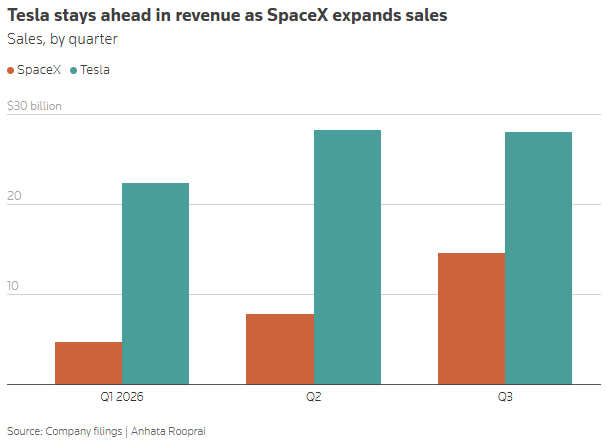
In terms of revenue, Tesla's revenue for the first nine months of 2026 increased from US$69.93 billion in the same period last year to US$78.67 billion due to a recovery in electric vehicle sales in an environment of high fuel prices and an increase in fully automated driving (FSD) software subscriptions. SpaceX's revenue nearly doubled from US$13.7 billion to US$27.08 billion during the same period, driven by the continued growth of Starlink and AI businesses.
In terms of market sales ratio, investors will pay about $12.50 for every $1 of Tesla's estimated sales over the next 12 months, while SpaceX is about $14.50.
In terms of profit and debt, Tesla achieved a profit of 4.3 billion US dollars in the first nine months of 2026, thanks to the recovery in electric vehicle sales, the growth of high-margin FSD software subscriptions, and the electric vehicle charging and insurance business. SpaceX lost 413 million US dollars during the same period due to continued heavy spending on AI infrastructure. However, thanks to the new high-margin data center business, its losses were narrower than in the first nine months of 2025. In the third quarter, the company made a profit of $4.4 billion for the first time as a listed company.
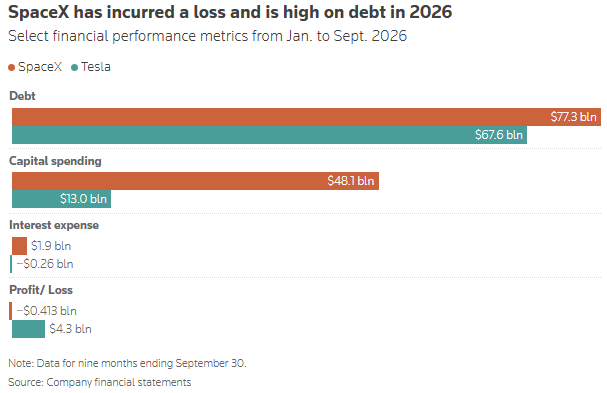
As of September 30, Tesla's debt was 9.5 billion US dollars, of which about 6 billion US dollars were loans from China for daily operations. Tesla also arranged a new credit line of $30 billion, but it hasn't used it yet, and said it doesn't plan to use it this year. As of the end of September, SpaceX's debt was $38.8 billion, of which $25 billion was a priority unsecured note issued in June and matured from 2031 to 2056. Musk said on Sunday that SpaceX has completed $40 billion in debt financing for graphics processing units (GPUs).
In terms of capital expenditure and free cash flow, Tesla lowered its 2026 capital expenditure forecast from over $25 billion to around $20 billion. Capital expenditure for the first nine months of 2026 was $13.01 billion, of which $4.7 billion was in the third quarter, far below analysts' expectations of $7.5 billion. SpaceX spent 48.1 billion US dollars during the same period, including 19.6 billion US dollars in the third quarter, mainly for AI computing power, starship infrastructure, and satellite production.
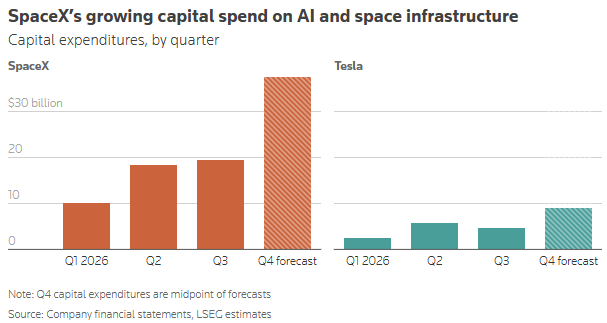
The company expects capital expenditure to accelerate further to $35 billion to $40 billion in the fourth quarter. Tesla's net cash inflow for the first nine months of 2026 was $1.88 billion, thanks to capital expenditure far below expectations. SpaceX's spending was still far higher than revenue, spending $34.97 billion in cash over the same period. Analysts expect its free cash flow to remain negative in the fourth quarter. Analysts said the merger with Tesla could ease some of the pressure on SpaceX's free cash flow through shared services and joint loans.
By the end of September, Tesla held 45.4 billion US dollars in cash and investments, an increase of about 1.4 billion US dollars from the beginning of 2026. The company also invested $2 billion in the first nine months to buy SpaceX shares, which became a financial link between the two companies. SpaceX held 51.3 billion US dollars in cash as of the end of September, and raised 85.7 billion US dollars after going public in June.
SpaceX's AI business begins to “carry the flag”, and Tesla's cash flow becomes fuel
What is driving the merger from rumors to formal negotiations is not a rocket or electric vehicle, but a previously underestimated variable: AI computing power.
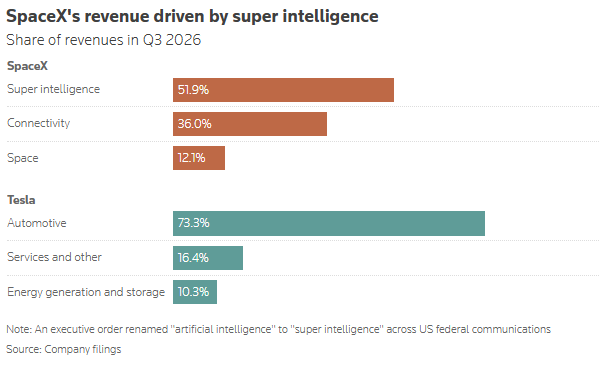
According to SpaceX's third-quarter earnings report, the superintelligence (SI) business revenue reached 7.56 billion US dollars, an increase of 830% over the previous year, surpassing Starlink's connectivity business for the first time and becoming the company's largest source of revenue; the nominal computing power of the computing power infrastructure climbed from 0.6 gigawatts in the same period last year to 1.7 gigawatts, and Musk expects to add 10 gigawatts of computing power in 2027. It was this business that drove SpaceX to achieve quarterly profit for the first time since listing — net profit of US$4.4 billion, compared to a net loss of US$1.1 billion in the same period last year.
But the capital consumption of AI computing power is just as staggering. SpaceX spent 48.1 billion US dollars on capital in the first three quarters and consumed 34.97 billion US dollars in cash. Analysts expect free cash flow for the fourth quarter to remain negative; while Tesla's capital expenditure for the same period was only 13.01 billion US dollars, free cash flow was positive at 1.88 billion US dollars, holding cash and investments of 45.4 billion US dollars.
Palma, CEO of Fortuna Investments, made a straightforward and accurate judgment: Tesla's auto business has high gross margin and abundant cash flow. “This cash flow can improve SpaceX's profit situation and fund space exploration and launch projects with huge capital expenses.” In other words, the financial logic of the merger is not a “strong alliance” narrative slogan, but rather an internal capital reallocation of high-cash flow assets and a high-capital-consuming asset under the same controller.
Deeper strategic clues point to Terafab. The two companies have jointly developed this chip manufacturing joint venture in Texas, which RBC analyst Tom Narayan describes as Musk's “way around Nvidia and TSMC.” The essence of the merger is to combine Tesla's robot manufacturing capabilities, SpaceX's AI computing power infrastructure, and TeraFab's autonomous chip ambition into a vertical closed loop from a physical actuator to a computing power base.