
French Savings Rate Debate Could Be A Game Changer For BNP Paribas Stock
- BNP Paribas recently expanded its footprint with a new shared services hub in Uptown Bonifacio in the Philippines and completed two floating rate euro medium term note issues totaling US$73 million, while also adding senior transaction banking leadership in India and hosting a biotech and health conference in Paris.
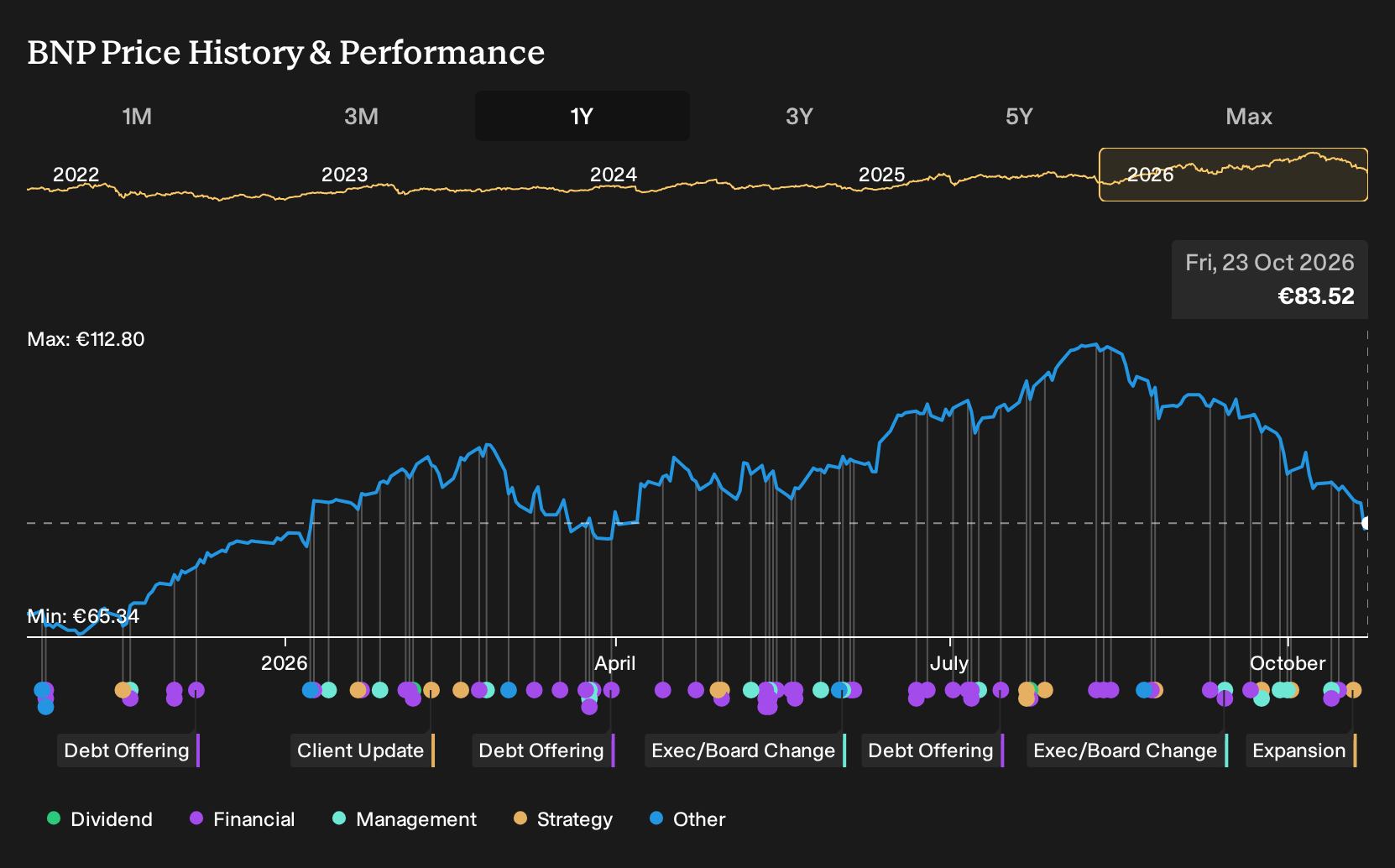
- In the same period, BNP Paribas' earnings power has faced renewed scrutiny as French authorities weigh a higher Livret A savings rate, which could lift funding costs just as the bank pursues AI driven efficiency programs and cost transformation to support its current valuation.
- We will now assess how BNP Paribas' investment narrative could be reshaped by the Livret A funding debate and its cost focused response.
Compare how BNP Paribas is handling funding pressures and efficiency goals with other banks that also emphasize balance sheet strength and cost control using our curated 221 resilient stocks with low risk scores
BNP Paribas Investment Narrative Recap
To own BNP Paribas you need to be comfortable that its efficiency and AI program, plus cost focused moves like the Philippine shared services hub, can offset pressure from regulated savings products such as Livret A and still keep earnings power intact. The short term swing factor is how effectively management protects net interest income and fees as French funding costs are debated.
The biggest operational risk remains heavy exposure to tightly regulated Eurozone retail markets, where margin pressure can bite just as higher bad loans and reliance on wholesale funding already sit on the risk radar. Recent announcements do not materially change these core sensitivities, but they do show management leaning harder into cost control and fee income.
The new delivery center in Uptown Bonifacio matters because it is a concrete piece of BNP Paribas’ efficiency and AI roadmap rather than a headline about future plans. Centralising global shared services for Corporate and Institutional Banking in a lower cost location can support the push toward a better cost income ratio if execution goes smoothly.
For you as an investor, the link to catalysts is straightforward. If this hub delivers stable service quality, it can help fund technology investment, support transaction banking growth and partially cushion any earnings drag from higher Livret A funding costs or weaker Arval resale conditions. Poor delivery or operational issues would cut the other way and amplify existing risk around bad loans and external funding reliance.
BNP Paribas' current consensus narrative points to revenues of €61.0 billion and earnings of €16.4 billion by 2029, based on analysts expecting 6.0% yearly revenue growth and an earnings increase of €3.6 billion from €12.8 billion today.
Discover why BNP Paribas' fair value points to a 43% potential upside compared with its current price, a gap that may not last much longer.
Exploring Other Perspectives
Three fair value estimates from the Simply Wall St Community span roughly €119 to €215 per share, a wide gap for the same BNP Paribas equity story. These private investors have not yet factored in the Livret A funding debate, the new Philippine hub or the recent euro MTN issuance, so use their spread as a starting point and compare several contrasting views.
Explore 2 other BNP Paribas fair value estimates, including one that suggests as much as 158% upside from the current price!
The Verdict Is Yours
Disagree with existing narratives? Extraordinary investment returns rarely come from following the herd, so go with your instincts.
- A great starting point for your BNP Paribas research is our analysis highlighting 5 key rewards and 4 important warning signs that could impact your investment decision.
- See our latest analysis for BNP Paribas. The report includes a comprehensive fundamental analysis summarized in a single visual, the Snowflake, making it easy to evaluate the overall financial health of BNP Paribas at a glance.
Looking for more investment ideas beyond BNP Paribas?
If the BNP Paribas story has sharpened your thinking about risk, value and balance sheet strength, broaden your watchlist by using the Simply Wall St Screener to spot other companies that fit your preferred profile.
- For investors who want quality at a sensible entry point, scan a curated set of companies that currently look mispriced relative to their fundamentals with the 194 high quality undervalued stocks.
- If capital preservation and resilience matter most to you, filter for businesses that pair robust finances with lower risk characteristics through the 221 resilient stocks with low risk scores.
- For readers building an income focused portfolio, narrow in on companies offering higher yields with supportive fundamentals by reviewing the 229 dividend fortresses.
Have feedback on this article? Concerned about the content? Get in touch with us directly. Alternatively, email editorial-team@simplywallst.com