
Want to Build Serious Passive Income Starting in Your 40s? This Dividend Growth ETF Has the Best Track Record.
Key Points
SCHD has delivered the highest total returns among dividend ETFs since inception.
The ETF focuses on both yield and dividend growth.
It could enable a 40-year-old to build a meaningful passive income stream by the time they turn 50.
Once I hit my 40s, I started focusing more on generating passive income. That strategy has me on track to work less once I reach my 50s, as my passive income will start covering a larger share of my expenses. One of the keys to my strategy has been investing in dividend growth stocks.
An easy way to build passive income is to invest in an ETF focused on dividend stocks. The Schwab U.S. Dividend Equity ETF (NYSEMKT: SCHD) has the best track record, making it a top choice for those in their 40s seeking to build a serious passive income stream.
Missed AI’s "Act 1"? Act 2 Could Be 15x Bigger. Most investors think they missed the AI boat because they didn't buy Nvidia in 2005. But according to our analysts, we’re only at the end of "Act 1"—the R&D phase. "Act 2" is the global rollout. Continue »

Image source: Getty Images.
What is the Schwab U.S. Dividend Equity ETF?
The Schwab U.S. Dividend Equity ETF tracks the Dow Jones U.S. Dividend 100 Index, which holds 100 high-quality, high-yielding dividend stocks. It screens companies based on several dividend quality characteristics, including dividend yield, five-year dividend growth rate, and financial strength.
This ETF's dual focus on yield and dividend growth sets it apart from other dividend ETFs, which concentrate on one or the other. Over the last 12 months, SCHD has paid a 3.2% distribution yield. That's higher than the S&P 500 (1.1% dividend yield) and many top dividend ETFs. Meanwhile, the fund's current holdings have grown their dividends at more than 9% annually over the last five years. SCHD's combination of yield and growth has enabled it to deliver strong returns compared to other top dividend ETFs:
Fund |
1-Year |
3-Year |
5-Year |
10-Year |
Since inception |
Inception date |
Current yield |
|---|---|---|---|---|---|---|---|
SCHD |
21.9% |
14.3% |
8.5% |
11.5% |
12.3% |
10/20/2011 |
3.2% |
VYM |
12.8% |
17.7% |
11.6% |
11.3% |
9.1% |
11/10/2006 |
2.4% |
HDV |
17.9% |
16.1% |
12.1% |
9.4% |
10.6% |
3/29/2011 |
3.1% |
DGRO |
13% |
17.6% |
11% |
13.2% |
12% |
6/10/2014 |
2% |
VIG |
9.9% |
16.6% |
10.7% |
12.9% |
10% |
4/21/2006 |
1.5% |
Data source: ETF websites.
While a couple of those funds have delivered higher total returns over the past decade, SCHD has the best return record since inception. It also offers the highest current yield.
How to build serious passive income in your 40s with SCHD
SCHD's high starting yield enables investors to generate more passive income from the beginning. For example, a $1,000 investment in SCHD would generate about $32.40 of annual dividend income. For comparison, if you invested the same amount in DGRO, you'd only collect $20 of dividend income that first year. Meanwhile, the income stream you'd collect from SCHD would grow each year from that higher starting point as the ETF's holdings raise their payouts.
To put that growth into perspective, I modeled how much dividend income an investor could build over a decade using rather modest assumptions. I assumed a $275 monthly investment in SCHD over a decade, with dividend reinvestment, and that the ETF increases its dividend by 9% annually while its share price grows at the same rate. Here's what that would look like:
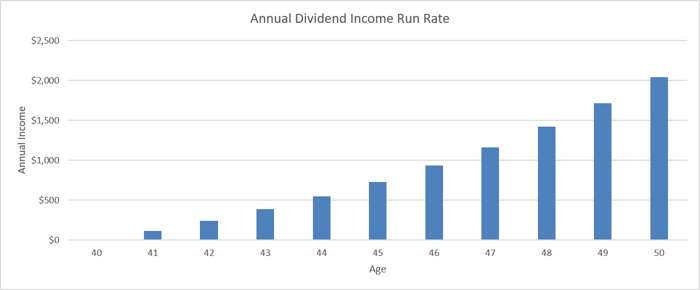
Data source: Author chart.
In 10 years, you could generate over $2,000 in annual dividend income. While there's no guarantee SCHD will grow its dividend at that rate, it gives you an idea of its income potential.
A top-notch passive income investment
SCHD is a great dividend ETF for those seeking to build passive income. It has the best track record in its class due to its dual focus on yield and growth. That's why it's becoming a foundational piece of my passive income strategy in my 40s.
Matt DiLallo has positions in Schwab U.S. Dividend Equity ETF. The Motley Fool has positions in and recommends Vanguard Dividend Appreciation ETF and Vanguard High Dividend Yield ETF. The Motley Fool has a disclosure policy.