
Rollins (ROL) Could Be 21% Below Fair Value Following AI Search Pressures
Rollins (ROL) just put AI-driven disruption front and center, with Q3 2026 results showing revenue growth but softer residential customer sign ups and a detailed plan to rethink digital lead generation.
Recent trading tells you investors are still recalibrating their view of Rollins. The share price has climbed about 7.2% over the past month and 4.1% over the last week, yet remains down roughly 41% year to date. This leaves long term total shareholder returns far more muted and signals that enthusiasm has cooled despite the latest earnings update and dividend increase.
Spot under-pressure compounders like Rollins and compare how other service outfits are handling AI-driven customer acquisition by scanning our curated list of 21 high quality undiscovered gems.The recent rebound in Rollins looks less like a growth surge and more like investors rethinking how much of the AI hit is already in the price. Does that reset leave the valuation stretched, or is it starting to make sense again?
Most Popular Narrative: 115% Overvalued
Rollins closed at $34.82, while the most followed narrative pegs fair value closer to $16.20. That gap puts the long term compounder story under pressure and turns attention to what might be driving such a sharp valuation disconnect.
Rollins is the dominant pure-play compounder in global pest control, a structurally necessary, recession-resistant service business that has grown revenue for 24 consecutive years and delivered ROIC of 23 to 31% for 12 consecutive years, without a single year of ROIC below 21% even through COVID-19. The investment thesis rests on three mutually reinforcing pillars: (1) a Wide Moat rooted in switching costs, commercial customers cannot switch providers without triggering compliance risk, and residential customers renew habitually at annual price increases of 3 to 4% above CPI without meaningful churn; (2) a proven M&A flywheel that converts a fragmented industry of 34,000+ U.S. operators into compounding route density and FCF, completing 30 to 45 bolt-on acquisitions annually at disciplined multiples with zero reported impairments; and (3) a capital-light business model with minimal reinvestment needs, generating FCF of $678M in FY2025 on $3.76B of revenue. Under the Neutral scenario, Rollins compounds revenue at 8.2% over 10 years and FCF from $678M to $1.56B, anchored by management's own organic growth guidance of 7 to 8% and a structural tailwind from climate-driven pest season extension in its core Sun Belt markets. At a 30% Margin of Safety and a 22x FCF exit multiple, the setup offers a durable, high-conviction entry into a business that is difficult to compete against, impossible to disrupt digitally in its core commercial segment, and biologically guaranteed in its demand.
See why 10 investors see Rollins as 115% overvalued.
According to Esteban, that narrative still frames Rollins as a high quality compounder, but the assigned fair value of $16.20 implies investors may be paying far more than this framework supports at the current share price. The discount rate used in this work is 6.98%, which matters because it anchors the cash flow assumptions driving that $16.20 estimate.
The same narrative also marks revenue growth expectations at a decline of 16.7%, which contrasts with the broader dataset showing annual revenue growth of 7.1% and earnings growth of 9.6% per year in forecasts. That tension between a cautious long range revenue path in the narrative and the more moderate growth outlook in the consensus style metrics helps explain why some holders are questioning whether Rollins still deserves a premium story multiple after an AI related hit to customer acquisition.
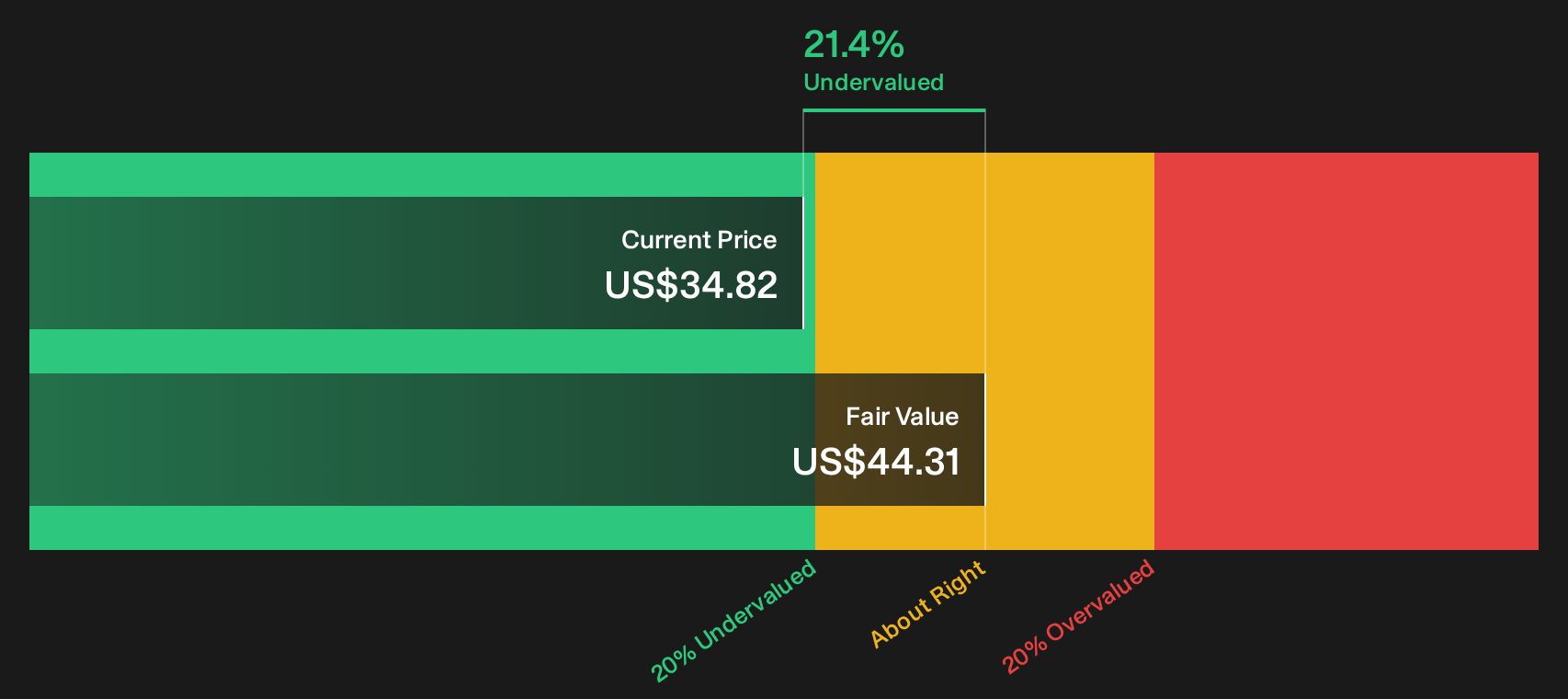
For readers weighing this, it is worth noting that Rollins earns a value score of 2 out of 6 overall, yet is also described as trading about 21.4% below one internal fair value estimate based on discounted future cash flows at $44.31. That mix of an overvaluation signal from the narrative, an undervaluation flag from the DCF output, and expensive looking P/E comparisons suggests the market is still trying to reconcile Rollins' high quality business traits with slower recent earnings momentum and a tougher benchmark from faster growing peers.
Result: Fair Value of $16.20 (OVERVALUED)
Still, the Rollins narrative could crack if AI driven lead pressure worsens, or if future acquisitions fail to convert into the expected cash generation.
Find out about the key risks to this Rollins narrative.
Another View: SWS DCF Versus The Rollins Narrative
A very different picture comes from our DCF model. On those cash flow assumptions, Rollins at $34.82 is about 21.4% below an estimated fair value of $44.31. Instead of 115% overvalued, this approach points to undervalued. Which story do you think fits the current business more closely?
Look into how the SWS DCF model arrives at its fair value.
Simply Wall St performs a discounted cash flow (DCF) on every stock in the world every day (check out Rollins for example). We show the entire calculation in full. You can track the result in your watchlist or portfolio and be alerted when this changes, or use our stock screener to discover 27 high quality undervalued stocks. If you save a screener we even alert you when new companies match - so you never miss a potential opportunity.
Next Steps
Mixed messages like these can make Rollins seem difficult to evaluate. Consider acting promptly, reviewing the figures independently, and weighing both the 1 or more risks and 1 or more rewards that investors are focusing on by checking out the 3 key rewards and 2 important warning signs.
Looking for more Rollins-like investment ideas?
Do not stop your research with Rollins alone. The best opportunities often sit just off your radar, and the Simply Wall St screener is built to help you spot them early.
- Target potential value plays and compare how far expectations differ from price by scanning our curated list of 27 high quality undervalued stocks.
- Prioritise resilience in your watchlist by reviewing a 30 resilient stocks with low risk scores that filters for companies with more stable risk profiles.
- Hunt for future standouts before they are widely followed by working through a focused 21 high quality undiscovered gems.
Have feedback on this article? Concerned about the content? Get in touch with us directly. Alternatively, email editorial-team@simplywallst.com