
High prices and high interest rates continue to exert pressure! US consumer confidence fell to a five-month low in October, and inflation expectations hit a new high since May
The Zhitong Finance App learned that due to continued high prices and interest rates, US consumer confidence declined further in October to its lowest level in five months. Meanwhile, consumer expectations for future inflation have risen. Both short-term and long-term inflation expectations hit new highs since May, highlighting that inflationary pressure continues to erode the purchasing power of American households.
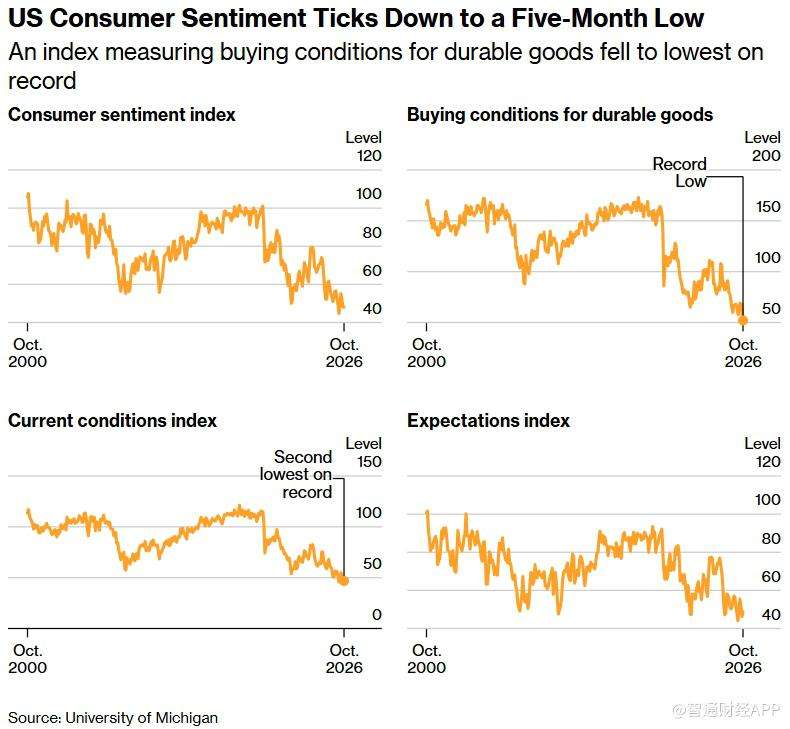
According to survey data released by the University of Michigan on Friday, the final value of the US consumer confidence index fell to 48 in October, down from 48.1 in September. Although the index continued to weaken, the final reading improved from the initial value and was higher than all economists' predictions in the Bloomberg survey.
In terms of inflation expectations, consumers expect prices to rise 4.7% in the next year, up from 4.6% in September; the average annual inflation forecast for the next five to ten years will reach 3.5%. Both indicators have risen to their highest levels since May this year.
Joanne Hsu, head of consumer research at the University of Michigan, said in a statement that after experiencing five consecutive years of higher inflation than the Federal Reserve's target level, consumers' short-term and long-term inflation expectations have risen in recent months, which indicates that high inflation expectations may gradually become entrenched and become a potential risk facing the US economy.
Consumer confidence in the US continues to be under pressure, mainly affected by factors such as high inflation, weak recruitment activities, and high mortgage interest rates. Despite the recent decline in US mortgage interest rates, overall financing costs are still at a high level, continuing to curb residents' demand to buy homes and other large sums of money. Meanwhile, the price of gasoline in the US is still significantly higher than $4 per gallon, further increasing the burden on household living costs.
Over the past few months, prices in the US have risen faster than wages, further squeezing the actual purchasing power of households. According to data released last week, consumer prices in the US rose at the fastest rate in five months in September, reflecting the continued push for inflation due to rising energy and other living costs.
As the US midterm elections enter the final sprint stage, the cost of living issue has also become a core economic issue that voters are concerned about. Hsu pointed out that regardless of political positions, American consumers generally believe that the risks posed to the economy by inflation in the coming year far outweigh unemployment.
The survey showed that consumer confidence among supporters of both the Democratic Party and the Republican Party improved in October, but the confidence of independent voters declined for the third month in a row, reflecting that there are still differences in the views of different political groups on the economic outlook.
Notably, high interest rates are having a more obvious effect on consumers' willingness to buy large items. According to the data, the durable goods purchase conditions index fell to its lowest level on record in October. The report points out that rising interest rates and increasing consumer concerns about the affordability of goods are the main reasons driving this indicator down.
Meanwhile, nearly 70% of surveyed consumers expect interest rates to rise further in the next year, the highest rate in more than three years.
This result shows that although the market continues to pay attention to the future direction of the Federal Reserve's monetary policy, ordinary consumers are still generally concerned that financing costs may increase further, thereby increasing the burden of housing, automobiles, and other large consumer expenses.
Judging from the sub-indicators, the index measuring consumers' views on the current economic situation fell to the second lowest level in history, highlighting the dissatisfaction of American households with the current economic environment. However, the consumer expectations index, which measures future economic prospects, improved for the first time since July, indicating that although consumers are still pessimistic about the current economic situation, their views on future economic development have stabilized to a certain extent.
Overall, the US consumer confidence data for October shows that continued inflationary pressure and high interest rates are still the main factors affecting residents' willingness to spend. Although consumer expectations for future economic prospects have improved slightly, rising prices, pressure on actual income, and high borrowing costs are still limiting households' ability to spend.
What is particularly noteworthy is that short-term and long-term inflation expectations are rising at the same time, which may further make it more difficult for the Federal Reserve to control inflation. If consumers continue to expect prices to rise rapidly in the future, the inflationary mentality may gradually solidify and have an impact on future consumption decisions and price trends.
The statistics for this University of Michigan consumer survey are from September 22 to October 19.