
Rambus (RMBS) Launches New AI Memory Chip As Valuation Debate Heats Up
Rambus (RMBS) just put a fresh product in front of investors, unveiling a new power management IC designed for LPDDR6 SOCAMM2 server memory, aimed at AI infrastructure and power efficiency.
Rambus has been active on the product front, yet the share price has softened recently, with a 30-day share price return down 4.29% and a 90-day move down 10.07%. This contrasts with the 3-year total shareholder return of 77.47% and 5-year total shareholder return of 304.71%, which point to a much stronger longer run record that investors will weigh against this new LPDDR6 SOCAMM2 PMIC launch.
Scan beyond Rambus to see how other AI infrastructure plays stack up by reviewing our hand-picked 55 AI infrastructure stocks aligned with this kind of memory and power efficiency story.
Rambus now trades below the average analyst target after a recent pullback. At the same time, the business has just introduced new AI oriented products. Is that caution sensible, or is the gap too wide?
Most Popular Narrative: 34% Undervalued
Rambus last closed at $92.80 while the most followed narrative points to a fair value of about $141.57. The story centers on whether the current discount lines up with the company’s AI focused product and cash generation profile.
The current valuation implies that Rambus shares do not fully reflect the combination of record revenue, strong cash from operations and ongoing buybacks, which supports the view that the stock is undervalued and that the overall narrative remains bullish.
See why 36 investors see Rambus as 34% undervalued.
Result: Fair Value of $141.57 (UNDERVALUED)
Still, the Rambus story can change quickly if margin pressure persists or if the antitrust investigation escalates and starts to drag on cash generation.
Find out about the key risks to this Rambus narrative.
Another Take On Rambus: Cash Flow Model Flashes Caution
The first narrative leans on analyst fair value of $141.57, yet the Simply Wall St DCF model points the other way. On that cash flow view, Rambus shares at $92.80 trade well above an estimated future cash flow value of about $32.66, which frames the stock as expensive rather than discounted. Which set of assumptions do you trust more, the earnings path or the cash generation projected into that model?
For anyone weighing that gap, it helps to see exactly how those long term cash estimates are built in the SWS DCF model, step by step, before leaning on either signal too heavily. Look into how the SWS DCF model arrives at its fair value.
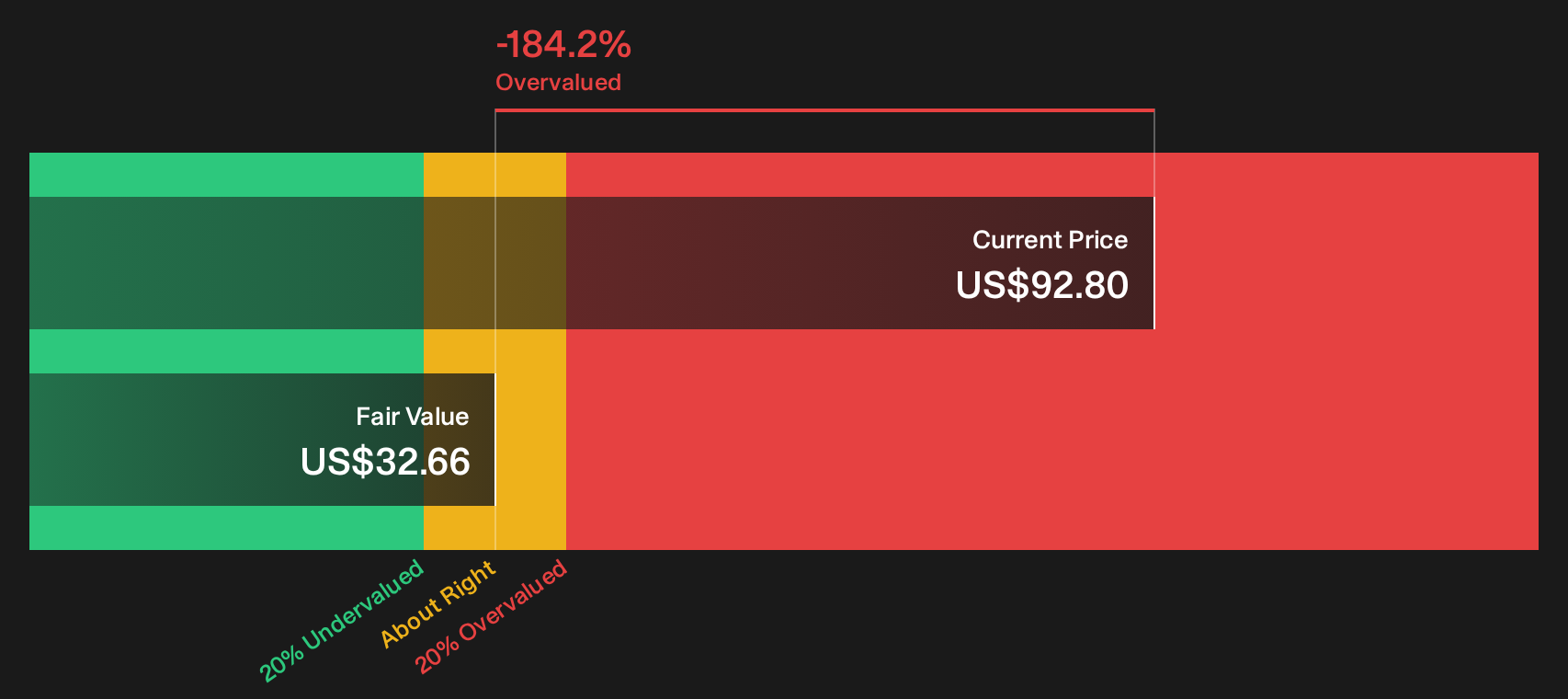
Simply Wall St performs a discounted cash flow (DCF) on every stock in the world every day (check out Rambus for example). We show the entire calculation in full. You can track the result in your watchlist or portfolio and be alerted when this changes, or use our stock screener to discover 32 high quality undervalued stocks. If you save a screener we even alert you when new companies match - so you never miss a potential opportunity.
Next Steps
Mixed signals around Rambus can either paralyze you or push you to examine the numbers yourself and decide where you stand. Move quickly, stress test both the upside and the risks, then weigh the balance with the help of 3 key rewards and 1 important warning sign.
Looking for more Rambus style investment ideas?
If you like the kind of tension around Rambus, do not stop here. Fresh watchlist ideas often come from scanning outside your usual comfort zone.
- Target higher yield while still prioritising resilience by reviewing a curated pool of 7 dividend fortresses built for investors who want income with support from fundamentals.
- Hunt for quality at a reasonable entry point by scanning our 32 high quality undervalued stocks that combine robust finances with potentially attractive pricing signals.
- Reduce portfolio stress by focusing on defensiveness and capital protection through the 31 resilient stocks with low risk scores that screens for businesses with lower overall risk scores.
Have feedback on this article? Concerned about the content? Get in touch with us directly. Alternatively, email editorial-team@simplywallst.com