
Tokyo Ohka Kogyo (TSE:4186) Gains From EUV Demand, Is It Fully Priced?
Fresh sector forecasts for photoresists and ancillaries have pushed Tokyo Ohka Kogyo (TSE:4186) into focus, as semiconductor manufacturers ramp up EUV lithography for 5G devices, automotive chips, and rapidly expanding demand in China.
Recent trading has been choppy for Tokyo Ohka Kogyo, with the share price down 5.90% over one day and 22.37% over 90 days, even as the year-to-date share price return is 29.93% and the 1-year total shareholder return reaches 57.60%, suggesting that long-term performance remains positive while short-term sentiment has weakened.
Scan beyond Tokyo Ohka Kogyo and compare it with a hand picked 55 AI infrastructure stocks benefiting from next generation chip production and EUV driven demand.
After a pullback that leaves Tokyo Ohka Kogyo up strongly over 1 year but weaker over recent months, the question now is whether the current valuation still tilts the risk reward toward new buyers or recent holders.
Preferred P/E of 23.3x: Is it justified for Tokyo Ohka Kogyo?
On earnings multiples, Tokyo Ohka Kogyo trades on a P/E of 23.3x, which leaves the stock looking expensive relative to both its own fair P/E estimate and the wider Japanese chemicals sector.
The P/E ratio compares the current share price with earnings per share and gives you a quick sense of how much investors pay for each unit of profit. For a specialist materials supplier tied to semiconductor demand, this metric often reflects how strongly the market is pricing in both future earnings and the stability of those cash flows.
Here, the gap is wide. Tokyo Ohka Kogyo changes hands at 23.3x earnings, while the estimated fair P/E sits at 19.8x. The stock also trades at a higher multiple than the JP Chemicals industry at 12.7x and above the 16.7x peer average, which points to a valuation that already factors in a significant degree of optimism and leaves less room for disappointment if forecasts or sector conditions soften from current expectations.
Explore the SWS fair ratio for Tokyo Ohka Kogyo.
Result: Price-to-earnings of 23.3x (OVERVALUED)
Still, the story can unravel if demand for high end EUV photoresists cools faster than expected, or if Tokyo Ohka Kogyo faces aggressive pricing from rival suppliers.
Find out about the key risks to this Tokyo Ohka Kogyo narrative.
Another View: What the SWS DCF Model Says About Tokyo Ohka Kogyo
The earnings multiple paints Tokyo Ohka Kogyo as expensive, yet the SWS DCF model points in the opposite direction. At ¥7,802 the shares trade about 50.3% below an estimated future cash flow value of roughly ¥15,696. This frames the stock as undervalued on cash flows, which raises the question of which signal deserves more weight.
Look into how the SWS DCF model arrives at its fair value.
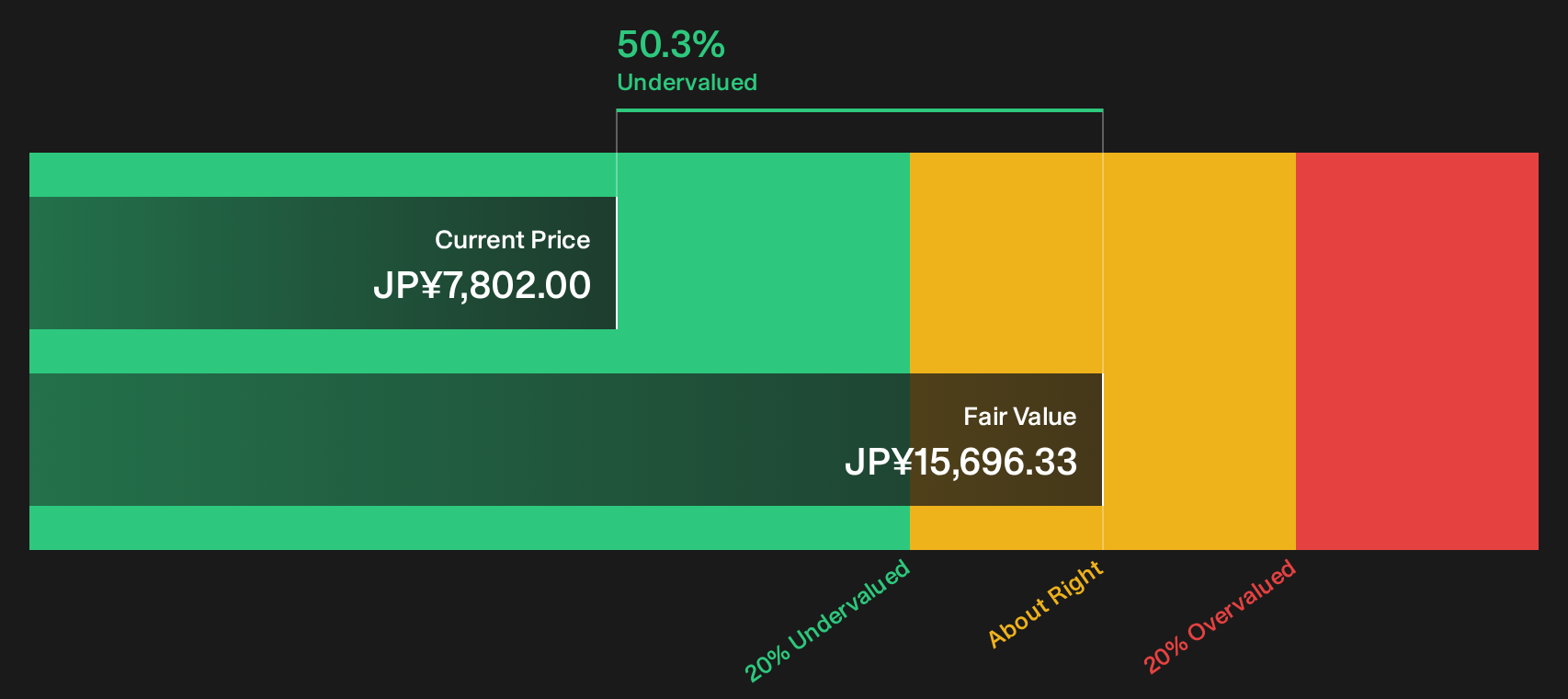
Simply Wall St performs a discounted cash flow (DCF) on every stock in the world every day (check out Tokyo Ohka Kogyo for example). We show the entire calculation in full. You can track the result in your watchlist or portfolio and be alerted when this changes, or use our stock screener to discover 14 high quality undervalued stocks. If you save a screener we even alert you when new companies match - so you never miss a potential opportunity.
Next Steps
Mixed signals around Tokyo Ohka Kogyo can feel confusing. Move quickly, test the numbers against your own thesis, and then weigh the 3 key rewards and 1 important warning sign
Looking for more investment ideas beyond Tokyo Ohka Kogyo?
If Tokyo Ohka Kogyo has sharpened your interest in semiconductors and materials, do not stop here. Broader opportunities often come from comparing several high quality setups side by side.
- Target potential mispricing by scanning a 14 high quality undervalued stocks that combines strong fundamentals with prices that may not fully reflect their underlying business strength.
- Strengthen your income plan by reviewing a 29 dividend fortresses built around higher yields and companies that pay shareholders consistently.
- Dial down portfolio stress by focusing on a 21 resilient stocks with low risk scores designed to highlight businesses with more resilient risk profiles.
Have feedback on this article? Concerned about the content? Get in touch with us directly. Alternatively, email editorial-team@simplywallst.com