
Forget Rivian's Revenue and EPS: This Is the Q3 Number Investors Need to Watch.
Key Points
Rivian's vehicle production surged during the third quarter.
Its additional production shift won't impact Q3 earnings results much, if at all.
Automotive gross profit should soon turn positive and contribute more to consolidated gross profits.
Rivian Automotive's (NASDAQ: RIVN) most important financial milestone isn't another quarter of positive consolidated gross profit. It's unlocking the enormous gross profit potential of its automotive business as production of its highly anticipated R2 ramps up.
That's what makes the upcoming third-quarter earnings report so intriguing. Investors will get another glimpse of whether Rivian's improving vehicle economics can offset declining regulatory credit revenue and begin to drive what could be the company's biggest source of gross profit growth.
Missed Nvidia in 2009? This Rare Signal Is Flashing Again. In 2009, a "Double Down" signal flashed for a little-known chipmaker called Nvidia. For the first time in years, that same "Total Conviction" signal is flashing for a company 1/100th the size of Nvidia. Continue »
Graph worth a thousand words
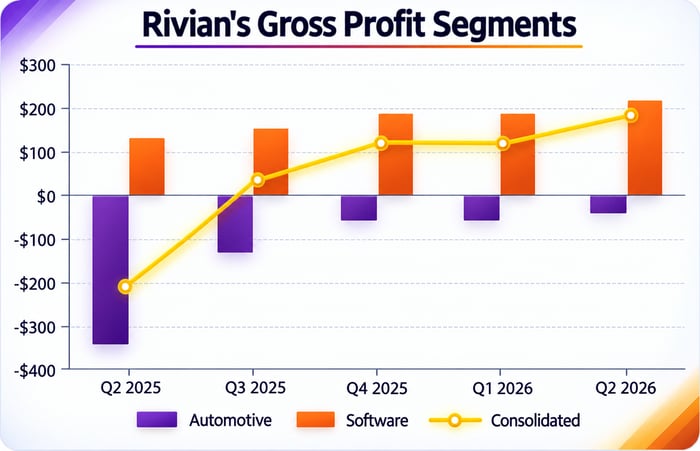
Data source: Rivian SEC filings. Chart by author using ChatGPT.
This is a simple yet incredibly powerful graph that shows a couple of critical things.
First, not all gross profit is created equal. Between the two segments that feed into consolidated gross profit, automotive and software & services, the latter boasted a strong 42% gross profit margin during the second quarter, while the automotive business continues to run at a loss. That's why we see that software & services generated positive gross profit much faster, and has carried consolidated gross profit overall.
Second, and arguably more intriguing, is just how dramatically automotive gross profit has improved despite remaining in negative territory. Over the past year, Rivian's automotive gross profit improved by $299 million, roughly 3.5 times the $86 million improvement in software and services gross profit.
That illustrates the enormous potential impact of improved vehicle economics, even though the automotive industry remains unprofitable on a gross-profit basis. Or, in other words, automotive gross profit could have more upside in the near term than software.
A step further
That's what makes the next couple of quarters extremely intriguing, as investors will get early data on how the R2 production ramp-up affects automotive gross profit. There are certainly factors to consider, such as the high up-front costs of launching the R2 and low initial production. Once Rivian crosses that break-even threshold and operating leverage kicks in, and those fixed costs are absorbed over an increasingly larger vehicle fleet, the company can really gear up for a surge in automotive gross profits.
This brings us to another important point highlighting the potential for automotive gross profit to soar over the next year: Rivian expanded R2 production by adding a second shift near the end of the third quarter. That means we won't see much, if any, impact of that additional shift in automotive gross margins for the third quarter, and the gains (hopefully) will be more organic efficiency and cost improvements, setting the stage for a bigger jump in automotive gross profits to end the year in style, as they say.
Keep in mind that even the fourth quarter won't fully capture Rivian's potential, as the EV maker plans to add a third shift next year and roll out the lower-priced R2 trims that generate higher volume demand and, in turn, production, which should combine to boost automotive gross profits even higher. Remember that Rivian launched the R2 with its highest-priced trims first to help offset high up-front costs and lower initial production numbers.
Automotive breakeven
Another huge factor to keep in mind is that during the second quarter, Rivian received about $108 million in regulatory credit sales and has noted that investors should expect this to be considerably less in the second half of the year.
Essentially, Rivian would have to lower costs and organically optimize the first shift enough to offset the loss of credit sales so automotive gross profits come in positive. That's asking a lot, even considering Rivian increased quarterly vehicle production by nearly 57%, from 12,613 in the second quarter to 19,751 in the third quarter.

Image source: Rivian.
Investors also have to be fair. More production doesn't always guarantee improvements in vehicle economics. That's because real-life operations entail higher labor expenses, supplier disruptions, potential recalls, or simply unexpected inefficiencies and costs.
What it all means
Software and services have provided Rivian with a valuable source of high-margin gross profit, but automotive could ultimately offer much greater upside as R2 production scales. The challenge is that higher production alone won't guarantee stronger margins, particularly as regulatory-credit revenue declines and the company absorbs the costs of launching a new vehicle.
That's what makes Rivian's third-quarter results so important. Investors shouldn't focus solely on whether automotive gross profit improves or deteriorates. Understanding why it changes will provide a much clearer picture of whether Rivian is approaching sustainable profitability in automotive. And even reaching that milestone would be just one step toward the larger goal of generating operating profits one day.
Daniel Miller has no position in any of the stocks mentioned. The Motley Fool has no position in any of the stocks mentioned. The Motley Fool has a disclosure policy.