
Gibson Energy (TSX:GEI) Could Be 2% Overvalued As Buy Upgrade Lifts Interest
Gibson Energy (TSX:GEI) just caught fresh attention after a Zacks upgrade to a Buy rating, tied to higher earnings estimates, firmer business fundamentals, and stronger investor interest.
Recent price action backs up the renewed interest in Gibson Energy, with the share price at CA$33.59 after a 7.42% 30 day share price return and a 31.21% year to date share price return. Long term investors have seen a 96.08% three year total shareholder return that points to momentum building rather than fading.
Scan the energy space for other potential breakouts by checking our hand picked list of 42 power grid technology and infrastructure stocks that are moving on stronger fundamentals and rising investor interest.
After a near CA$34 price tag and recent gains, Gibson Energy now asks a simple question of new money: Does the current valuation still leave enough upside to justify the risk?
Most Popular Narrative: 2% Overvalued
With Gibson Energy last closing at CA$33.59 against a narrative fair value of CA$33.07, the most followed view frames the stock as slightly rich, yet still anchored to a detailed earnings and cash flow story.
Anchored by long-term, take-or-pay contracts with investment-grade customers at major terminals (e.g., Edmonton, Hardisty, Gateway), Gibson is positioned to benefit from structural increases in North American energy demand and growing export needs. These are two drivers expected to underpin stable cash flows and support dividend growth even as the sector transitions to lower-carbon fuels.
See why 19 investors see Gibson Energy as 2% overvalued.
Result: Fair Value of CA$33.07 (OVERVALUED)
Still, the bullish script on Gibson Energy starts to fray if North American oil demand weakens, or if key terminal customers scale back or fail to renew contracts.
Find out about the key risks to this Gibson Energy narrative.
Another View: Gibson Energy Through A Cash Flow Lens
The narrative fair value pegs Gibson Energy as only 2% overvalued at CA$33.07, yet the Simply Wall St DCF model paints a very different picture. On that cash flow work, TSX:GEI at CA$33.59 trades well below an estimated value of CA$76.78, which points to a large implied upside gap that investors need to test for themselves.
That kind of disconnect raises a blunt question for anyone following Gibson Energy. Are analyst-style earnings multiples anchoring expectations too low, or is the DCF framework leaning too hard on optimistic cash flow paths and discount rate choices? Look into how the SWS DCF model arrives at its fair value.
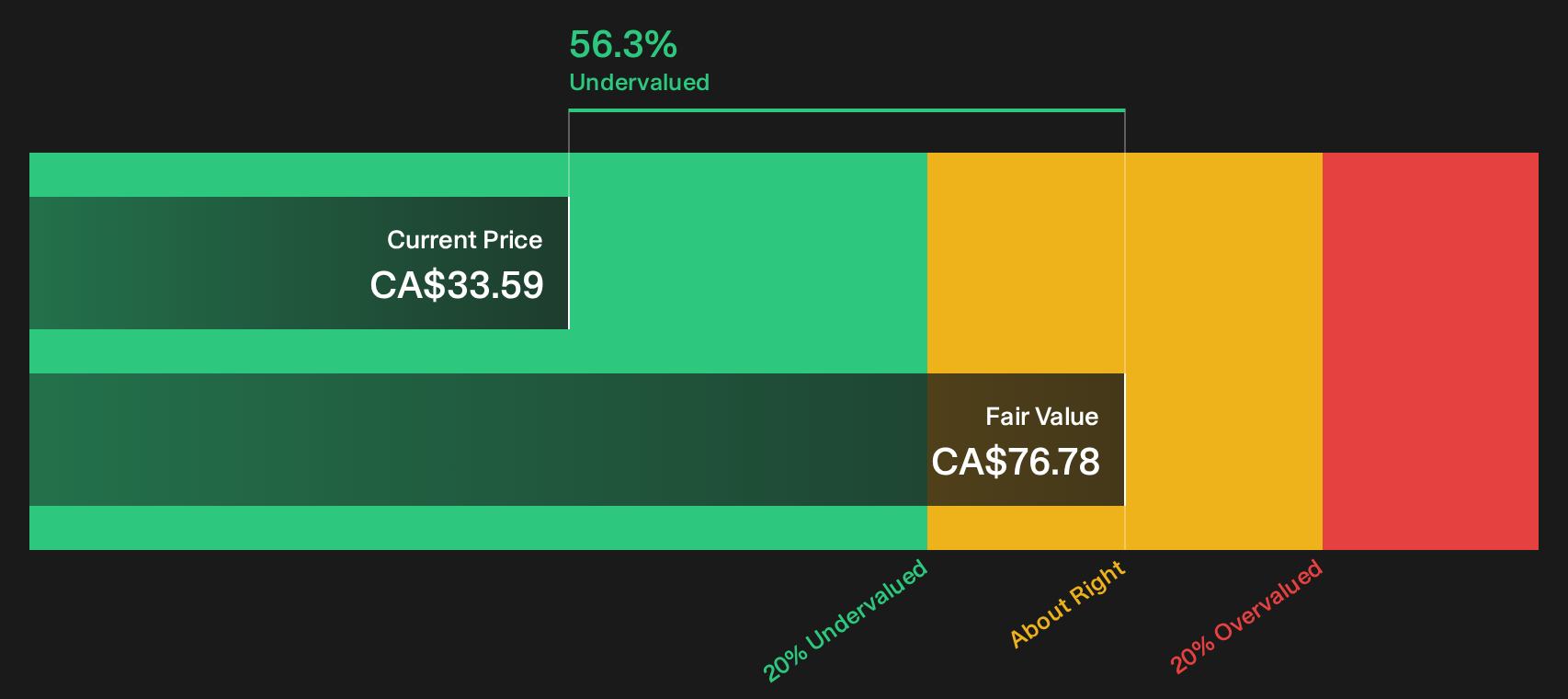
Simply Wall St performs a discounted cash flow (DCF) on every stock in the world every day (check out Gibson Energy for example). We show the entire calculation in full. You can track the result in your watchlist or portfolio and be alerted when this changes, or use our stock screener to discover 4 high quality undervalued stocks. If you save a screener we even alert you when new companies match - so you never miss a potential opportunity.
Next Steps
Mixed signals around Gibson Energy can either freeze you or push you to inspect the numbers yourself and decide what really matters. Move fast, review both the concerns and the upside case, then weigh the 3 key rewards and 2 important warning signs.
Looking for more investment ideas beyond Gibson Energy?
If Gibson Energy has your attention, do not stop here. Broaden your watchlist with a few focused screens that surface different types of opportunities worth investigating.
- Target resilient income by scanning 3 dividend fortresses that aim to pair higher yields with business models built around ongoing cash returns.
- Hunt for value by reviewing 10 high quality undiscovered gems that combine solid fundamentals with limited market attention so far.
- Prioritize capital protection by filtering for 8 resilient stocks with low risk scores that score well on financial strength and more measured volatility.
Have feedback on this article? Concerned about the content? Get in touch with us directly. Alternatively, email editorial-team@simplywallst.com