
AI trading concerns suspended! Muse is gaining momentum, Meta (META.US) continues to “burn computing power”
The Zhitong Finance App learned that Meta (META.US) handed over a three-quarter report “increasing both ends of income and expenditure at the same time” after the market on Wednesday: quarterly revenue of US$64.60 billion as of September 30, up 26% year over year, higher than LSEG's consolidated market forecast of US$63.37 billion; revenue guidance for the fourth quarter was US$73 billion to US$76 billion, and the median range was also higher than expected. However, in the same financial report, the company raised the lower limit of the 2026 capital expenditure guidance from US$130 billion to US$135 billion (the upper limit remains unchanged at US$145 billion) and announced the creation of a class of new shares without voting rights. In this quarter, when free cash flow has turned negative, Zuckerberg opened a new funding channel for the AI arms race.
Revenue side: advertising is still that money printer, Muse AI is growing strongly
Advertisements are still the mainstay of blood transfusions. In the third quarter, ad impressions increased 10% year over year, the average advertising price increased 14%, and the number of daily active household users (DAP) reached 3.64 billion, up 3% year on year; the median value of the fourth quarter guide was 74.5 billion US dollars, up about 24% year on year. Reuters and Bloomberg both pointed out that the vast majority of Meta's revenue still comes from advertising, and the main role of AI is still optimizing ad targeting and recommendations and increasing user engagement.
The real incremental narrative comes from Muse. In a conference call, Zuckerberg said that within a month and a half of the launch, more than 10 million US and Canadian users have opened Muse accounts, and the growth momentum is still strong; he expects Muse to serve “billions of people” in the future, and these users “are likely to generate more revenue than the average Meta user.” Currently, Muse remains free for most people, and Meta makes money through business-paid transaction fees, heavy user subscriptions, paying users who want to use the strongest models, and paid tools for businesses; Zuckerberg said, “If computing power efficiency continues to improve rapidly over the next few years — we think it's very likely — Muse will remain highly profitable for many years.”
However, AI's checkout schedule was pushed far behind. CFO Susan Li (Susan Li) bluntly stated in the earnings report: “These investments take longer to pay off than investments in core businesses.” Wells Fargo estimates in an October 6 report that Meta's 2027 operating expenses will be around $212 billion, and AI revenue will not contribute substantially until 2028. Additionally, some businesses have restricted access to Muse due to security concerns.
A new enterprise pipeline is also being laid: On September 28, Meta established the Meta enterprise platform, and Chirantan “CJ” Desai, then CEO of MongoDB, became the chief enterprise platform officer and reported directly to Zuckerberg. MongoDB's stock price fell more than 17% on the same day; the platform has yet to announce prices, available regions, and customer lists.
Expense side: Capital expenditure guideline range lower limit revised
In the third quarter, Meta's capital expenditure (including financial lease principal payments) reached US$34.91 billion; the company's cumulative expenditure for the first nine months was approximately US$86 billion. According to this estimate, to fall within the annual range of 135 billion to 145 billion US dollars, we will still need to spend about 49 billion to 59 billion US dollars in the fourth quarter.
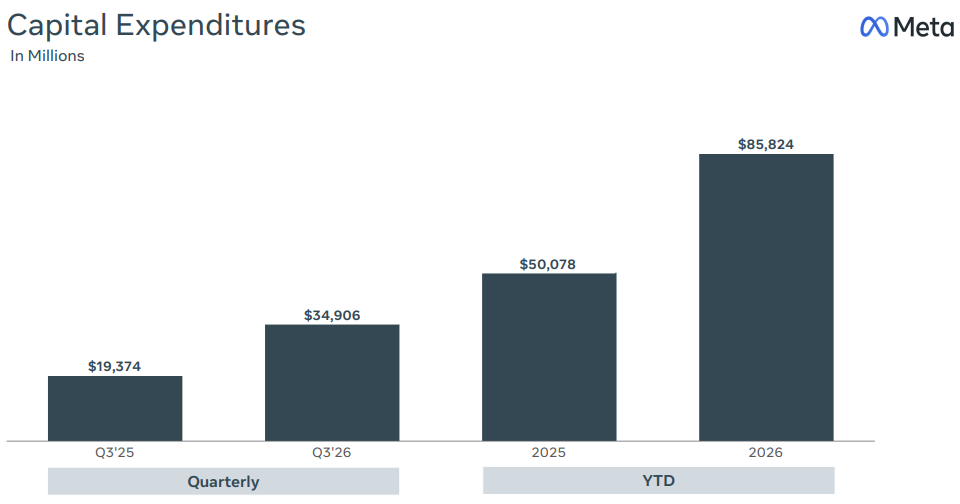
The market's original expectations were higher than this: FactSet's analyst model originally anticipated capital expenditure of around $41 billion in the third quarter and over $49 billion in the fourth quarter, and FactSet expected Meta's spending of $196 billion in 2027. In other words, Meta raised the lower limit rather than the upper limit — it didn't open the floodgates any bigger; it just raised the “most conservative situation.”
Other expenditure items are being tightened. Financial reports show a 15% year-on-year reduction in the number of employees; Reality Labs is expected to lose up to $19 billion this year, falling to about $15 billion in 2027, saving resources “mainly for AI.”
Cash flow: From “printing money” to “overdraft”, one-time litigation costs rewrite the income statement
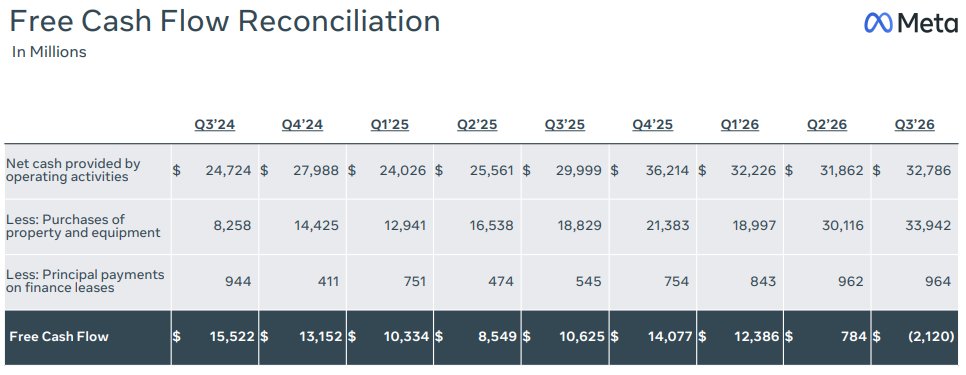
What's really impressive is the cash flow. Meta's free cash flow for the third quarter was $-212 billion, compared to a positive $10.63 billion in the same period last year; this figure was better than the market's previous estimate of about -94 billion US dollars, and turned negative for the first time since listing. Meanwhile, according to financial data, the cash flow from operating activities for the third quarter was US$32.79 billion, with a total of US$82.45 billion in cash, cash equivalents and marketable securities as of September 30 — the company still has sufficient operational hematopoietic capacity, and the gap is on the capital expenditure side.
The income statement was distorted by one-off factors: due to the $9.89 billion fee associated with the settlement reached with 52 state attorneys general in August, diluted earnings per share for the third quarter were $3.83; if this fee were excluded, earnings per share should have been $7.40.
As a result, the financing operation was a matter of course. Meta will create a new non-voting Class C common stock, which is scheduled to take effect in January 2027, and be distributed to existing shareholders on a 1:1 basis in the form of stock dividends; the new shares will be used for capital raising, employee compensation, and potential mergers and acquisitions, while not diluting CEO Mark Zuckerberg's control. The company says this move will ensure that Zuckerberg continues to lead the company “into the next era.” Class A shares will continue to be traded on the NASDAQ, and Class C shares will also apply for listing on the NASDAQ.
External debt is also fuel for this machine. According to Goldman Sachs data, as of 2026, the global AI-related debt issuance reached 489 billion US dollars, with the five largest manufacturers accounting for nearly 40%. Meta issued about $30 billion in bonds for data centers earlier this year; Meta Texas data center project issued $12.55 billion in July, with a yield of 7.534%, and a premium of about 287.5 basis points over 10-year US Treasury bonds during the same period. The off-sheet structure is also expanding: The Louisiana Hyperion data center was funded by issuing bonds through an entity in a joint venture between Meta and Blue Owl, citing reports of around $27 billion. Meta holds only a minority stake but promises long-term leases.
In the context of the new cloud sell-off: Meta is both a buyer and a referee
This is where this financial report is most indicative of current “computing power concerns.” Over the past two weeks, the AI infrastructure sector has experienced a round of sell-off: as of October 16, CoreWeave's stock price fell more than 15% in a single week, and the yield on bonds maturing 2030 jumped 500 basis points to nearly 16%, and the market focused on its $50 billion debt; CoreWeave was in the middle of a “circular financing arrangement” between chip company Nvidia and customers (OpenAI, Meta, etc.). Gartner anticipates that more than 80% of new cloud vendors will cease operating independently by 2030, and estimates that AI infrastructure spending could reach $7 trillion by 2030, while AI-related revenue would not exceed $3.6 trillion; AI-related bond issuance fell from $113 billion in June to $23 billion in September.
Meta's ledger gives three comparative signals.
First, the demand side has not collapsed. Muse requires a lot of computing power, which is one reason it hasn't been launched globally — a company with $82.45 billion in cash said it “doesn't have enough computing power,” which itself is the most direct footnote to demand; Musk also said on a SpaceX conference call this week that demand far exceeds supply.
Second, Meta is shifting from “selling computing power” to “using its own computing power.” While Meta launched an enterprise platform to test the waters of outbound computing power, Wells Fargo removed the anticipated resale of 500 megawatts of computing power in 2027 (about US$5 billion in high gross revenue) from the model in October, precisely because of Muse's success — computing power must first be left to its own products. For Xinyun, this is both order support and a double squeeze on supply substitution.
Third, the differentiation is not in AI requirements, but in capital costs. Meta had operating cash flow of $32.79 billion and $82.45 billion in cash for the third quarter, which was a self-funded buyer; intermediaries such as CoreWeave depended on debt rolling over, and J.P. Morgan estimated its mixed capital cost at 9% to 11%. When financing costs are repriced, leveraged intermediaries are the first to be pressured, rather than self-builders covered by cash flow — but Meta itself is also increasingly borrowing and making off-balance sheet arrangements, which makes it stand on the same interest rate curve as Xinyun, but at a higher position.
Risk at the end of the law: a $25 billion fine starts a long-distance run
On the same day as the earnings report, New Mexico Judge Francis Mathew ordered Meta to pay the state $25 billion. Mathew determined that the amount of fines due under state law was over $219 billion, eventually reduced to $25 billion; in September, the jury found that the company and its management made 26 misleading statements on data privacy, hate speech, etc., which estimated that the state's consumer protection law had been violated more than 43 million times; state attorney Randi McGinn had asked for between 35 billion and 40 billion US dollars, and Meta claimed a cap of 3.45 billion US dollars.
Meta's chief legal officer, C.J. Mahoney, said the company was confident it would win the appeal and said the ruling “made it almost impossible to do business in New Mexico”; the state's Attorney General Raúl Torrez called it “one of the biggest financial penalties for businesses in US history.” Previously, Meta had already paid $5 billion to the US Federal Trade Commission in 2019 due to the Cambridge Analytical incident, and another six states involved Cambridge Analytica's $459.2 million in the August multi-state settlement; New Mexico also won $942 million in two related trials earlier this year, and another trial opens next week.
Gil Luria, head of science and technology research at D.A. Davidson, believes the ruling is expensive but unlikely to affect the company's valuation — “Meta's market capitalization is close to $2 trillion, and it is likely that it will continue to appeal and drag the case down.” Minda Smiley, senior analyst at Emarketer, cautioned that if AI agents become more mainstream, questions about privacy and security will only intensify, “considering Meta's reputation in this field, it may eventually hurt it.”
Market Reactions and Institutional Views
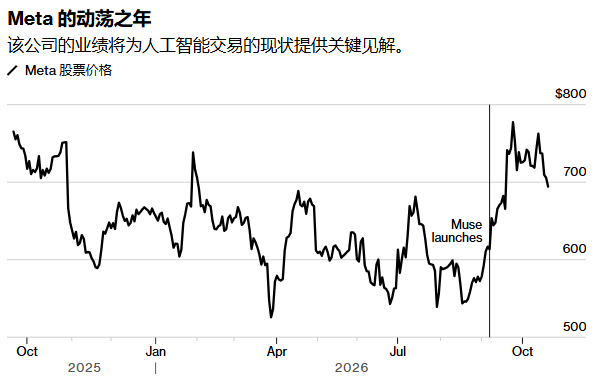
According to the data, Meta's stock price had risen about 6% in the year ending Wednesday when US stocks closed. The social media giant currently closed at 697 on Wednesday, with a market capitalization of $1.79 trillion and a price-earnings ratio of 26.52. After the results were announced, Meta rose 2.08% to $712 as of press time after the post-market period.
Goldman Sachs reaffirmed Meta's “buy” rating and maintained a target price of $860. Goldman Sachs said investors are expected to respond positively to Meta's third quarter 2026 earnings report. Financial reports showed that revenue for the quarter exceeded the upper limit of the company's previous guidance range, and advertising revenue increased 26% year over year. Goldman Sachs pointed out that during the performance conference call, Meta management expressed optimism about the large-scale promotion of AI and its positive impact on core business. At the same time, it suggested that investment would continue to increase in the future, but did not provide specific quantitative data.
Meanwhile, Raymond James reiterated his “strong buy” rating for Meta Platforms, with a target price of $860, and emphasized that the company's upcoming earnings report has attracted great attention from the market. Citizens maintains a “outperforming the market” rating, with a target price of $885, due to the fact that AI is progressing smoothly and the advertising business is performing well. On the other hand, BMO Capital reaffirmed the “in sync with the market” rating, with a target price of $580. Although acknowledging that the momentum of AI products has improved, it is cautious about the scale and timing of AI monetization.
Furthermore, the seller lineup is already crowded: Bank of America Justin Post buys $810; Deutsche Bank Benjamin Black buys $820; Bernstein Mark Shmulik buys $800; Wells Fargo raised the target price from $796 to $1,000 in October; Zacks summed up the average price target of 50 analysts at $824.56.
A quote from senior analyst Jesse Cohen broadly sums up the emotional shift in the earnings report: “The market has moved from punishing Meta for spending money to rewarding it with a compelling product story.”