
Down 12% in 1 Month, Bloom Energy Faces a Big Test on October 22. Here’s My Prediction.
Bloom Energy Corporation (BE) is set to report its third-quarter results on Oct. 22, but the stock has weakened ahead of the announcement. On Oct. 14, shares dropped despite Roth Capital raising its price target to $260. In all, BE stock has fallen about 12% over the past month, caught up in the wider selloff in AI infrastructure names. I think the recent weakness creates an opportunity for investors looking three to five years ahead to examine the stock more closely.
The pullback comes right after the best quarter in Bloom’s history. In the second quarter, revenue jumped 166% to $1.065 billion, crossing $1 billion for the first time. Bloom also raised its full-year revenue guidance to $3.9 billion to $4.2 billion, roughly double last year’s total. Management said every major U.S. hyperscaler, along with more than a dozen neoclouds and AI labs, has approved its fuel cells for their data centers.
About Bloom Energy
Bloom Energy designs, manufactures, sells, and installs solid-oxide fuel-cell systems for on-site power generation. Called the Bloom Energy Server, the company's energy server platform converts fuel like natural gas, biogas, and hydrogen into electricity through a non-combustion electrochemical process. The company also offers the Bloom Electrolyzer to produce clean hydrogen. Bloom Energy sells its products through direct and indirect sales channels to utilities, data centers, retail, healthcare, education, telecom, manufacturing, and other industries. Founded in 2001, the company is headquartered in San Jose, California.
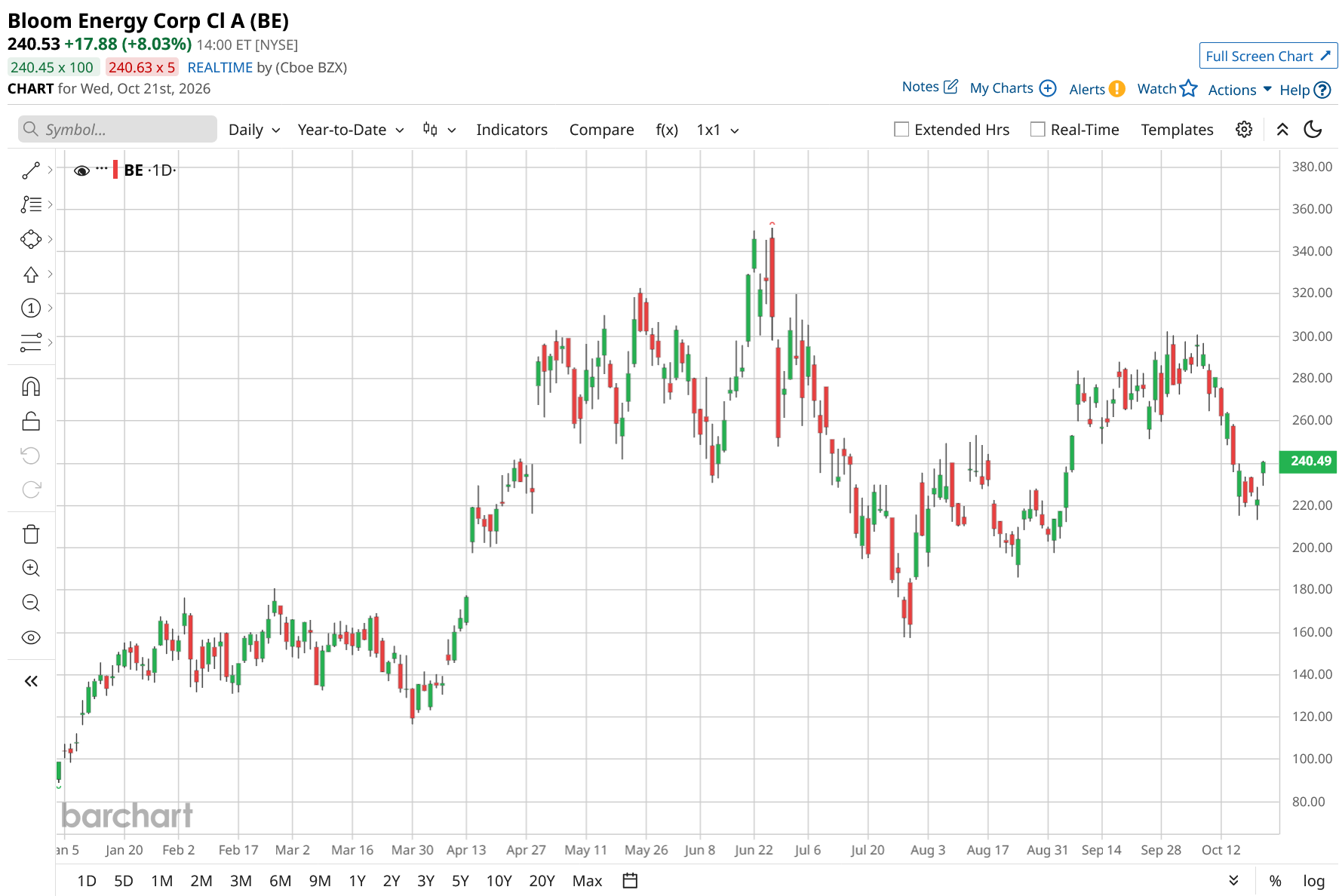
Over the past year, BE shares have surged 130%, outperforming S&P 500’s ($SPX) gain of 15% during the same period. The trend has continued this year as well, with the stock up 176%, while the S&P 500 gained 13% over the same period. BE stock has been fairly volatile, climbing from roughly $119 at the end of March to $345 by mid-June, and then down to about $240 today.
Earnings Must Catch Up With a Steep Multiple
Bloom Energy’s forward price-to-earnings (P/E) stands at 87.20x, about 35% below its five-year average of 134.25x. That comparison needs context, however, because the historical average was pushed higher by years of minimal profits. Its forward price-to-sales (P/S) multiple of 16.90x remains nearly three times the five-year average of 5.92x. This points to a steep valuation premium, but the earnings outlook offers some support. Analysts expect EPS to rise 256.30% in 2026 and 82.37% in 2027, potentially lowering the P/E to about 45x based on 2027 earnings. Growth is projected to moderate to around 35.78% in 2029. On the balance sheet, $2.72 billion in cash is close to the company’s $2.82 billion in debt.
Why Bloom Energy’s Backlog Supports a Long Runway
Bloom Energy’s second-quarter revenue surged 166% to a record $1.065 billion. Management also raised its 2026 revenue guidance to $3.9 billion to $4.2 billion, representing about 100% growth at the midpoint. Oracle’s plan to deploy up to 2.45 gigawatts of Bloom Energy fuel cells at its Project Jupiter AI campus adds to the opportunity. The company’s backlog stood at roughly $20 billion at the end of 2025. However, fulfilling that backlog will require successful execution and continued capacity expansion, since orders do not become revenue until they ship. Still, the CFO described the quarter as one of profitable growth with positive operating cash flow, which I believe gives Bloom Energy a solid foundation.
What I Expect on October 22
Bloom has beaten revenue estimates by at least 20% in each of its last four quarters. This time, the bar is higher than it looks. Analysts expect about $1.07 billion in Q3 and $1.23 billion in Q4. Together, that’s above what the midpoint of Bloom’s own guidance implies for the second half. In other words, Wall Street already expects Bloom to finish in the upper half of its range. I still think it gets there. In July, management said it had strong visibility into the second half. As I covered earlier, demand for Bloom’s power solutions keeps growing faster than expected. My prediction is that Bloom beats the $1.07 billion estimate and raises its full-year outlook for the third time this year. The main concern is concentration. Despite all those approvals, one customer still made up about 73% of Q2 revenue. If that customer slows its orders, Bloom's growth could stall quickly, no matter how strong the rest of its pipeline looks.
What Do Analysts Expect for BE Stock?
Bloom Energy is heading into its next earnings report with Wall Street expecting a big jump in profit. Truist analyst Christopher Souther raised BE’s price target from $218 to $240 but maintained a “Hold” rating ahead of its third-quarter results. The analyst expects strong results due to healthy year-over-year (YoY) demand, continued business growth, and improving profitability. In contrast, Baird raised the firm’s price target from $310 to $351 and kept an “Outperform” rating on the shares.
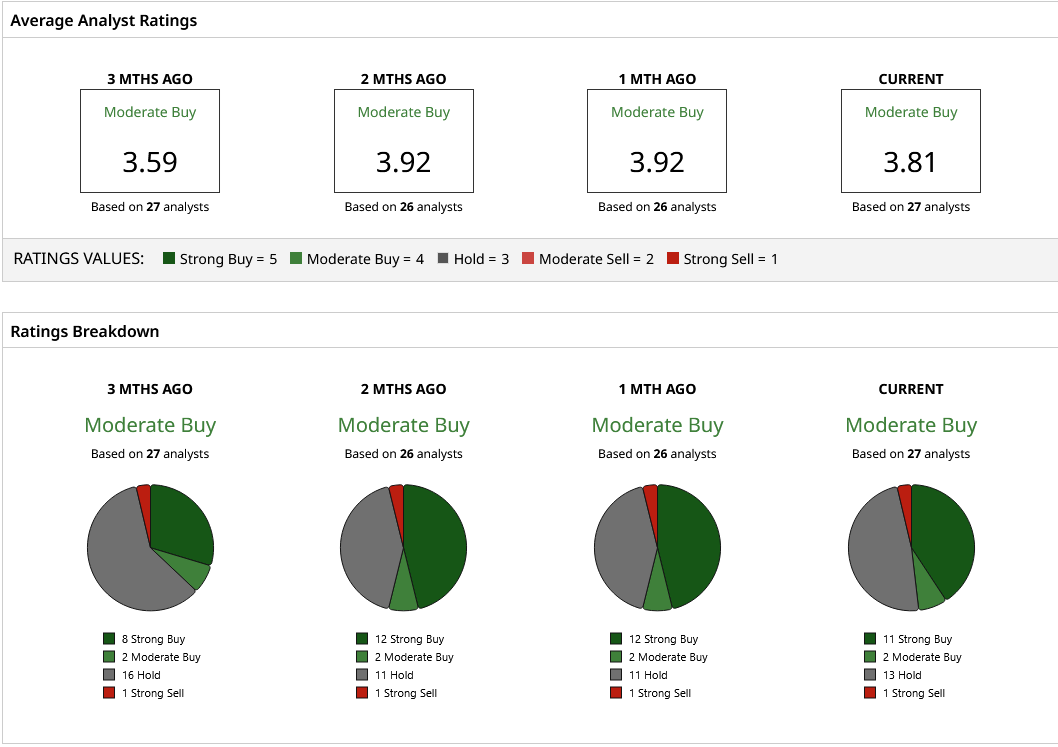
The wider analyst view is also positive. Out of 27 analysts, BE stock has a consensus “Moderate Buy” rating, and the average price target is $290.91. That suggests about a 21% upside from its current price.
On the date of publication, Jabran Kundi did not have (either directly or indirectly) positions in any of the securities mentioned in this article. All information and data in this article is solely for informational purposes. For more information please view the Barchart Disclosure Policy here.