
Prediction: $150 a Month Invested in Micron Stock Will Be Worth This Much by Year-End 2030
Key Points
Micron is worth $1 trillion, making it one of the most valuable technology companies in the world.
The company has several catalysts beyond artificial intelligence (AI) data centers.
A modest monthly contribution to Micron stock could become a multibagger by the beginning of next decade.
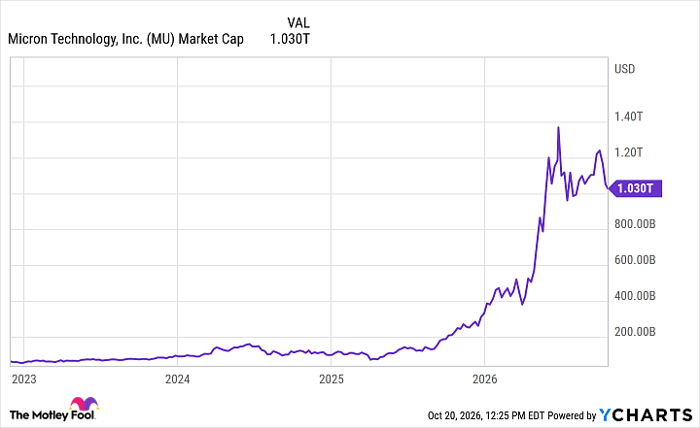
Over the last year, memory chip manufacturers have benefited from extraordinary demand for artificial intelligence (AI). In particular, Micron Technology (NASDAQ: MU) has witnessed its market capitalization propel from just $53 billion at the start of the AI revolution to more than $1 trillion today.
Missed AI’s "Act 1"? Act 2 Could Be 15x Bigger. Most investors think they missed the AI boat because they didn't buy Nvidia in 2005. But according to our analysts, we’re only at the end of "Act 1"—the R&D phase. "Act 2" is the global rollout. Continue »
MU Market Cap data by YCharts
Despite its historic rally, investors should not assume Micron's growth is finished. As AI moves beyond data centers and becomes increasingly embedded in everyday products, the company stands to benefit from another wave of demand. What's encouraging is that you don't need thousands of dollars to participate in Micron's upside.
As of this writing (Oct. 20), Micron stock trades around $900. But investors can purchase fractional shares, allowing them to invest a fixed amount without buying an entire share. Let's assess what could happen if you invested $150 in Micron every month between now and the end of 2030.
What tailwinds does Micron have?
Micron manufactures DRAM, NAND flash memory, and high bandwidth memory (HBM). These products help computers process, access, and store information.
HBM is becoming particularly important because AI accelerators require vast amounts of memory to process queries efficiently. Micron is already shipping HBM4 products optimized for Nvidia's Vera Rubin architecture, positioning the company to benefit from the AI infrastructure build-out.
Importantly, Micron's long-run opportunity extends beyond Nvidia's GPUs. The proliferation of agentic AI, CPUs, robotics, and autonomous systems will create additional demand for memory and storage. As these applications become more sophisticated and move into production, they will inevitably require greater capacity to process information, store data, and handle complex workloads.
Consider the automotive industry as an example. Micron has already announced long-term supply agreements with General Motors and Ford Motor Company. These partnerships support next-generation vehicle platforms, including advanced driver-assistance systems and AI-powered experiences inside of cars.
Micron also forged agreements with automotive technology suppliers such as Qualcomm, DENSO, and Hyundai Mobis -- demonstrating how memory is becoming essential across applications beyond consumer devices and hyperscale data centers.

Image source: Micron Technology.
How big can Micron get?
Micron currently boasts a market capitalization of roughly $1.03 trillion. I see a few reasons why the company could become significantly more valuable as AI infrastructure investments accelerate, fueling further demand for advanced memory.
First, AI systems are becoming more memory-intensive. As new processors enter production and companies deploy AI across enterprise applications, demand for HBM and advanced DRAM should continue growing.
Second, Micron is investing heavily in manufacturing capacity while securing longer-term strategic customer agreements. Higher-value products such as HBM should support more robust profitability than conventional DRAM, helping Micron turn growing demand into sustainable earnings growth.
Lastly, investors could begin valuing Micron differently as its role in the AI supply chain becomes more recognized and appreciated. Historically, memory manufacturers traded at modest valuation multiples because of their cyclical business models. However, increasingly sophisticated memory products, stickier customer relationships, and new use cases could support a more favorable long-term valuation.
Taken together, I think Micron could reach a $2.5 trillion market capitalization by December 2030. Compared with its current market cap, that represents 145% cumulative upside, equivalent to 24% annualized stock appreciation, or 1.8% per month when compounded.
While this is slightly aggressive, I think it's a reasonable upside scenario considering it's considerably below the stock returns Micron has already generated during the AI infrastructure supercycle. If I apply that projected growth rate to all 51 monthly investments of $150, the total contribution of $7,650 invested could finish 2030 worth approximately $12,400. That represents roughly $4,750 in investment gains, or 62% upside.
Smart investors always think about the long term
Of course, Micron's actual stock price won't move in a perfect line. Semiconductor stocks frequently experience sharp rallies and sell-offs, making short-term fluctuations difficult to predict. That's precisely what makes dollar-cost averaging appealing. Investors can build a position over a long-term time frame without attempting to identify the perfect entry price.
The bigger theme here is that Micron should continue benefiting from multiple secular growth tailwinds that can support additional stock price appreciation over the next several years. As AI becomes more integrated into computing, transportation, and everyday consumer products, demand for advanced memory should expand.
For this reason, I see Micron as a compelling buy-and-hold opportunity for patient investors right now.
Adam Spatacco has positions in Nvidia. The Motley Fool has positions in and recommends Micron Technology, Nvidia, and Qualcomm. The Motley Fool recommends General Motors. The Motley Fool has a disclosure policy.