
Meta (META.US) earnings report comes later: Is the “key test” of AI trading a reassurance pill or a lifesaver?
The Zhitong Finance App learned that as Meta (META.US) is about to release its latest quarterly earnings report, investors are becoming more and more anxious about the future of the artificial intelligence (AI) market. However, this financial report may not only calm some of the nervousness, but also further amplify market fears.
“If Meta delivers impressive financial reports, it will boost market confidence and hopefully reinvigorate the AI market by easing external concerns about the needs of the entire industry,” said Andrew Wang, managing partner of Runnymede Capital Management, which holds Meta shares. “Conversely, if Meta's earnings report is worrying, it will add another cloud to this sector that is already under pressure.”
The recent trend in Meta's stock price seems to have revealed a certain degree of pessimism in the market. The stock has been falling for five consecutive trading days, the longest losing streak since July, and closed lower on 9 of the last 11 trading days. The stock is on its way to its worst annual performance since 2022.
On the other hand, looking at the rise in the market in September, it was largely due to the instant popularity of its Muse smart device. Investors saw that Facebook's parent company's continued increase in AI investment is expected to translate into revenue and higher growth rates — and this is where CEO Zuckerberg had doubts before. The company's latest AI model also received enthusiastic feedback from the market.
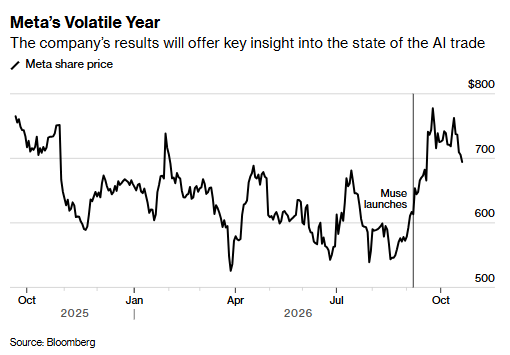
Meta's third-quarter results will be announced after the market on Wednesday. If the financial report shows that its spending plan is reasonable, it can provide reassurance to investors who have doubts about the broader future of AI spending. This concern is one of the drivers of the recent collapse in semiconductor stocks and market concerns about the debt levels of companies such as CoreWeave (CRWV.US).
“Currently, the AI movement is still playing, but investors' patience is waning,” said Max Stamakun, chief investment officer at Israilov Financial. “If Meta's earnings report disappoints, it may exacerbate some concerns in the market and have a negative impact on market sentiment.”
Meta is one of the first AI capital expenditure giants to disclose results this earnings season, and its performance may set the tone for next week's earnings reports for Microsoft (MSFT.US), Amazon (AMZN.US), and Alphabet (GOOGL.US). Earlier, strong preliminary sales data from server manufacturer Ultra Micro Computer (SMCI.US) and better-than-expected revenue forecasts for Elon Musk's SpaceX (SPCX.US) led to a short-term rebound in AI-related targets.
Wall Street anticipates that so-called AI hyperscale companies will continue to spend heavily. Meta expects negative free cash flow until at least 2028, and its capital expenditure for the third quarter is expected to exceed $40 billion, compared to less than $19 billion in the same period last year. Capital expenditure is expected to be around US$140 billion in 2026, US$2020 billion in 2027, and US$218 billion in 2028. Maintaining this spending pace is critical for companies that partner with Meta to advance their AI ambitions.
“Meta's capital expenditure expectations can support short-term demand for chips and related devices, and Muse's strong performance means Meta's infrastructure procurement needs are sustainable,” Wang said.
According to compiled supply chain data, one of the companies that may fluctuate due to Meta earnings reports is AMD (AMD.US), because its CPU chips provide computing power support for various AI agents. Meta accounts for 5.5% of AMD's revenue and is the chipmaker's second-largest customer after HP (HPQ.US). The success of Muse has made Wall Street analysts more confident about AMD's future. This also shows that the market sentiment towards chipmakers and other areas of AI infrastructure is highly dependent on leading AI customers to continue to fulfill their investment plans.
In the second half of this year, the Philadelphia Stock Exchange semiconductor index has dropped 21% cumulatively. The root cause is that investors are questioning the sustainability of AI capital expenditure plans. The index still rose 59% in 2026 — it doubled in the first half of the year — but recently experienced eight consecutive trading days of decline, the longest continuous decline since October 2008. Last week's 11% decline was also the worst weekly performance since April 2025.
Because of this, investors are counting on Meta's earnings report to boost market sentiment, according to Israilov's Stamakun. According to the average estimates of analysts compiled, the company's net profit for the third quarter is expected to surge by about 230% and revenue to increase by 24%. Annual revenue is expected to grow by about 27%, which will be the fastest annual growth rate since 2021.
“Thanks to Muse, Meta seems to have returned to the focus of the market, and any good news the company releases will improve the overall market sentiment about AI,” Stamakun said. “The AI field may reach the point where the first domino falls, but I don't think that domino will be Meta, nor will it fall because of Meta.”
Other than that, from a valuation perspective, Meta's stock doesn't look particularly expensive. The stock's current price-earnings ratio is less than 19 times the estimated profit for the next 12 months, which is slightly lower than its 10-year average and the valuation multiples of the Nasdaq 100 Index, which mainly focuses on technology stocks. Among the “Big Seven” US stocks, its valuation is only higher than Nvidia (NVDA.US), making it the second-cheapest target in the sector.
“In my opinion, for a company like Meta with such broad coverage and opportunities, this valuation is reasonable,” Wang said. “I wouldn't say it's already a bargain to buy with a closed eye, but if its expected profits prove to be sustainable, then it's clearly attractive.”