
BlackRock sees a “once in a generation” bond market layout opportunity! If the cost of AI financing falls, can technology shareholders expect a rise in the market?
The Zhitong Finance App learned that as long-term US bond yields of 10 years or more surged and continued to be the highest in more than 20 years, and corporate credit bond yields are also on an upward path, top Wall Street strategists have begun to discuss this kind of investment inspiration — that is, the trend of high yield is simultaneously raising the AI financing threshold for large-scale expansion of AI computing power infrastructure, and making bond assets a competitive source of income again. Therefore, if capital re-embraces high-yield corporate bonds and long-term US bonds, it may push the credit market and long-term yield indicators downward, thereby resuming the bullish trajectory of AI computing power-themed stocks and broad technology stocks that have continued to be under pressure recently.
The fixed income strategist team at BlackRock, the world's largest asset management giant, recently said that it is now possible to build a decentralized fixed income asset portfolio with a yield of more than 7%, an interest rate duration (Duration) of less than three years, and an average credit rating of A- to hold earnings to significantly reduce the dependence on Alpha's excess income under the Federal Reserve's path of interest rate cuts, narrowing interest spreads, and severe stock market turmoil.
Meanwhile, CoreWeave (CRWV.US), which is at the core of the “AI computing power sell-off storm” and the “AI bubble bursting argument”, has continued to be under pressure in recent stock trends. Some bond yield indicators once exceeded 16%, and the market focused on examining its “huge upfront investment and instalment payment of contract revenue” financing model. Goldman Sachs, on the other hand, upgraded it to a positive rating of “buy” after the collapse, and J.P. Morgan also maintained the most optimistic “increase” rating: the recent differences between the long and short sides surrounding CoreWeave focused on whether financing pressure had been overpriced, and whether the improved return on computing power projects could continue to efficiently cover higher capital costs.
BlackRock's fixed income strategists emphasize a “once-in-a-generation” short-term portfolio high-yield bond investment opportunity, that is, the historical-grade investment appeal brought about by the current rare high yield. If global capital believes in the bond market prospects and further lowers the yield on corporate credit bonds and long-term US bonds closely linked to the trillion-dollar AI infrastructure process — that is, huge bond market purchases accelerate the decline in benchmark yields, corporate bond purchases drive credit spreads narrower. If combined with AI cloud computing related computing power to provide corporate profits, orders, and cash flow growth to meet expectations that remain steady The two are expected to jointly mitigate AI financing pressure supports a new round of tech stock valuation expansion.
BlackRock's view of “a rare high yield for a generation”
Global asset management giant BlackRock said that current global corporate bond yields, particularly those closely linked to continued strong AI demand and unprecedented AI infrastructure processes such as CoreWeave, Microsoft, Google, Amazon, and SoftBank, provide a more resilient source of return and are not dependent on harsh expectations of falling interest rates or narrowing interest spreads.
BlackRock's core judgment is that inflationary pressure and expectations of interest rate hikes in Europe and the US have once again raised the initial yield of bonds, but under the trend where AI is expected to drive productivity changes, investors have the opportunity to obtain income that required taking more risks in the past with lower interest rate sensitivity and better average credit quality. “A bond yield of more than 7%, a tenure of less than three years, and an average A-rating” reflects the opportunity to build a portfolio, and the return base comes more from the accumulation of earnings during the holding period. As a result, fixed-income assets are expected to reduce the portfolio's dependence on stock performance and enhance resilience to employment, inflation, and geopolitical shocks.
The asset management giant's fixed-income strategist team wrote in its quarterly fixed income outlook released on Wednesday that it is now possible to build a diversified fixed income portfolio with a yield of more than 7%, a period of less than three years, and an average credit rating of A- or above.
At a time when inflationary pressure is heating up again and the US and ECB systems are restarting the process of raising interest rates, yields have reached levels that were only briefly seen three years ago and during the global financial crisis. Although financing needs are still huge, these high-rated investment-grade bonds recently issued by Microsoft, Google, and Amazon are providing investors with a very rare opportunity to lock in unusually rich yield indicators.
“This is a high yield that almost a generation can only experience once,” James Turner, head of BlackRock's global fixed income business in Europe, the Middle East and Africa, said in an interview. “Today, you can get much higher returns from arguably safer investments, and in the 2010s and early 2020s, to get the same return, people had to get involved in riskier investments.”
BlackRock strategists said in the report that opportunities in the investment-grade credit market include AI cloud computing and corporate mixed capital bonds in a wider range of fields such as utilities, telecommunications, and energy. Interest spreads in these high-rated credit bond markets have narrowed less than the overall bond market.
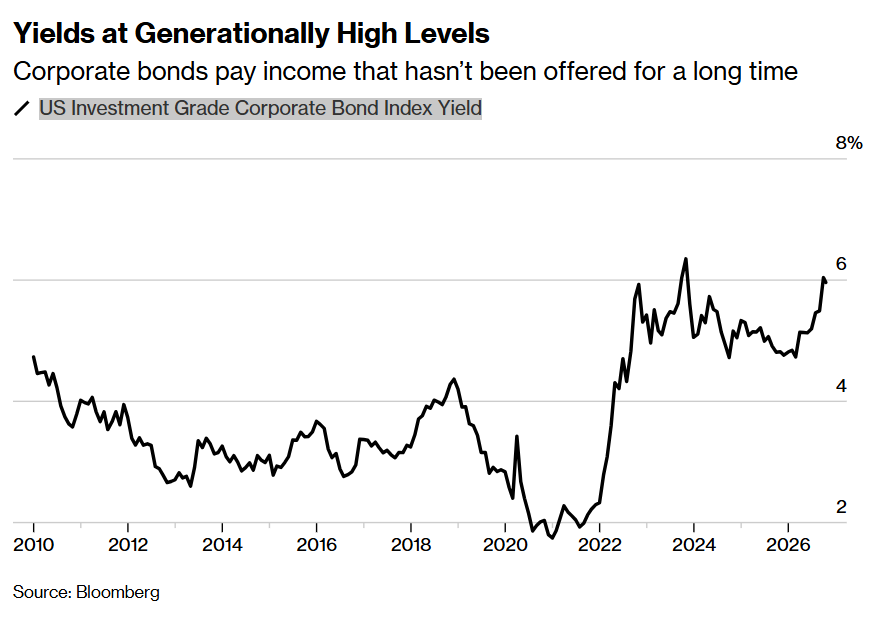
As shown in the chart above, the yield of the US investment-grade corporate bond index and the long-term US bond yield index are all at record highs that are hard to meet in a generation — in particular, credit market corporate/corporate bonds provide rich investment returns that have not been seen in a long time.
One issue worth paying attention to is the fragmentation within the credit market. BlackRock cautioned that when interest spreads are wide, a broad allocation of market assets can contribute quite a bit of strong returns; however, the current environment requires investors to make more careful choices between regions, industries, and ratings, and even within the capital structure of the same issuer.
In the relatively high-yield bond market, BlackRock is optimistic about the investment value of some B-grade borrowers in the real estate, finance, and service industries, because its fundamentals are still stronger than reflected in current market pricing.
“Today, which companies can perform well and which have the right future strategies are very much dependent on each company's specific business situation,” Turner said.
BlackRock said that the corporate credit bond market now provides an opportunity to build such portfolios: they are less dependent on obtaining excess alpha investment returns through stocks, and are also more portfolio resilient in the face of the next non-farm payrolls data, inflation data that exceeds expectations, or geopolitical news.
“If you have a fixed income asset-type yield target, then the additional risks required to obtain a yield of 5%, 6%, or 7% in today's era of AI intelligence explosions and AI technology are expected to bring about productivity changes are very different from the risks required when the Federal Reserve aggressively raised interest rates in 2022,” Turner said.
The AI frenzy has entered a “capital cost stress test,” but Wall Street bucked the trend and saw CoreWeave, which is mostly in the eye of an AI bubble storm
This round of adjustments has extended from technology stock valuations to the industrial financing chain. As of October 16, the Philadelphia Semiconductor Index retreated about 22% from its June 22 high and entered a technical bear market; South Korea's KOSPI fell about 20% in about a week as of the 15th, while Samsung Electronics and SK Hynix fell 17.8% and 24.3% respectively during the week. On October 19, the fee rebounded 1.6%, but the cumulative decline over the previous eight trading days reached 15.7%. US bond yields, on the other hand, retreated after rising and are still at a high level: they hit about 5.37% before the ten-year term, and were around 5.12% at the end of October 20. These data dynamics all mean that even if risk appetite is temporarily fixed, financing projects linked to AI computing power infrastructure will still have to face significantly increased financing and return thresholds.
Pressure is also spreading to unlisted companies. The new cloud company nScale, one of Coreweave's rivals, is seeking an IPO valuation of around $30 billion, which is one of the leaders of NeoCloud (NeoCloud) funded by Nvidia, but some investors think that $16 billion to $19 billion is more attractive, about 37% — 47% lower than its target. **This reflects that the issuance valuation has experienced a sharp drop in price, and the “valuation has fallen short” that has not yet been completed. When the progress of project delivery and power supply is questioned, Nscale's huge contract may require higher discounts to be converted into equity value investors are willing to pay.
The credit pressure faced by CoreWeave is more direct: the yield on bonds due in 2031 surpassed 16% last week and was still around 15.13% on October 19; the 5-year credit default swap (CDS) spread exceeded 1,100 basis points, and the corresponding five-year cumulative implied default probability was about 63% — 64% — this is a market pricing result that relies on assumptions such as recovery rates and includes risk premiums; it is not a direct statistical prediction of the actual probability of default. Its stock price has fallen by more than 50% from its May high, and was finally reversed on October 20, rebounding slightly by 1.65% to close at $62.13.
While the market is questioning whether AI infrastructure projects can continue to cover financing costs, Wall Street financial giant Goldman Sachs's bullish judgment on CoreWeave is that the market has overestimated future financing costs and underestimated the room for improving project returns — computing power supply constraints and platform performance are expected to support unit capacity revenue, and unlike the risks borne by secured project finance (Project Finance) and unsecured corporate bonds, the latter secondary market yield of about 15% cannot be applied to all financing. As a result, Goldman Sachs raised its rating and lowered its target price at the same time, reflecting an improvement in the benefit-risk ratio after the stock price plummeted. If future AI financing costs decline further after capital floods the bond market, the market's bullish sentiment on CoreWeave and the AI computing power theme and technology sector as a whole is expected to further escalate in the future.
Based on the closing price of $62.13 on October 20, 2026, Goldman Sachs raised the CoreWeave rating from “neutral” to “buy”, while lowering the target price to $106, which still corresponds to a potential increase of about 70.6%, showing that it believes that investment attractiveness has improved after a sharp retracement in stock prices. J.P. Morgan maintains an “overholding” rating. The target price target for the end of 2027 is $125, which corresponds to a potential increase of about 101.2%.
Judging from the overall expectations of Wall Street analysts, of the 36 analysts compiled by MarketBeat as of October 21, 25 gave a buying rating, 8 recommended holding, and 3 recommended selling. The overall rating was “moderate buying”; its 12-month average target price was $132.40, which is about 113.1% higher than the closing price mentioned above. This also shows, to a large extent, that although the credit market is highly wary of financing pressure, sell-side analysts as a whole still tend to be optimistic about CoreWeave's share price recovery space.