
3 Consumer Staples Stocks With Pricing Power as Tariffs Raise Costs
Tariffs are quietly reshaping your supermarket receipt. New research from the New York Fed links Trump’s 2025 tariff structure and the Iran war driven energy shock to stickier inflation, from groceries to gasoline. That pressure does not hit every business the same way. Some consumer staples giants can pass on higher costs, while others absorb the squeeze. This article unpacks three such stocks exposed to these forces.
The three stocks below are just a starting sample, and the full tariff pass through screen surfaced 79 more large U.S. consumer staples and packaged food businesses with equally compelling stories that are not covered here.
If you want to identify, compare, and analyze which of those giants look best positioned for your own watchlist, head straight into the U.S. Consumer Staples and Packaged Food Companies With Tariff Pass-Through Power screener
Campbell's (CPB)
Overview: Campbell's is a U.S.-focused packaged foods producer whose soups, sauces and snacks line supermarket shelves and household pantries.
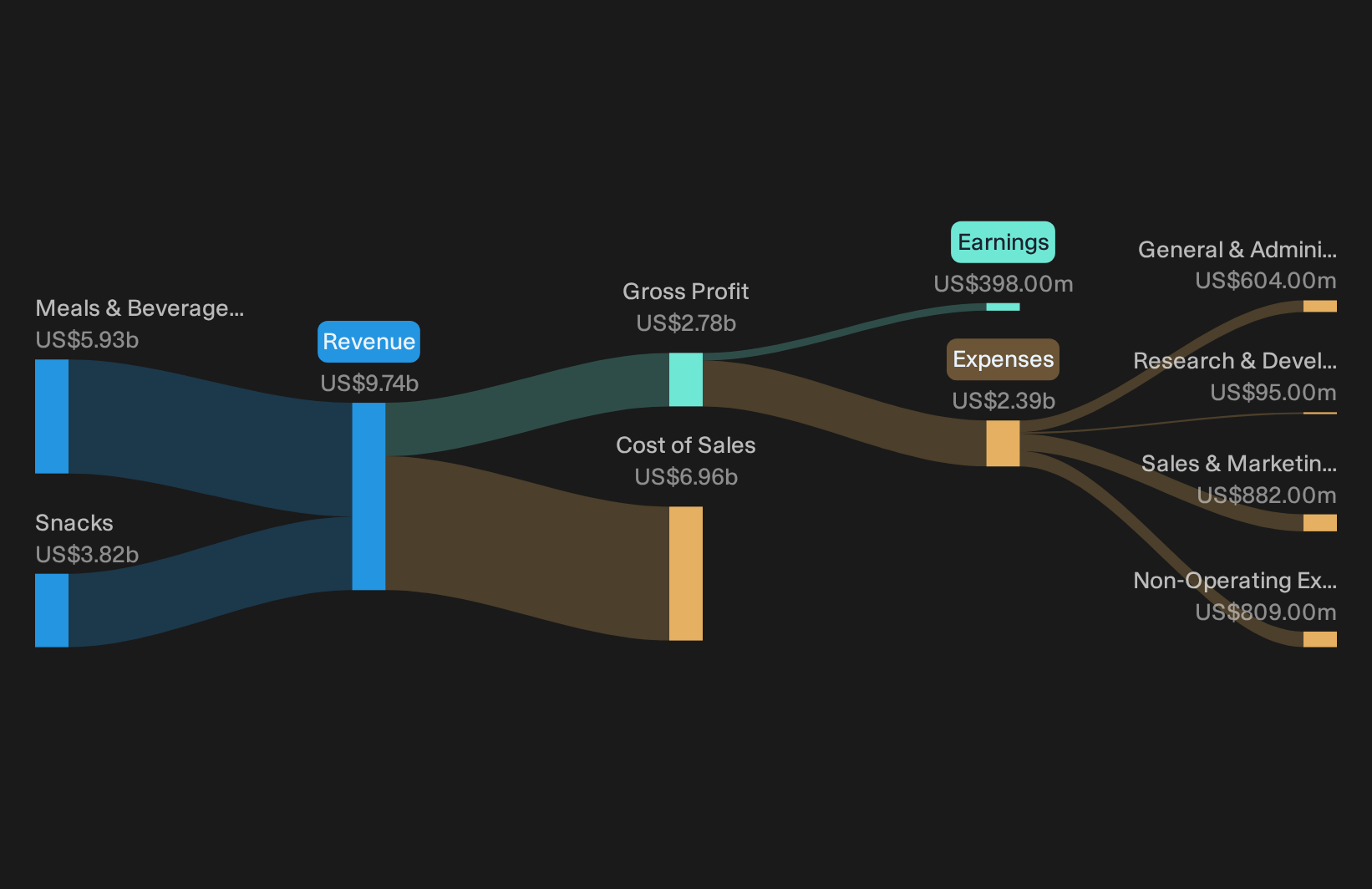
Operations: Campbell's generates about US$5.9b from Meals & Beverages and US$3.8b from Snacks, with roughly US$9.3b earned in the United States.
Market Cap: US$5.9b
Campbell's sits squarely in the tariff pass through story, with a heavily U.S. based pantry portfolio that gives it room to adjust prices as costs climb.
"Campbell's introduction of a revenue growth management capability and recent list price increases of around 4% to 5% on roughly 60% of the portfolio are intended to offset the assumed 5% to 6% raw material and packaging inflation and double-digit logistics inflation in FY27."
What happens to Campbell's earnings power now largely hinges on how one unresolved pressure shapes the balance between volume and pricing.
That pricing versus volume trade off is exactly what the full narrative for Campbell's unpacks, revealing where tariff pressure could be masking pricing power or stalling demand momentum.
Kimberly-Clark (KMB)
Overview: Kimberly-Clark makes everyday personal care and tissue products like diapers, tissues and toilet paper, anchored by deeply entrenched U.S. brands.
Operations: Kimberly-Clark generates about US$10.7b from North America and US$5.9b from International Personal Care, highlighting a strong domestic earnings base.
Market Cap: US$36.0b
Kimberly-Clark matters for this tariff pass through screen because shoppers tend to keep buying its branded diapers and tissues even when prices inch higher, which helps the business push more of those Fed flagged cost shocks through the checkout without immediately losing the shopper.
"Continued innovation across premium and mid tier product lines, with mix in major markets already heavily skewed to premium offerings and 10 consecutive quarters of volume plus mix led performance, supports the view that further premiumization can help Kimberly-Clark lift net margins and operating profit even in relatively slow growing categories."
What happens to Kimberly-Clark’s margin story now depends heavily on how one unseen pressure shapes the balance between pricing and loyalty.
That pressure on loyalty and pricing is exactly where the full narrative for Kimberly-Clark shows whether tariff and cost shocks are quietly accelerating earnings power or masking deeper risk.

Procter & Gamble (PG)
Overview: Procter & Gamble sells everyday household and personal care brands, from Tide and Pampers to Gillette and Oral-B, across global markets.
Operations: Procter & Gamble generates around US$30.3b from Fabric & Home Care, US$20.4b from Baby, Feminine & Family Care, and US$45.3b internationally versus US$41.7b in the United States.
Market Cap: US$366.3b
Procter & Gamble matters for this tariff pass through theme because its everyday staples and wide shelf presence give it room to adjust prices when input and tariff costs rise, without immediately losing its place in U.S. shopping baskets.
"Procter & Gamble operates within a very competitive environment. However, its higher operating margins and wide moat are a clear sign it still operates with competitive advantages over its competitors and that it has the capability of raising prices if needed."
What happens to Procter & Gamble’s pricing power now depends on how one persistent cost shock affects shopper loyalty and long-term margins.
That pressure on shopper loyalty is exactly where the full narrative for Procter & Gamble reveals whether Procter & Gamble’s pricing power is quietly accelerating or masking its next chapter.

Curious About Alternative Opportunities?
Fresh themes move fast, and the next breakout pockets of momentum can be caught early while they are still flying under the radar. Consider acting while they remain less widely followed.
- Spot resilient income ideas before yields change in response to demand and scan a curated set of 8 dividend fortresses while the payouts still look appealing.
- Hunt for potential future leaders in automation and efficiency by checking a focused pool of 91 robotics and automation stocks before the crowd chases the momentum.
- Track developments in digital infrastructure as demand for data evolves and review a curated group of 55 AI infrastructure stocks while pricing still reflects early-stage interest.
Have feedback on this article? Concerned about the content? Get in touch with us directly. Alternatively, email editorial-team@simplywallst.com