
The next wave of AI debt is approaching: tech giant CDS soars to a record high, and the bond market is in full swing
The Zhitong Finance App learned that on Tuesday, the credit risk indicators of some large technology companies rose to record highs. Investors are preparing for a wave of bond issuance after the earnings season, and are worried that this wave of supply may further impact the already pressured debt market.
Meta Platforms (META.US) and SpaceX (SPCX.US) are the first to release earnings reports this week, and investors will keep an eye on the latest developments in the two companies' spending plans and AI ambitions. Pacific Investment Management Company (PIMCO) multi-asset credit strategist Lotfi Caroui said that technology companies have raised related estimates several times, and bondholders expect these companies to finance AI construction through continuous debt issuance. This potential oversupply of bonds is driving up the credit protection costs of technology bonds.
According to ICE Data Services data, Oracle (ORCL.US) credit default swap (CDS), which is widely regarded as an AI debt risk barometer, once rose to a record 343 basis points. Meta's credit risk index also hit an all-time high, rising 6.3 basis points to 114.8 basis points before it released its earnings report on Wednesday.
In an interview on Tuesday, Karui said, “We haven't found the right balance between the size of debt issuance that the market can absorb. There are still big differences in predictions about how much debt capital this round of AI construction will eventually consume.”
According to the data, global companies have borrowed more than 450 billion US dollars this year for artificial intelligence-related research and development. Now, as technology companies announce their latest results and end the so-called quiet period, the market expects them to once again enter the bond market and issue on a huge scale.
The AI ecosystem's credit risk is heating up
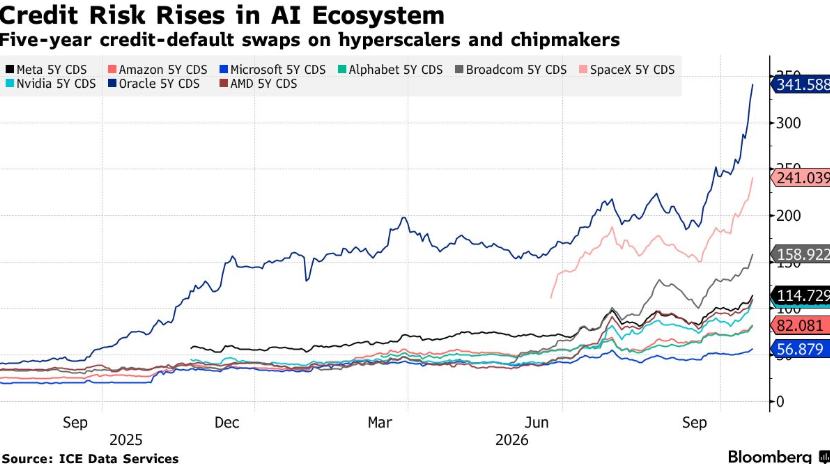
Bondholders are already cutting back some of their existing exposure to the industry to make room for potential large-scale issuances. Bank of America analysts estimate that traders bought about US$451 million of hyperscale cloud vendor bonds on Monday, the highest net purchase since mid-September. Analysts believe this may be the result of investors selling such bonds due to supply and demand concerns.
Investors expect Meta to issue bonds in the next few days. If Meta starts issuing, it will break the “dry period” of more than two months of issuance of US dollar bonds by major US technology companies. Meanwhile, SpaceX is in talks with banks and investors to raise $40 billion to buy chips from Nvidia (NVDA.US).
Meta told investors when it last issued US bonds in April this year that it would not enter the market again until at least the fourth quarter. The statement was aimed at supporting demand for April issuance, but it also made market participants believe that Meta will still issue another bond in the US market this year to support its rising AI investment and spending targets.
Since 2022, Meta has generally published its third-quarter results on the last Wednesday of October, but this year it chose to release it on October 21, the penultimate Wednesday of the month. Some investors believe this schedule may provide Meta with more flexibility in issuing bonds after the release of earnings reports and before the November midterm elections. CreditSights analyst Jordan Chalfin wrote in last month's report that he believes there is a possibility that Meta will conduct large-scale bond transactions after reporting earnings.
Meta's April launch plan is a six-part deal totaling $25 billion. Since then, the company has been communicating with Eurobond investors about potential issuance matters. Hyperscale cloud vendors, including Meta, are using different markets around the world to finance their AI expansion.
Demand for hedging heats up, CDS trading volume hits record
Big tech companies' aggressive AI spending plans and record borrowing have brought the industry under fresh scrutiny at a time when investors increasingly question whether related investments can generate sufficient returns. This has boosted CDS demand associated with the tech industry and pushed transaction volume to a new high. The stocks and bonds of riskier credit entities in the industry, such as CoreWeave (CRWV.US), have been particularly hard hit.
Barclays credit strategist Gigal Patel's analysis shows that as of September, CDS transactions related to the top ten hyperscale cloud vendors and chip makers surged 691% this year, reaching a record high of 140 billion US dollars, up from about 17.7 billion US dollars in the same period last year. However, some swap contracts have not been traded until recently.
Steven Colenstein, fixed income portfolio manager at T. Rowe Price, said: “As demand for AI-related issuance and financing continues to grow, investors are paying more and more attention to the correlation between those previously viewed as different credit entities. ”
SpaceX announced earnings after the US stock market on Tuesday. The last time the company raised in the high-grade bond market was in June, when it issued $25 billion in bonds. This is also the first time it has issued bonds. ICE data shows that on Tuesday morning, the five-year CDS of SpaceX debt once rose to 242 basis points, a new intraday high; the CDS was around 111 basis points when active trading began in June.
Macroeconomic uncertainty, rising global interest rates, and concerns that changes in the US political landscape may weaken support for the industry have put pressure on technology bond issuance in recent weeks. The last major US technology bond issue was in August by Google's parent company Alphabet (GOOGL.US, GOOG.US).
Many market participants expect major tech companies' bond issuance to pick up after the midterm elections later this year, and growth will be more pronounced in 2027.