
Is Life (TSE:8194) Undervalued On New Earnings Guidance And A Higher Dividend?
Life (TSE:8194) just paired fresh earnings guidance for the year to February 28, 2027 with a higher second quarter dividend, giving investors new visibility on expected profits and near term cash returns.
Life’s share price has pulled back in recent weeks, with a 1 month share price return of down 11.6% and a year to date share price return of down 6.9% even as the latest guidance and dividend increase hit the tape. At the same time, the 3 year total shareholder return of 47.5% and 5 year total shareholder return of 44.1% show that longer term holders have still seen meaningful gains, so recent weakness points to fading short term momentum rather than a clear break in the broader story.
Scan beyond Life and see how other retailers and consumer names with solid cash generation stack up in our hand picked 13 high quality undervalued stocks.Life now trades well below both analyst targets and intrinsic estimates, so the gap between price and implied worth has widened again after the pullback. Where does a fair line in the sand actually fall?
Preferred P/E of 11.4x: Is it justified?
On current numbers, Life screens as inexpensive, with the SWS DCF model pointing to a future cash flow value of ¥6,166.73 per share against a last close of ¥2,381, and the P/E ratio lining up at 11.4x compared with both peers and an estimated fair level of 14.6x.
The P/E multiple captures how much investors are paying for each unit of earnings. It is especially watched for supermarket groups, where profit growth tends to be steadier rather than rapid. For Life, the ratio of 11.4x sits against five year earnings growth of 6.4% per year and forecasts calling for profit to expand by about 4.86% annually.
This combination suggests the market is not paying a high price for those earnings streams. Revenue is projected to rise 3.9% per year and earnings are expected to advance, albeit at a slower pace than the broader JP market. The estimated fair P/E of 14.6x is materially higher than the current 11.4x. This points to meaningful headroom if sentiment shifts toward that fair ratio level.
Relative pricing reinforces that picture. The same 11.4x P/E compares to a peer average of 15.4x and a JP Consumer Retailing industry average of 13.1x, so Life trades at a visible discount to both direct competitors and the wider consumer retail group.
Explore the SWS fair ratio for Life.
Result: Price-to-earnings of 11.4x (UNDERVALUED)
Still, softer recent share price performance and any pressure on consumer spending in Japan could easily slow enthusiasm for Life’s valuation catch up story.
Find out about the key risks to this Life narrative.
Another view on Life’s valuation
The P/E argument already points to Life as inexpensive, yet the SWS DCF model goes even further. On that framework, an estimated future cash flow value of ¥6,166.73 per share versus a market price of ¥2,381 suggests the stock is deeply undervalued. Which signal do you weigh more heavily when the gap looks this wide?
Look into how the SWS DCF model arrives at its fair value.
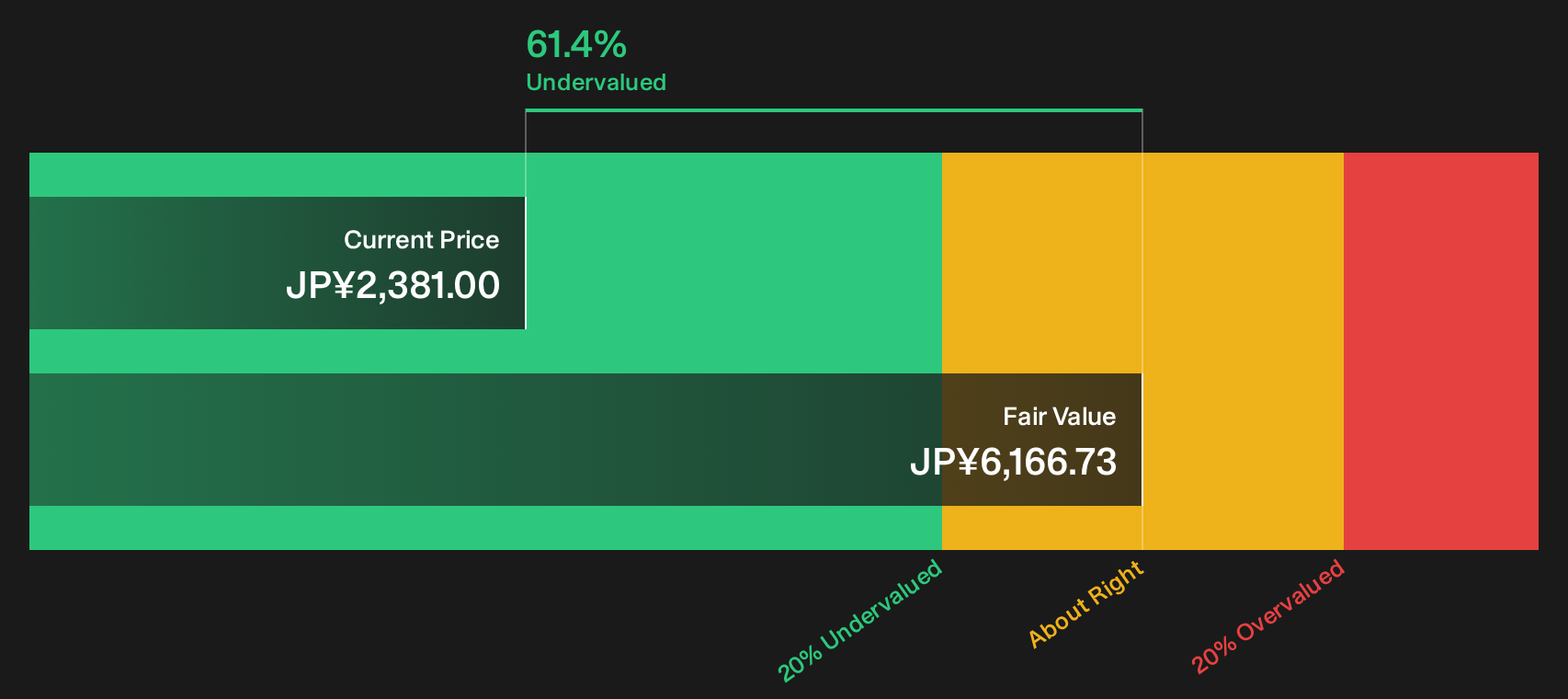
Simply Wall St performs a discounted cash flow (DCF) on every stock in the world every day (check out Life for example). We show the entire calculation in full. You can track the result in your watchlist or portfolio and be alerted when this changes, or use our stock screener to discover 13 high quality undervalued stocks. If you save a screener we even alert you when new companies match - so you never miss a potential opportunity.
Next Steps
Sentiment around Life may look conflicted at first glance, so consider moving quickly, reviewing the underlying data for yourself and weighing up 3 key rewards and 2 important warning signs.
Looking for more investment ideas beyond Life?
If Life caught your attention, do not stop there. Broader opportunity often shows up where pricing, balance sheets and dividends quietly line up in your favor.
- Target resilient cash flows and potential mispricing by scanning companies that screen as high quality and undervalued using the Simply Wall St tool 13 high quality undervalued stocks.
- Prioritise staying power and financial strength by checking a curated list of solid balance sheet and fundamentals (22 results) that can help you avoid fragile balance sheets.
- Hunt for tomorrow’s potential standouts before the crowd notices through a focused set of 73 high quality undiscovered gems.
Have feedback on this article? Concerned about the content? Get in touch with us directly. Alternatively, email editorial-team@simplywallst.com