
Contact Energy (NZSE:CEN) Could Be 58% Undervalued Following Its Green Bond Launch
Contact Energy (NZSE:CEN) has kicked off a NZ$225 million subordinated, unsecured climate or green bond offering, putting its capital structure and funding mix in focus for investors watching the stock.
At around NZ$8.63, Contact Energy’s recent share price moves show a mixed picture, with a 7 day share price return of 2.13% contrasting with a 90 day share price return that declined 5.16%, while the 5 year total shareholder return of 35.53% points to steadier long term compounding as investors weigh this new green bond against existing expectations.
Scan how Contact Energy’s green bond move compares with other utilities funding growth and sustainability projects by running the 42 power grid technology and infrastructure stocks alongside this announcement.
So is Contact Energy’s green bond step a clean read on confidence in the underlying business, or is it simply a shift in investor sentiment that now needs to be tested against the current valuation setup?
Preferred Multiple of 22x P/E: Is it justified?
Contact Energy is being valued at a P/E of 22x at a last close of NZ$8.63, which puts the share price on a richer earnings multiple than many electric utilities peers.
The P/E ratio compares the current share price to earnings per share and gives you a quick sense of how much investors are paying for each dollar of profit. For a regulated and capital intensive sector like utilities, this measure often reflects how the market weighs earnings stability, growth potential and balance sheet risk.
For Contact Energy, the 22x P/E is described as expensive against the Global Electric Utilities industry average of 14.3x. This is a meaningful gap and points to investors assigning a premium. At the same time, the stock is framed as good value when compared with an estimated fair P/E of 25.3x and a peer group average of 49.5x. The current level could be seen as sitting below where the market may eventually settle if those reference points hold.
Explore the SWS fair ratio for Contact Energy.
Result: Price-to-earnings of 22x (ABOUT RIGHT)
Still, that premium can be pressured if Contact Energy’s earnings track record stumbles, or if sector sentiment cools on regulated utilities as a whole.
Find out about the key risks to this Contact Energy narrative.
Another View: Contact Energy Through A Cash Flow Lens
The earnings multiple paints Contact Energy as roughly fairly pitched, yet the SWS DCF model suggests a very different story. With the shares at NZ$8.63 and the future cash flow value estimated at NZ$20.53, the model points to the stock trading well below that cash flow based figure. Which lens do you trust more for a long term position?
Look into how the SWS DCF model arrives at its fair value.
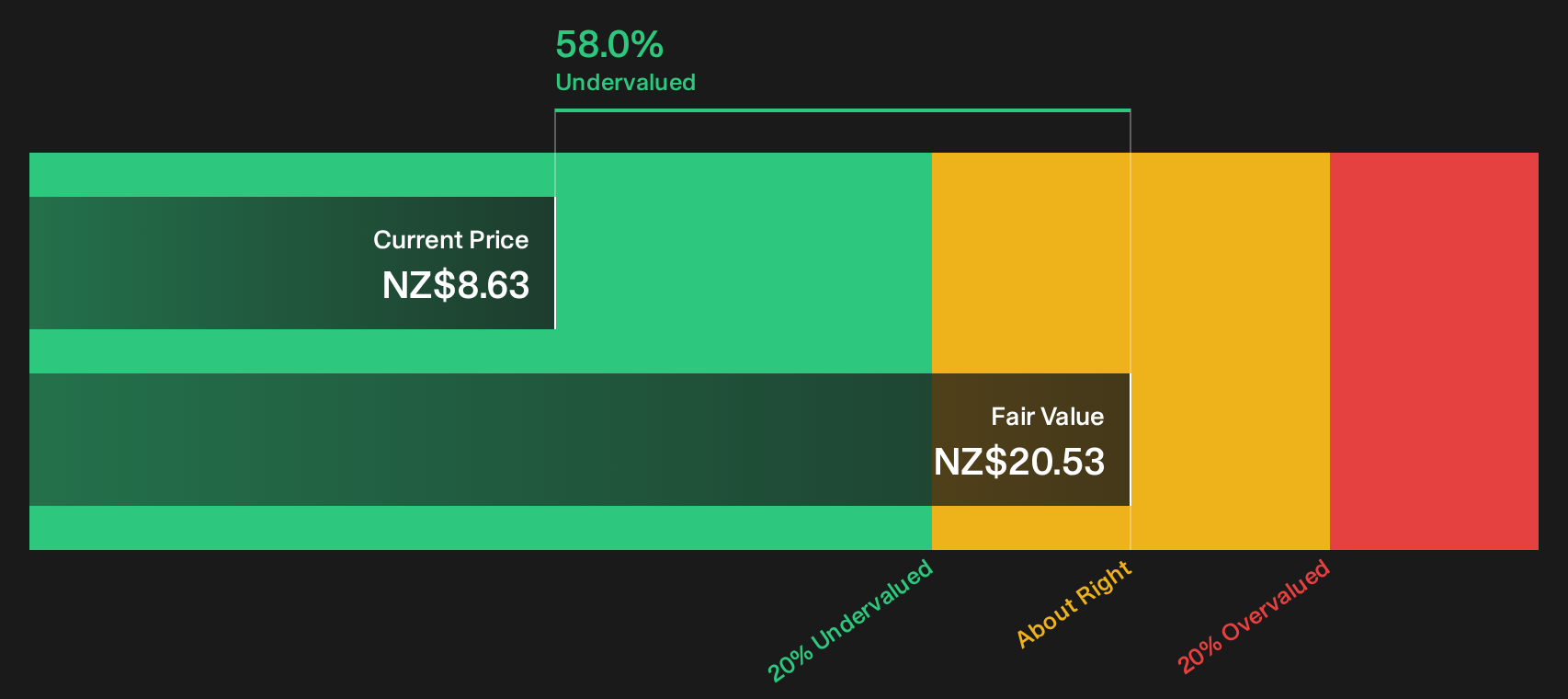
Simply Wall St performs a discounted cash flow (DCF) on every stock in the world every day (check out Contact Energy for example). We show the entire calculation in full. You can track the result in your watchlist or portfolio and be alerted when this changes, or use our stock screener to discover 194 high quality undervalued stocks. If you save a screener we even alert you when new companies match - so you never miss a potential opportunity.
Next Steps
Mixed signals or early opportunity. With both concerns and bright spots showing up in the data, it may be useful to move quickly and review the full picture for yourself by weighing the 2 key rewards and 2 important warning signs
Looking for more investment ideas beyond Contact Energy?
Do not stop at one opportunity. Put Contact Energy in context by lining it up against a wider field of ideas that match the way you like to invest.
- Target resilient balance sheets and steady fundamentals by scanning the list of solid balance sheet and fundamentals (202 results) that filters for strength before excitement.
- Hunt for potential mispricing by reviewing the 194 high quality undervalued stocks that focuses on quality companies trading at what may be compressed valuations.
- Build a watchlist of potential future standouts through the 614 high quality undiscovered gems that surfaces under followed businesses with solid underlying metrics.
Have feedback on this article? Concerned about the content? Get in touch with us directly. Alternatively, email editorial-team@simplywallst.com