
Does ShareFile Enterprise Launch Change The Bull Case For Progress Software (PRGS)?
- Progress Software recently introduced ShareFile Enterprise, a version of its secure document collaboration platform aimed at large and regulated organisations that need automated access controls, AI driven threat detection, native data loss prevention and centralised security operations.
- The move gives Progress Software a clearer entry point into governance heavy workflows, where document access, compliance reporting and employee provisioning create meaningful software spending and stickier relationships.
- This push into AI driven document security for regulated enterprises could influence how investors view Progress Software's broader investment narrative.
Scan how Progress Software's ShareFile Enterprise fits into the broader push for secure, AI driven document workflows by comparing it with 39 profitable AI stocks that aren't just burning cash that are shaping this corner of the market.
Progress Software Investment Narrative Recap
To own Progress Software, an investor needs to be comfortable with a slower growth profile and 7.2% forecast annual revenue growth that leans on acquisitions and high margin software. The key short term swing factor is how efficiently the firm ramps newer AI and SaaS offerings without eroding its 38% to 39% margin framework that analysts reference in their narrative.
ShareFile Enterprise matters operationally only if it scales without dragging on gross margin through higher cloud and AI compute costs. The biggest risk is that the Domo integration or SaaS mix leaves group profitability below plan, especially given existing debt levels and already mixed performance in regions such as EMEA.
The clearest related announcement is the integration of Domo's AI and data platform into the broader Progress Software data stack. That project is tied to a targeted US$280 million to US$290 million steady state revenue contribution and well over US$100 million of EBITDA by fiscal 2027, making it central to the medium term earnings story.
Viewed next to ShareFile Enterprise, the Domo plan shows how management is trying to build an AI ready data layer plus secure, document centric workflows on top. Execution risk is real. Domo integration, customer contract shifts toward consumption and ShareFile Enterprise adoption all need to track to plan for Progress Software to hold its high margin profile and support free cash flow.
Progress Software Analyst Expectations And Valuation Setup
Progress Software sits in an unusual spot where analysts are pencilling in higher revenue but softer profitability over time. Consensus models point to 8.4% annual top line growth over the next three years, even as profit margins are expected to move from 9.2% today to 5.9% by 2029. That margin compression connects directly to the ShareFile Enterprise and Domo story, because a heavier SaaS and AI workload mix can be both more capital light and more compute hungry at the same time.
On earnings, forecasts call for profit to shift from US$92.4 million today to US$75.7 million by 2029, which is a decline of about US$16.7 million. Analysts are effectively saying that Progress Software may generate more revenue but keep less of each dollar as net income. For anyone weighing the stock, the question becomes whether products like ShareFile Enterprise, the Domo integration and broader AI features can eventually support better efficiency than the current models build in.
Those same consensus figures anchor the headline valuation story. To reach the analyst price target, Progress Software would need to be on US$1.3b in revenue and US$75.7 million in earnings by 2029, with the shares trading on a P/E of 35.7x those profits compared with 16.5x today. That implies the market would need to accept a higher multiple even while net income is projected to be lower than current levels.
Progress Software's narrative projects US$1.3b revenue and US$75.7 million earnings by 2029. This assumes 8.4% yearly revenue growth and an earnings decrease of about US$16.7 million from US$92.4 million today.
There is also a capital structure angle that matters for long term holders. Analysts assume the share count falls by 4.74% per year over the next three years, which would support earnings per share even if absolute profit is under pressure. ShareFile Enterprise only really earns its place in that framework if it helps protect cash generation so that Progress Software can keep shrinking the share base without stretching the balance sheet.
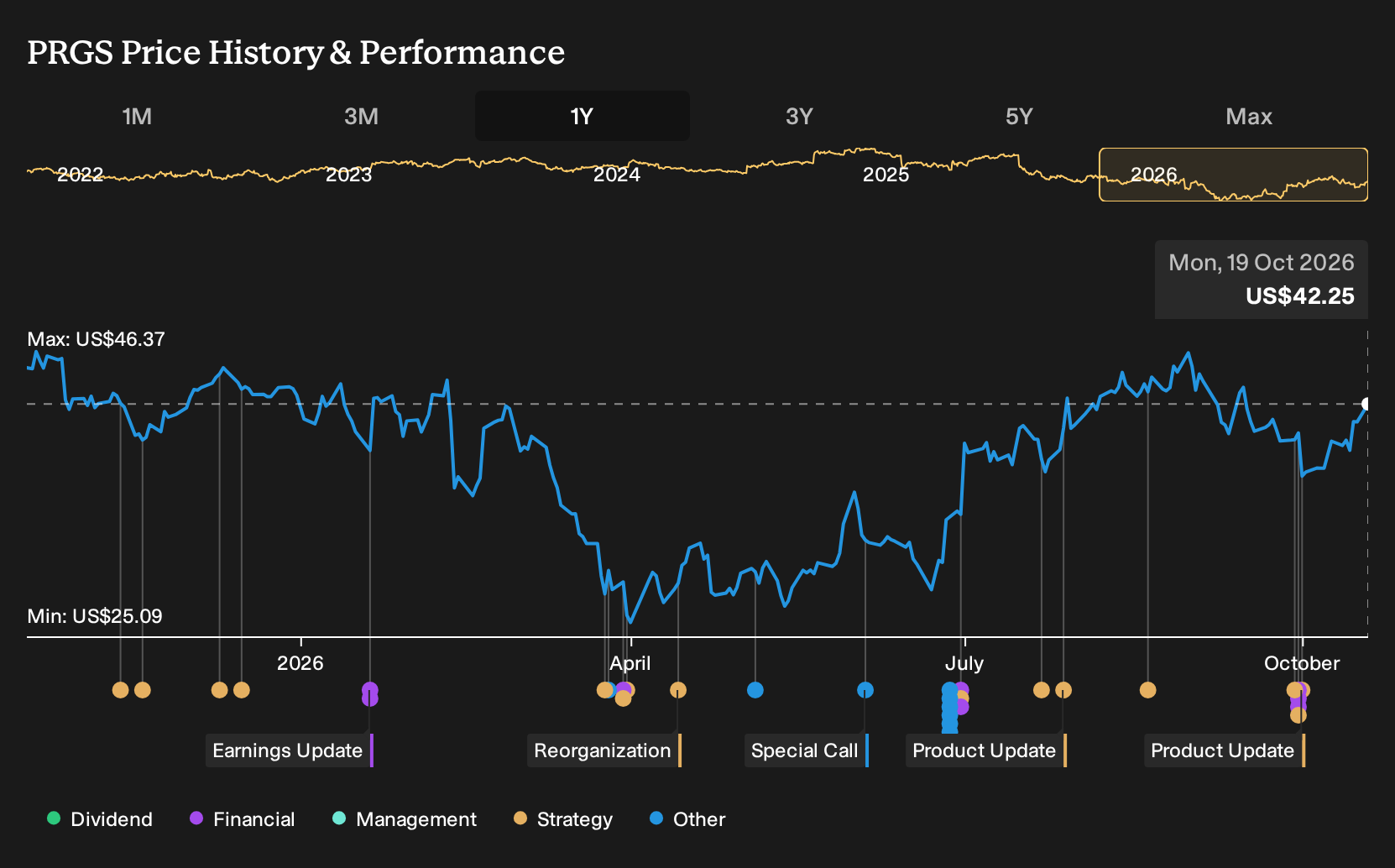
Price targets add another layer of tension. The current consensus sits at US$56.2, around 33.8% above the US$37.2 share price cited in the report, with a spread between US$40 on the low end and US$83 at the top. Analysts are effectively signalling that, despite modelling a weaker earnings line, they still see the equity as undervalued relative to their 2029 scenarios, which places more weight on the durability of recurring revenue and the perceived quality of the AI and document security stack than on near term profit trends alone.
Uncover why Progress Software's fair value indicates a 33% potential upside to its current price, which could narrow quickly if sentiment catches up.
Exploring Other Perspectives
One alternate view focuses on regulatory and contract churn risk rather than the upside from ShareFile Enterprise. The most bearish analysts were assuming Progress Software reaches US$1.3b of revenue but only US$55.7 million of earnings by 2029. That paints a far more cautious story, so treat today’s launch as a possible narrative reset and compare both angles yourself.
Explore 2 other Progress Software fair value estimates, including one that suggests as much as 5% downside from the current price.
Form Your Own Verdict
Disagree with existing narratives? Extraordinary investment returns rarely come from following the herd, so go with your instincts.
- A great starting point for your Progress Software research is our analysis highlighting 3 key rewards and 1 important warning sign that could impact your investment decision.
- See our latest analysis for Progress Software. The report includes a comprehensive fundamental analysis summarized in a single visual, the Snowflake, making it easy to evaluate Progress Software's overall financial health at a glance.
Looking For More Investment Ideas Beyond Progress Software?
If Progress Software's mix of AI, security and recurring revenue has your attention, it can help to compare it with other businesses that match your risk, income and balance sheet preferences. The Simply Wall St Screener gives you a quick way to filter for the type of stocks that fit how you like to invest.
- For investors who want potential upside with tighter risk controls, scan a curated set of 32 resilient stocks with low risk scores that may better match a steady, capital preservation mindset.
- If resilience and financial strength matter most to you, focus on companies in the list of solid balance sheet and fundamentals (25 results) and see which ones combine prudent leverage with consistent fundamentals.
- Income focused readers who care about cash returns can zero in on 8 dividend fortresses and compare their yields, payout histories and balance sheets side by side.
Have feedback on this article? Concerned about the content? Get in touch with us directly. Alternatively, email editorial-team@simplywallst.com