
Bairong Smart-W (06608) Zhang Shaofeng appeared at the Qianhai Open Source Strategy Summit: AI Roll-up Reshapes the Industry AICC Intelligent Customer Service Accelerates Large-scale Implementation
Zhitong Finance App learned that in October 2026, the Qianhai Open Source Fund 2026 Investment Strategy Summit with the theme of “Seek New Quality and Seize the Momentum” was solemnly held. As an influential large-scale annual investment strategy summit in the domestic capital market, this summit brought together leading experts and heads of investment institutions in various fields at home and abroad to conduct in-depth discussions on the macro situation, industrial transformation, and investment opportunities under the AI wave, which attracted market attention.
Zhang Shaofeng, founder, chairman and CEO of Bairong Smart-W (06608), attended the summit via video presentation and delivered a keynote speech entitled “From Big Models to Enterprise-Level Agents: The Key Path to Large-Scale AI Implementation - AI Roll-up Ecological Practice”. It is worth noting that Bairong Intelligence was invited to participate in the Qianhai Open Source Annual Investment Strategy Summit in Beijing, Shanghai, and Shenzhen, which shows the company's deep accumulation in the field of AI industry implementation and high recognition in the capital market.
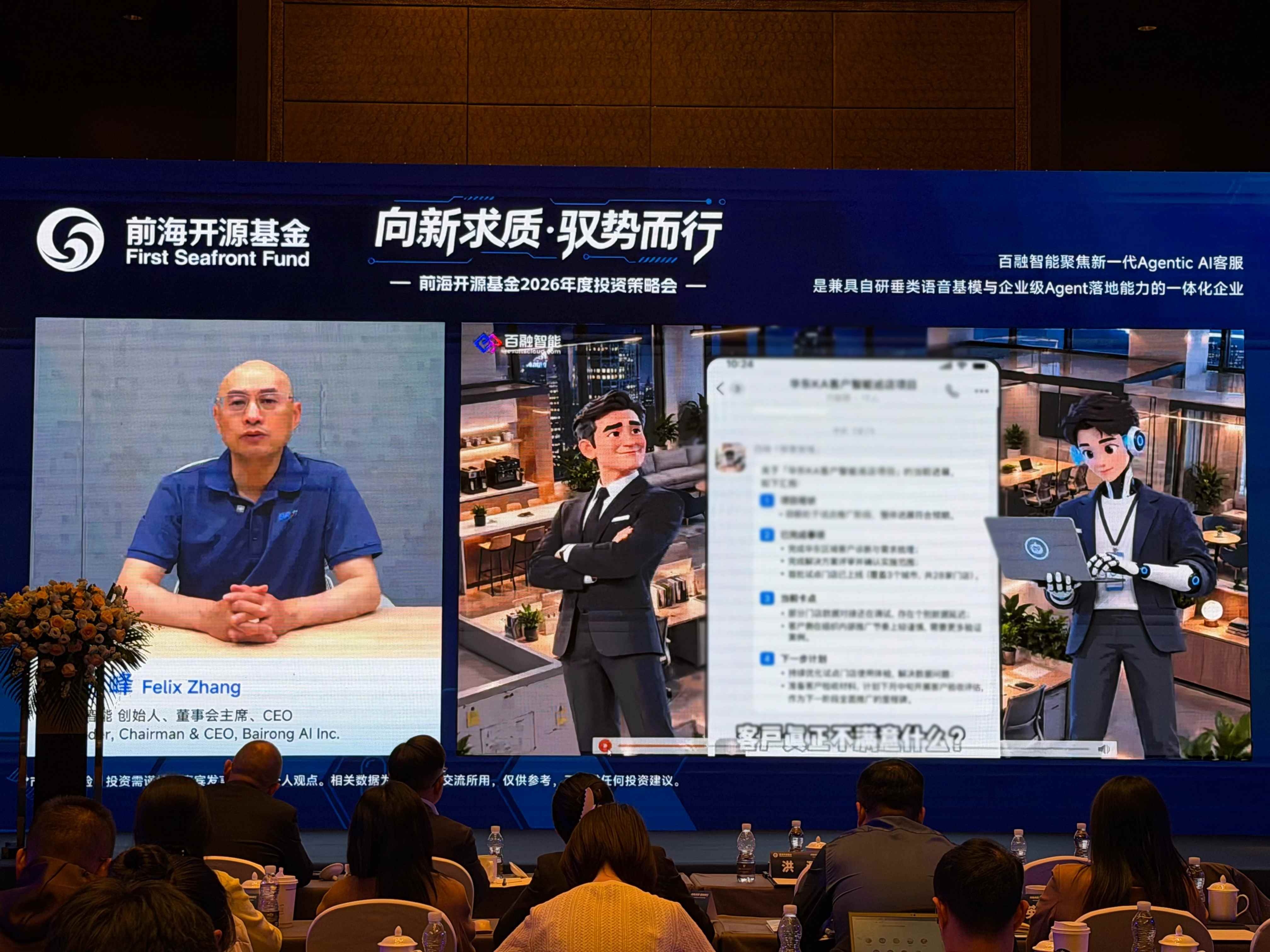
Mr. Zhang Shaofeng, founder, chairman and CEO of Bairong Intelligence, delivered a keynote speech at the summit in the form of a video speech
Core insight: AI is moving from “being able to analyze” to “capable work”
In his speech, Zhang Shaofeng pointed out that the boundaries of AI's capabilities continue to expand — from reasoning ability and multi-modal models to more complex tool calls and long-chain execution capabilities. In the past, users used AI mainly for data analysis, content generation, and assisted decision-making; now enterprises and individuals are experimenting with AI to undertake specific tasks, operate real systems, and deliver business results.” AI has moved from an auxiliary tool to a labor agent (agent form).” This transformation is profoundly changing the purchasing model of enterprises — from buying software to buying results, and companies' spending on AI is extending from IT budgets to operating and labor cost pools.
Zhang Shaofeng further clarified: AI is not equal to a big model; generative AI and decision-making AI together form an AI layout; a large model is not equal to an intelligent body; enterprise-level agents also need support for system capabilities such as perception, memory, and execution; and simply having a model does not directly make an enterprise-level agent that can land on the enterprise — the ability to execute the “last mile” is the key.
AI Roll-up: A New Organizational Approach to Embracing Industrial Change
Mr. Zhang Shaofeng's speech focused on AI roll-up, a new type of industry organization. Zhang Shaofeng divided its evolution into three stages: traditional roll-up emphasizes merger and acquisition integration and scale effects; AI roll-up is “merger and acquisition integration+AI restructuring and delivery”; generalized AI roll-up is not limited to mergers and acquisitions; the focus is on AI restructuring and delivery itself.
He introduced typical practices in North America — completing actual workflows and improving efficiency by promoting the AI engineering transformation of the target of the acquisition. In China, the path is more about organic deployment of AI on the customer side or integration after mergers and acquisitions.” The common essence of both paths is to extend AI to real workflows, customer relationships, and service delivery.” Zhang Shaofeng emphasized, “AI does not replace professionals, but rather reallocates professionals to judgment, customer relationships, and high-value services.”
Based on observations on the rise of professional vertical model companies such as Anthropic, Zhang Shaofeng proposed a core industry judgment: future models with commercial value will have some kind of vertical attribute. The industry will form a three-tier division of labor: a general large model, a vertical basic model, and an enterprise-level agent (“silicon-based employee”). For enterprises, an integrated enterprise with a “vertical model+enterprise agent” is more likely to form a closed business loop of “business implementation → data accumulation → backfeed model → model optimization”.
AICC implementation practice: Bairong Intelligence's AI roll-up sample in China
Bairong Intelligence's AICC (Intelligent Communication) scenarios have a wide range of requirements, quantifiable value, and closed-loop tasks. Naturally, it is suitable for charging based on business results. The new generation of AICC is extending from “relatively simple outbound” to “complex inbound”, supported by voice multi-modal models, active dialogue models, and enterprise-level agents, moving from “being able to talk naturally” to “being able to complete production-level tasks according to business processes.”
Based on this judgment, Bairong Intelligence focuses on the field of AICC intelligent communication, outputs “silicon-based employees” through integrated deployment of vertical models and agents, and transforms the traditional manpower model. The company has built three basic models for self-development: the BR-Voice multi-modal speech model, the BR-LLM-Proactive large model for actively guided dialogue, and the BR-Vision-Doc document analysis multi-modal large model, and continuously iterate the model with a real business data flywheel to verify positive user feedback from commissioning and transform it into evaluation, reward regression, and reinforcement learning signals.
In terms of business model, Bairong Intelligence uses the RaaS (pay-for-business results) model: billed according to the amount of work successfully completed, the size of the agents (silicon-based employees) that went online, or distributed according to the scale of the business promoted by the agent.” The pay-for-results model does not simply sell AI tools, but rather undertakes specific tasks and delivers business results through agents. This is also a commercial expression of the 'technology-restructured AI roll-up path'.”
Furthermore, the same voice model base can also enable business owners to improve internal efficiency. Bairong Intelligence also showcased the “Bairong Distribution” product — an AI multi-position collaboration system for sales, covering sales, pre-sales, product, delivery, etc., and penetrates the entire process of “demand → plan → business → POC → delivery”, so that first-line facts can directly reach the decision-making level.
Conclusions: Four Core Conclusions
At the end of his speech, Zhang Shaofeng summed up four core conclusions:
1. AI agents drive AI into production systems - capacity boundaries expand, purchasing logic changes, and AI enters the labor cost pool;
2. AI roll-up is a new type of industrial organization - the North American model is capital control+AI engineering transformation, and the Chinese model is merger and acquisition+AI transformation & enterprise-side organic agent deployment;
3. The general model does not take everything — Anthropic uses professional vertical models to quickly catch up in the vertical field and verify the trend of industry specialization;
4. Integration is an important path for enterprises to implement AI on a large scale — “vertical model+enterprise-level agent” integration. Bairong's implementation in multiple industry scenarios in the AICC intelligent communication field has obtained preliminary verification.
As a SOTA-level AI enterprise focusing on the AICC (intelligent communication) field, Bairong Intelligence is embarking on a large-scale implementation path with Chinese characteristics in the AI roll-up industry wave, with self-developed voice basic models and enterprise-level agent implementation capabilities as the core.